
Reclaiming a Voice
The growing movement to learn and preserve Chaldean
By Sarah Kittle
Stephen Hannawi is a man with a mission. It all started when he was 8 years old in Tel Kepe, where he and his older brother served in church—attending Vespers, daily prayers, and the rosary.
In Iraq, Vespers was celebrated in the Chaldean language; Stephen started to learn the language so that he could participate in the liturgy. “I love the language because it was the language of Jesus Christ,” Stephen explains. He was seriously considering entering the priesthood.
“I was around priests and deacons, and it was a good environment,” he recalls.
By age 13, the demographics in Tel Kepe began to shift. Persecution of the Christian community was becoming increasingly apparent, and Christian lands were being confiscated and given to non-Christians. “It was a painful realization,” Stephen says, “realizing the language and the culture is a target.”
As an adolescent, Stephen made a vow—to protect the Chaldean language for the rest of his life.
He continued serving at church, sometimes spending 14-hour days. He trained deacons, held language classes for 40 to 50 students each summer over four months, and began preserving church manuscripts, creating a library and cataloging the texts. With access to these invaluable records, he dedicated himself to study, putting in long hours daily.
“My dad was a teacher, so he always pushed us for academic excellence,” he says. “Being involved in church, I heavily wanted to invest my time in the language and the ancient tones of the Chaldean liturgy.”
Lost Treasure Found
Luckily for Stephen, electricity came to Tel Kepe in the 1940s and because of that, the church had archives which included 8mm tapes. “I found my lost treasure,” says Stephen. “I have all this and I was so eager to learn.”
It took years, but Stephen learned every hymn, even those no longer in use. When a priest told him, “You’re never going to chant those,” he replied, “It’s OK, Father, I’m learning it as history because I want to preserve it.”
He also created a dictionary to record the dialect of his hometown, which was becoming diluted. “My grandmother’s generation spoke very differently from mine,” he recalls. He spent time with elders to record and preserve their words. Although the original dictionary did not survive, the work lives on.
By age 13, Stephen had developed enough fluency to instantly translate classical Chaldean into the Tel Kepe dialect during Mass, particularly the Saint Paul’s letters and Old Testament readings.
Father Raphael Kanona, a priest in Tel Kepe, became Stephen’s mentor. “He was older, and he was my treasure for any questions I had,” Stephen says. “He played a big role in my training.”
Even as a child preparing for priesthood, Stephen prioritized the language. “I started collecting parables, lullabies, and folk songs from my town because it was going away,” he says. “It was fading.”
Continuing the Mission
Stephen and his brother were both deacons in Iraq, serving alongside each other. When they came to America as young adults, they noticed that the Chaldean language, so far removed from the source, was becoming even more weakened. “We promised each other that one day we’ll do something about it,” Stephen says.
Before that dream could be realized, his brother joined the U.S. Army as an interpreter and gave his life in service. “That made my promise to him sacred,” Stephen says. “I know I’m doing it by myself now.”
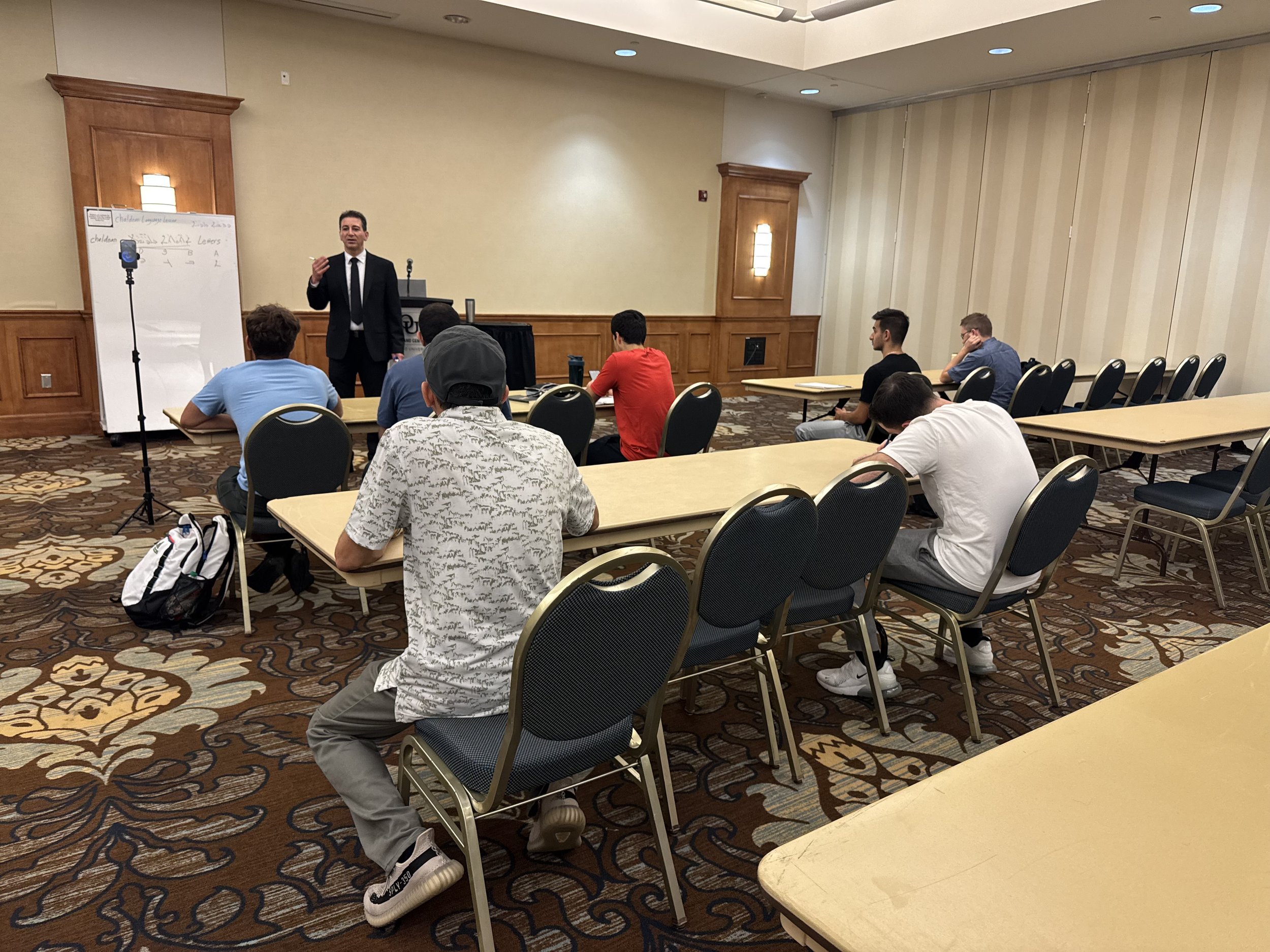
Fast forward to 2025: Stephen is teaching a Chaldean Revival class at Oakland University, where he has received tremendous support. “Oakland University is about diversity,” he explains.
He also receives strong backing from the Chaldean community. “I see youth hungering for identity,” he says. “So I am teaching identity through language. Belonging is powerful. You need belonging. Identity gives you that.”
According to Stephen, English may be the language of power, but Chaldean is the root. “It has been the language of science for 3,000 years. No other language can claim that.”
Chaldean history is steeped in science. “Our culture created the world’s first writing system in the city of Uruk, laying the foundation for recorded knowledge,” Stephen explains. “From there, our culture was advanced in mathematics, law, finance, agriculture, irrigation, architecture… Math was the language of the universe. They built ziggurats aligned with the Earth’s magnetic field. We don’t know what they knew.”
Hannawi emphasizes that language preservation is not only a Chaldean concern—it is a matter of human history. Yet he sees Chaldean as uniquely sacred.
“You know, out of all the 7,000 languages of the world, God spoke Chaldean,” he asserts. “He chose a virgin. He chose a cross. And He chose a language. It was not random. I truly think He wanted to honor it, because He spoke to Abraham in Chaldean. Even now, the Jewish people preserved the Chaldean language of Babylon. There’s no way this language could have survived without divine intervention. We are here. We are still ‘we.’ This language still exists by miracle.”
Identity Through Language
Hannawi teaches identity through language. “I want them to learn it well so they can teach their kids,” he says, “who may be the next generation of leaders, teachers, and influencers. I want to strengthen the Chaldean memory within them—spiritual, cultural, historical, and familial. It’s a long-term project, but I want a whole revival. This language has done so much for humanity; we should not let it go.”
He believes preserving Chaldean is an ethical obligation, not just for Chaldeans but for all humanity. “If it wasn’t for that 3,000-year advancement, where would we be? We would not have cars. We would not have artificial intelligence. We would not have all these advances we enjoy today.”
Hannawi’s workshop at Oakland University is free and non-credit, with no textbooks required. “They only have to show up. That’s it,” he says. The current group has 78 total members. Classes are also posted online for those who cannot attend in person, reaching thousands through Instagram, Facebook, and YouTube. “The lectures are permanent resources. People can access them anytime. I’m recording all grammar and conjugation for intermediate Chaldean now, aiming to finish by April.”
By then, Hannawi will graduate with a master’s in artificial intelligence, prepare for the Patent Law bar exam, and expand OU offerings to include intermediate and advanced Chaldean classes.
Reaffirming the Vow
“I lived all my childhood, from 8 until 18, immersed in manuscripts, hymns, and the Chaldean language,” Hannawi recalls. “There were hymns in my town that no other town had. Some were long and complex, requiring real vocal skill. ISIS burned them. ISIS thought they destroyed them forever; however, the powerless 13-year-old boy kept them in his heart. I still know them all. I chant them at funerals. My investment now is to create a website and spread this heritage. These hymns are not gone. They are still here.”
Hannawi sees language as central to Chaldean spiritual identity. “It’s the language of Jesus, of the prophets, of the martyrs, of the monks who wrote our liturgy. It’s a beautiful, highly spiritual liturgy that elevates you.” He believes Chaldean connects Heaven and Earth and considers it his lifelong mission to preserve the language for future generations.
“Preserve your identity. It is really who you are. Without your identity, you lose your sense of being,” he says. “Learn the language. If you don’t preserve your own identity, you become the collective memory of someone else.”