
Al-Mutanabbi – Poet Who Would Be Prophet
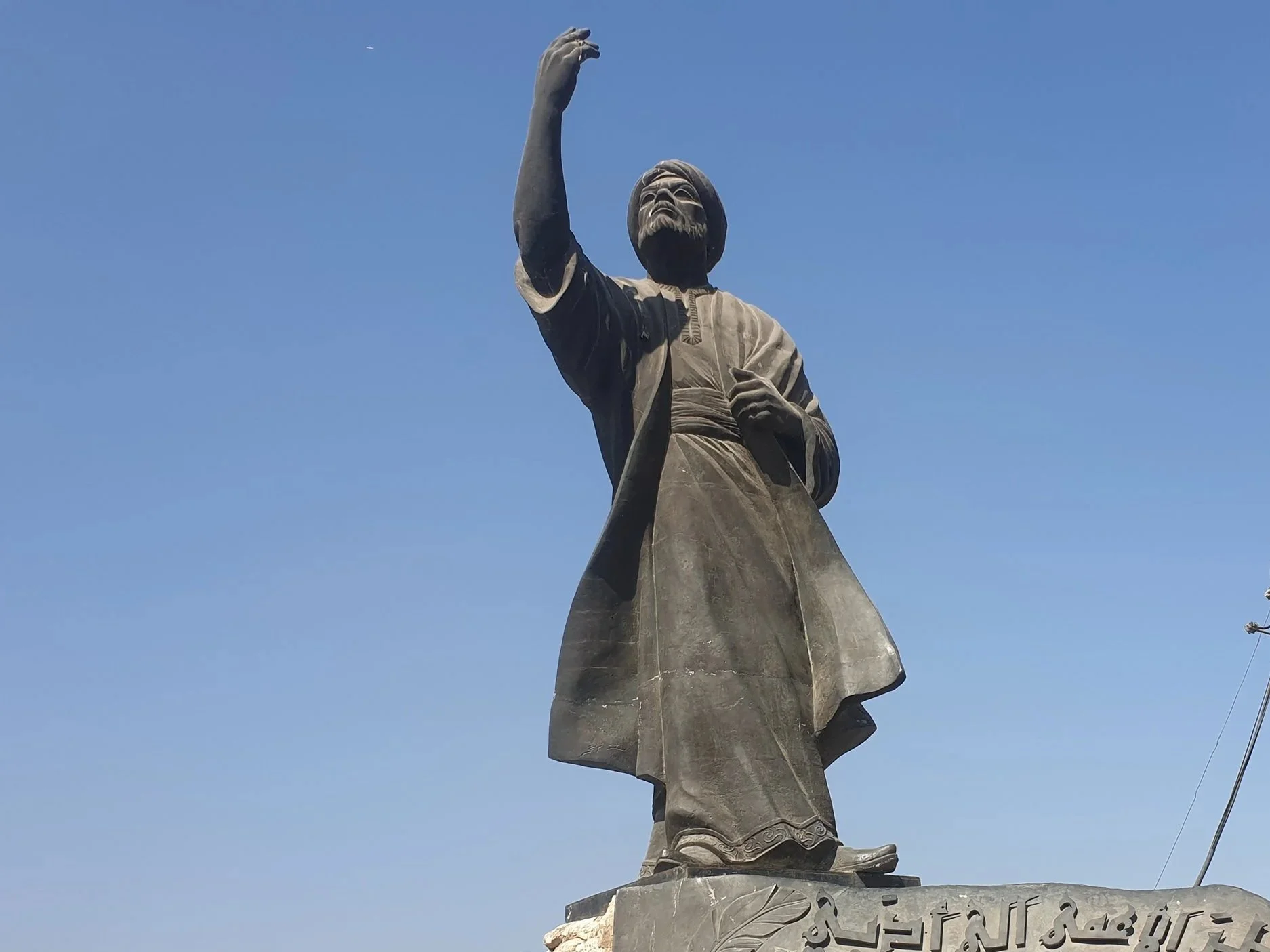
Statue of the poet Al-Mutanabbi, in Baghdad, Iraq. Photo by Kar7ar/Wikimedia Commons
By Adhid Miri, PhD
Part II
Poetry has long stood at the heart of Arabic culture. For its earliest speakers, it was the primary means of recording belief systems, oral history and philosophy. Originating on the Arabian Peninsula more than 1,500 years ago—well before the rise of Islam—Arabic poetry has since become a global art form.
Historically, the reach of Arabic poetry expanded alongside Arab states and Muslim influence. Andalusian poetry, for example, flourished in medieval Iberia but faded after the fall of Granada in 1492. Yet its forms and aesthetics continue to inspire poets in Morocco and beyond more than five centuries later.
Arabic poetry has always thrived as a public art. It is shared in cafés, at festivals, on radio and television, and at life’s milestones—weddings, funerals and communal gatherings. Discovering poetry is often an intuitive act, guided by a love of language. Though digital platforms have revived and broadened its reach in recent decades, poetry remains most powerful when read aloud and shared collectively.
Arabic poets write in a wide range of forms, including the classical ode, the modern ode, and free verse. Colloquial poetry also commands large audiences, particularly in Iraq, Egypt, Lebanon, Morocco and Jordan, where spoken recitations resonate deeply with everyday life.
This article highlights one of the most influential figures of the premodern Arabic literary canon: al-Mutanabbi. It does not attempt a comprehensive survey of his work but instead offers select insights for contemporary readers accustomed to concise engagement.
An Epic Life (915–965)
Abu al-Tayyib al-Mutanabbi—born Ahmad ibn al-Husayn ibn al-Hasan ibn Abd al-Samad al-Ja‘fi al-Kufi al-Kindi—stands among the greatest poets in Arabic history. He is best known by his nickname, al-Mutanabbi, meaning “the would-be prophet,” a title derived from both his audacious claims and the commanding authority of his verse.
Al-Mutanabbi was born in 915 in the southern Iraqi city of Kufa. His father was a water carrier who claimed noble Yemeni descent from the Kindah tribe. Al-Mutanabbi himself was famously evasive about the origins of his epithet. Restless by nature, he lived as a wandering poet, traveling through Baghdad, Damascus, Tiberias, Antioch, Aleppo and Cairo. He earned patronage by composing praise poetry for emirs and rulers.
His life reads as an epic pursuit of glory, wealth and power. Widely regarded as the supreme master of the Arabic language, al-Mutanabbi wrote primarily panegyrics (written in praise of something) marked by bold imagery, improbable metaphors and unmatched rhetorical force.
Educated in Damascus, he lived among Bedouin tribes, absorbing their dialects and traditions, and became involved in revolutionary movements. He began composing poetry at age 9 and quickly gained a reputation for sharp wit and intellectual confidence. In the 920s, after the Shiite Qarmatians sacked Kufa, he joined them and later led a failed revolt in Syria in 932, during which he claimed prophetic status—cementing his controversial nickname.
After the revolt’s suppression, al-Mutanabbi spent two years imprisoned. He recanted in 935 and returned to life as a traveling poet, producing his earliest known works. Though his poetic reputation grew rapidly, his political ambitions—to become a wali, or governor—were never realized.
From 948 to 957, he enjoyed his most celebrated period as court poet to Sayf al-Dawla, the Hamdanid ruler of Aleppo. During these years, he composed his greatest poems, many praising Sayf al-Dawla’s campaigns against the Byzantine Empire, in which al-Mutanabbi himself participated. These panegyrics remain among the masterpieces of Arabic literature.
Rivalries and jealousy at court—particularly with scholars and poets such as Abu Firas al-Hamdani—eventually eroded his standing. His political ambitions further strained the relationship, prompting his departure for Egypt, then ruled by the Ikhshidids.
In Cairo, al-Mutanabbi joined the court of Abu al-Misk Kafur, but his hopes of advancement were again thwarted. When it became clear that he would not be granted political authority, he left Egypt around 960 and composed scathing satirical poems attacking Kafur.
Death and Legacy
Al-Mutanabbi’s towering ego and fearless verse often made him enemies. In one famous line, he warned: “If you see the lion’s canines, do not think the lion is smiling.”
His uncompromising style ultimately contributed to his death. In 965, while traveling near Baghdad, he was ambushed by men seeking revenge for a poem that insulted a man named Dabbah al-Asadi. Initially, al-Mutanabbi considered fleeing, but a companion reminded him of his own verse: “The steeds, the night and the desert know me; the sword, the spear, the page and the pen.”
Refusing to contradict his words, al-Mutanabbi stood his ground and was killed alongside his son and servant on September 23, 965.
The “Arab Shakespeare”
Al- Mutanabbi is considered the greatest of classical Arabic poets, a political firebrand, one of the greatest poets in the Arabic language and the most prominent and influential poet in the Arab world. His work has been translated into more than 20 languages, earning him the enduring epithet “the Arab Shakespeare.”
Across nearly 300 poems, al-Mutanabbi treated poetry as both art and discipline. His verses explore wisdom, pride, courage, ambition, exile, war and death. Many lines have entered everyday speech as proverbs, reflecting universal truths about human experience.
Though firmly rooted in the classical qasidah (an ancient elaborate form of Arabic poetry), al-Mutanabbi reshaped the form, infusing it with personal voice and philosophical depth. His poetry combines Iraqi and Syrian stylistic elements with classical tradition, producing a neoclassical style of lasting influence.
Words That Endure
Translating al-Mutanabbi is notoriously difficult, given the density of his metaphors and the precision of his language. Arabic critics often describe great poetry as “a string of pearls—one exquisite line following another.” A complete translation of his work remains a monumental challenge, though key selections have been widely rendered into English.
Among his most quoted lines:
On Pride and Character:
“I am the one whose literature the blind can see and whose words the deaf can hear.”
“The worst of gain is that which besmears one’s honor.”
“I sleep soundly, oblivious to its troubles. And people stay up all night because of it and argue.”
“Guided by the stars, whispering tales of ancient grace, he sought Allah’s divine embrace.”
On Wisdom:
“Small deeds are great in small men’s eyes; great deeds are small in great men’s eyes.”
“Not everything a man desires is achieved; the winds blow against the sailor’s wish.”
“I am already drowning, so what do I have to fear from getting wet?”
On Ambition:
“If you seek a noble aim, do not settle for less than the stars.”
“The highest kingdoms are those built on solid foundation.”
On Valor and Courage:
“Firm resolutions happen in proportion to the resolute, and noble deeds come in proportion to the noble.”
“Glory and honor were healed when you were healed, and your pain passed on to the enemy.”
On Love:
“Under the moonlit sky, love blossomed like a rose. Hearts synchronized as the gentle breeze blows.”
“You have homes in our hearts.”
These enduring lines capture the clarity, force and philosophical reach that define his genius.
Legacy
In 1932, Baghdad named its famed booksellers’ market Mutanabbi Street in his honor. The narrow, car-free street—lined with bookstores and stalls—has become a symbol of intellectual freedom and cultural life.
At one end stands a statue of the poet by renowned Iraqi sculptor Mohammed Ghani Hikmat, gazing toward the Tigris River. Created in the 1960s, the monument endures, much like al-Mutanabbi’s verse.
We live between two eras: the age of steeds, desert and night, and the age of WhatsApp, Google and social media. Yet al-Mutanabbi’s poetry bridges both worlds. His words remain alive, reminding readers that language—when mastered—transcends time and place.
Through his poetry, we enter the Arab world of the 10th century and discover truths that remain strikingly relevant today. In an age of fleeting attention, al-Mutanabbi stands as proof that powerful words endure.
References: Diwan Abu al-Tayyib al-Mutanabbi; The Complete Poems of al-Mutanabbi, Vol. I, translated by James F. Warren; Arabic Poetry by Mustafa Abu Sneineh; Encyclopaedia Britannica; Wikipedia.