
Ahead of His Time
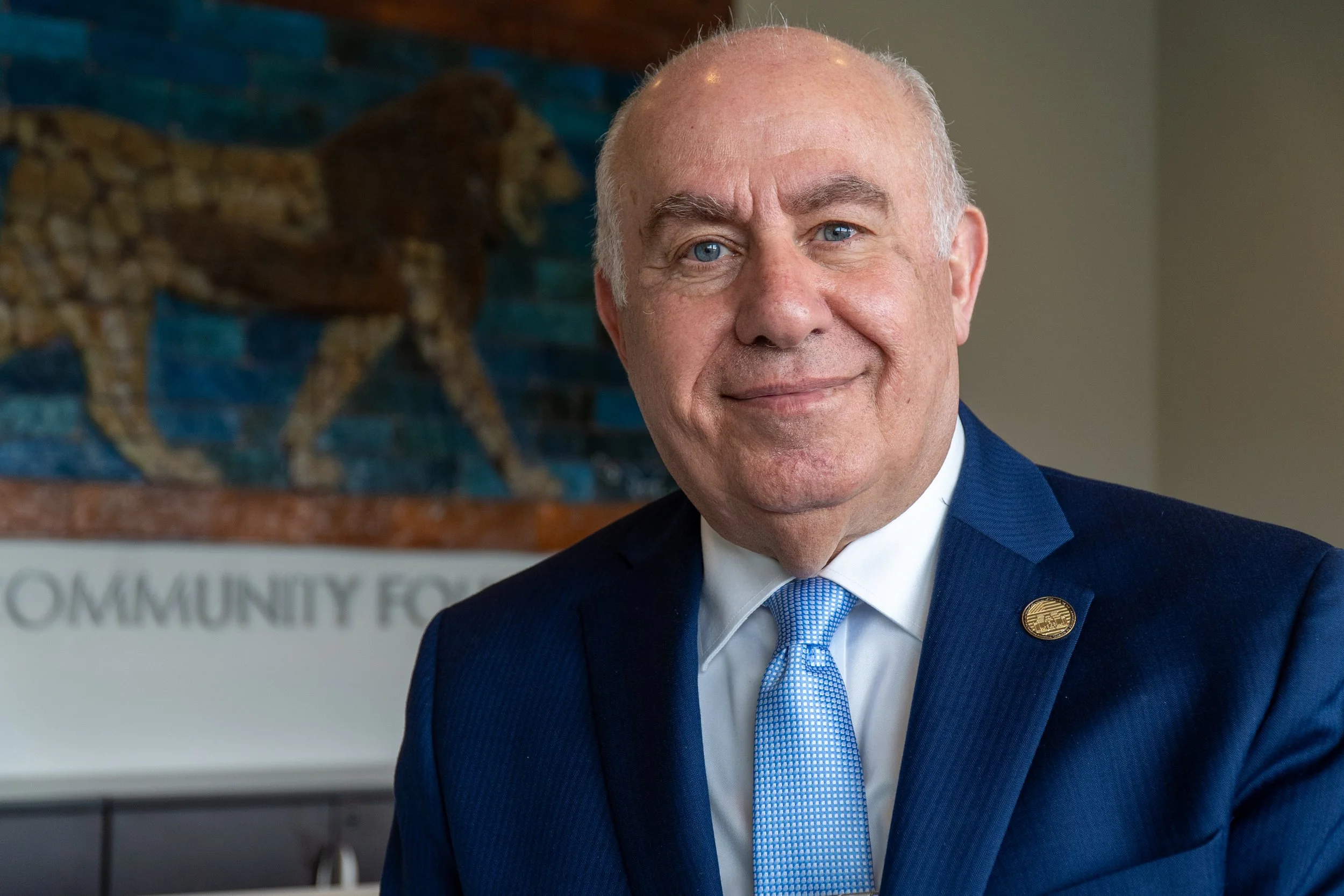
Dr. Adhid Miri is a man with vision
By Sarah Kittle
Dr. Adhid Miri has lived many lives in one—scientist, educator, entrepreneur, historian, cultural preservationist, and, for Chaldean News readers, one of its most trusted and thoughtful voices. To read his work is to travel across centuries and continents, from ancient Mesopotamia to modern Michigan, guided by a man who understands both the chemistry of molecules and the chemistry of people.
Born in Baghdad in 1948, Dr. Miri grew up surrounded by books, languages, and learning. Family lore holds that when he was born at home—common in Iraq at the time—he was wrapped not in cloth but in books and newspapers from his father’s library. Whether legend or truth, the image is fitting. “Those became like tattoos printed on me,” he says, reflecting on a lifelong love of reading, history, and culture.
From Molecules to Meaning
By training, Dr. Miri is a chemist. Educated in Iraq and England, he worked in academia and research, including a period at King’s College in London. In the mid-1970s, he returned to Iraq to help rebuild the country, serving as a professor at Basra University. It was a promising chapter—one defined by science, teaching, and optimism—until history intervened.
When the Iran-Iraq War erupted in 1980, Basra found itself under constant shelling. Students were killed crossing waterways to reach campus. Faced with the impossible choice between safety and vocation, Dr. Miri made the painful decision to leave the discipline he loved.
“I was forced to exit chemistry,” he reflects. “But instead of the chemistry of elements, I learned the chemistry of life, the chemistry of people.”
He arrived in the United States in 1981 during a difficult economic period marked by high inflation and scarce jobs. Though he briefly found work as a chemist, family considerations led him down an unexpected path: entrepreneurship.
Ahead of the Curve
Long before craft coffee and boutique breweries became cultural mainstays, Dr. Miri was already there. He entered the coffee business with The Coffee Exchange, which he later sold, with a partner, to Caribou Coffee. Later, he opened the microbrewery Copper Canyon Brewery, again demonstrating an instinct for emerging industries.
“I love liquids,” he explains. “Items made with water as a major component are very profitable; water is a blessed product!”
For Dr. Miri, business was never an end in itself, but a means to build something lasting. His ventures reflected both foresight and pragmatism—an ability to recognize opportunity while remaining grounded in values shaped by family, faith, and community. That same practical mindset allowed him not only to succeed financially, but to create a foundation sturdy enough to support what mattered most to him beyond commerce.
“I don’t consider myself a very good businessman,” he says with characteristic humility. “But business served me well.” It provided stability, opportunity, and education for his children—and, eventually, the freedom to return to his first loves: writing, teaching, and cultural service.
A Historian at Heart
Today, Dr. Miri is best known to Chaldean News readers as a cultural and history writer whose articles illuminate the deep roots of the Chaldean people and their place within the broader tapestry of Mesopotamian civilization. His passion for history, languages, and geography runs deep and personal.
“People would be surprised how many don’t know their own culture,” he says. “It is our responsibility, the role of this generation, to explore it and expose it to the younger generation.”
That mission has shaped much of his work at the Chaldean Community Foundation West, where he teaches Arabic, guides tours of the facility, provides translations for the Chaldean Community Foundation and Chaldean News, and contributes to educational programming for both adults and youth.
He was also instrumental in developing the Chaldean Town historical marker and in curating content for the Chaldean Cultural Museum, where history is not treated as distant or abstract, but as living memory.
Among Dr. Miri’s most urgent projects is a forthcoming museum gallery documenting what he calls the “Genocide of the 21st Century”—the devastation inflicted upon Iraq’s Christian and minority communities following regime change and the rise of ISIS.
“When I left Iraq, there were nearly 1.5 million Christians,” he notes. “Today, that number is about 123,000.”
Between 2019 and 2022, Dr. Miri made multiple trips back to Iraq to document destroyed towns, collect artifacts, and photograph what remained—often traveling through the Nineveh Plain. Burned photographs, damaged objects, and remnants of daily life now serve as evidence, not waste.
“In the West, we understand that artifacts tell stories,” he says. “Each one matters.”
Dr. Miri’s writing often extends beyond the Chaldean experience to include Iraq’s other ancient communities—Mandaeans, Yazidis, and Jews—whose histories are deeply intertwined.
“We lived together,” he recalls. “In Iraq, Christians often lived alongside Jewish and Yazidi neighbors. And when we came to the United States, history repeated itself.”
He tells the story of a photograph from his college days: four students seated on a bench—a Jew, a Shiite, a Sunni, and a Christian—each representing a major strand of Iraqi society. It is a powerful reminder of what once was, and of what fragmentation has cost.
The Legacy of Education
Education is the unifying thread of Dr. Miri’s life, and his family history. His father, an educator fluent in four languages, served as the first principal of the American School for Boys in Baghdad in 1925 and authored books still used today. His siblings became physicians, professors, pharmacists, and teachers.
“That legacy shaped us,” Dr. Miri says simply.
For the future of the Chaldean community, he returns again and again to one word: education. Using a chemist’s metaphor, he describes America as “the stainless steel of the world”—an alloy made stronger by its components.
“We don’t want to dissolve in it,” he says. “We want to be part of it.”
Now retired from business but more active than ever, Dr. Miri continues to write, teach, curate, and envision new projects, including a digital Chaldean family tree that would connect generations through shared history and data.
As he prepares to host podcasts of his own, his philosophy remains clear: write with intention, choose topics wisely, and meet readers where they are.
“Timing matters,” he says. “It’s all about the readers.”
In every sense, Dr. Adhid Miri has been ahead of his time—seeing value before others did, preserving stories before they vanished, and reminding a community of who it has been, and who it can still become.