
Love, Courage, and Community in Crisis
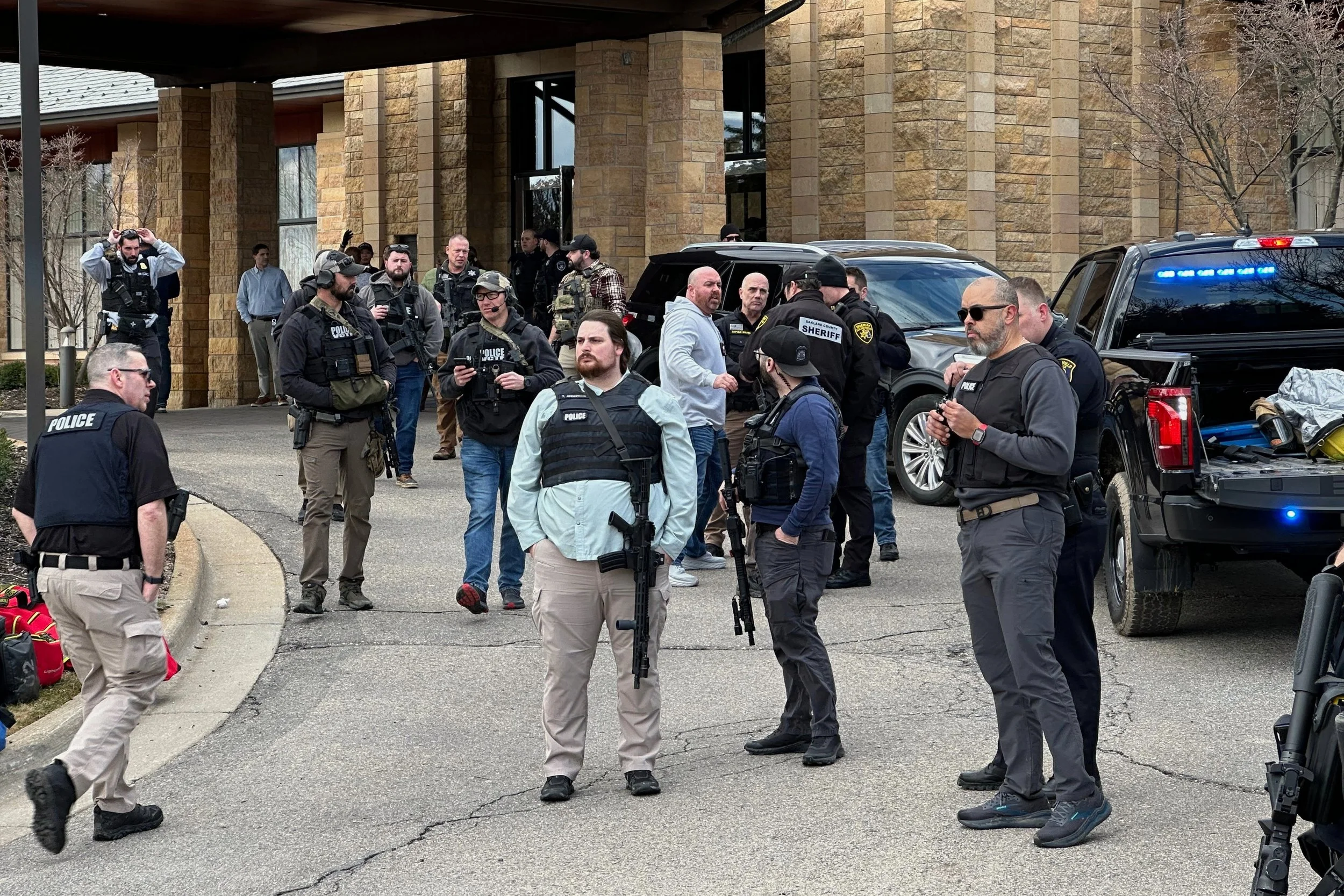
Shenandoah Country Club functioned as a command center for law enforcement following the March 12 attack on Temple Israel.
Shenandoah shines in time of need
By Sarah Kittle
On Thursday, March 12, 2026, an alert went out across West Bloomfield: active shooter in the area. Schools and organizations went immediately into lockdown—no one in or out. Those inside were told to shelter in place as police raced to potential targets. An attack was underway at Temple Israel, 5725 Walnut Lake Road, but it was unclear if the assailant acted alone.
Mary Romaya, executive director of the Chaldean Cultural Center inside Shenandoah Country Club, was driving on Walnut Lake Road around 12:20 p.m. when she first sensed something was wrong.
“I kept having to pull over because of all the police cars, ambulances, fire trucks, speeding by,” she said. “As I got closer to Shenandoah, I could see the flashing lights on all the emergency vehicles, but they weren’t moving. I realized that something had happened at either Shenandoah or Temple Israel.”
Within minutes, Romaya arrived at Shenandoah and went to her office. By then, teachers and children from the Susan and Harold Loss Early Childhood Center were running into the ballrooms, seeking safety.
“The children were in groups with their teachers so that each ‘classroom’ would stay together,” Romaya recalled. “With others from Shenandoah, I passed out water, chips, M&Ms, and eventually chicken fingers and fries. I also grabbed a ream of paper and boxes of crayons for our Chaldean/Aramaic alphabet coloring book. I am a former teacher, and I remember thinking that we must keep the children safe and occupied.”
Meanwhile, across the street, a truck had been deliberately driven into the temple. It crashed through the doors and stopped in a hallway, where armed security guards engaged the assailant. One guard was struck and taken to Henry Ford West Bloomfield Hospital for treatment. Aside from first responders treated for smoke inhalation, he was the only person injured in what could have been a far greater tragedy.
In the chaos, more than 100 preschool children were quickly evacuated and “hustled into the awaiting arms” of the Chaldean-owned Shenandoah Country Club, as Detroit Jewish News publisher Arthur Horwitz later wrote. In a moment when Jews in Detroit and across the country felt “dazed, vulnerable and alone,” he emphasized that the Chaldean community responded without hesitation—“no strings attached. No hollow words.”
Back at Shenandoah, Romaya’s office quickly became the command center for Sheriff Bouchard and responding law enforcement agencies.
“Most of my time was in the ballroom assisting the teachers and eventually the parents when they began to arrive,” she said. “It was very emotional at first, but then we, the Shenandoah staff and myself, did whatever we could to make everyone—children, teachers, parents—feel safe and cared for.”
Parents arrived in waves, frantic to retrieve their children. Some 40 students and teachers also found refuge in the yard of a nearby Chaldean neighbor. Club president Patrick Kattoo directed staff to provide whatever was needed, from diapers to coloring sheets.
“Shenandoah will not stand to see frightened children,” he said.
Romaya helped keep the children occupied, passing out paper and crayons, comforting those who were crying, and making sure every child had a calm presence nearby.
“There were SWAT teams from the Oakland County Sheriff’s Department in the hallways ready to deploy to Temple Israel as needed,” she said. “Someone asked me if I felt scared seeing so much weaponry, but actually I felt safe and grateful that they were present to protect all of us. I also thought to myself that we are Chaldeans, and part of our culture is to welcome people into our homes and feed them.”
That instinct—to open doors without hesitation—was echoed by Shenandoah’s general manager, Hassan Yazbek, who told The New York Times, “We treat our neighbors as we treat ourselves. These are our brothers and sisters.”
Law enforcement established a command center at Shenandoah as children and teachers sheltered in the ballroom for hours. By Friday night, the same room was filled again—this time with nearly 1,000 Temple Israel congregants gathered for Shabbat services. What is typically a space for weddings and celebrations became, as Horwitz described, a “makeshift sanctuary,” hosting a service that was “somber, joyful and defiant.”
“Our doors are open,” Kattoo said, offering the club for services.
But what unfolded over those 48 hours was not spontaneous goodwill alone—it was the result of something far deeper.
The Chaldean and Jewish communities in Metro Detroit share a long and layered history, one built through decades of grassroots engagement and personal relationships. Long before March 12, Jewish grocers helped newly arrived Chaldean immigrants learn the business, stock shelves, and establish their first stores. Over time, those early connections expanded into partnerships in real estate, medicine, law, and public service.
Families attended one another’s weddings and funerals, shared holiday meals—from Passover seders to Thanksgiving dinners—and built friendships that extended beyond business into daily life. As Horwitz described, these were not distant or symbolic ties, but lived relationships—neighbors, colleagues, and friends woven into the same community fabric.
Institutionally, the collaboration deepened. At the request of the Chaldean community, Jewish leaders helped establish a model for coordinated philanthropy and planning. Community initiatives mirrored one another, from healthcare support programs to media—most notably the founding of this publication, Chaldean News, inspired in part by the Detroit Jewish News. Joint efforts, shared content, and ongoing dialogue further strengthened the connection between the two groups.
Both communities also share something less visible but equally powerful: parallel histories. Chaldeans, Eastern Rite Catholics with roots tracing back to ancient Mesopotamia, and Jews, one of the world’s oldest continuous religious traditions, are both ancient peoples shaped by displacement, survival, and resilience.
These shared experiences—of migration, faith, and perseverance—help explain the immediacy of the response on March 12.
“When last week’s terror attack unfolded,” Horwitz wrote, “these relationships undergirded the one Temple Israel established over the years with its Shenandoah neighbors… bringing Jewish children into the arms of friends, not strangers.”
For the West Bloomfield community, the attack felt deeply personal. The perpetrator, authorities say, was driven by grief over the death of immediate family members in Lebanon—innocent victims of a global conflict. Why he chose to target other innocents may never be fully understood.
In the days that followed, national media briefly turned its attention to the Chaldean community, casting it as a “glimmer of light in the darkness.” But as quickly as that spotlight arrived, it moved on.
What remained, however, was something more lasting.
A relationship built quietly over generations had been tested—and it held.
This isn’t the first time the communities have stood together. In the aftermath of 9/11, healing was shared. When Israel was attacked on Oct. 7, Shenandoah’s leadership stood in solidarity at a vigil across the street. And in everyday moments, the bond has been just as real—in shared businesses, shared institutions, and shared lives.
On March 12, that history became action.
Rabbi Joshua L. Bennett of Temple Israel told the CN, “The outpouring of support from law enforcement and community partners has been incredible. We are lucky that on the day of the event, the Chaldean community made their people, property, and love available to all of us. Since then, law enforcement, religious communities and individuals around the world have offered help and support. It is a true blessing and silver lining in the wake of tragedy.”
In the face of terror, Shenandoah Country Club and the Chaldean people provided more than shelter. They offered something deeper: a reminder that even in moments of unimaginable fear, community is not defined by proximity, but by response. That when the unthinkable happens, the strongest bonds are revealed not in statements or headlines, but in open doors, steady hands, and the simple, profound act of showing up for one another.