
Soccer on the World Stage
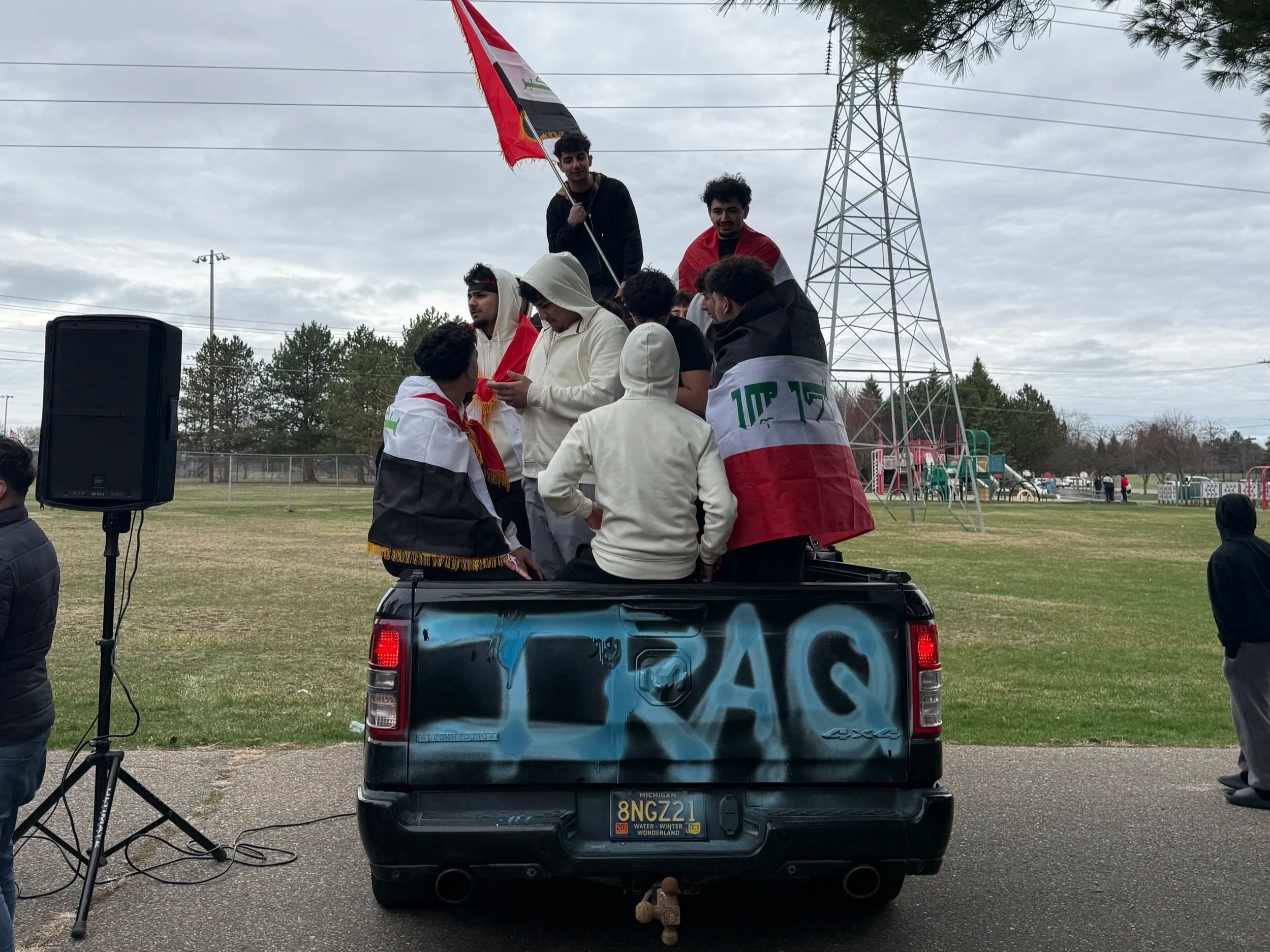
Young people display their pride in a “home country” many have never seen.
Lions of Mesopotamia bring joy to Michigan
By Weam Namou
In a historic match that ended late March 31, 2026, in Monterrey, Mexico, Iraq defeated Bolivia 2-1 to qualify for the World Cup. With the late kickoff, the Lions of Mesopotamia officially secured their first spot since 1986, as the calendar turned to April 1 in both Michigan and Baghdad.
The victory sparked celebrations across Iraq and thousands of miles away in Michigan, home to the nation’s largest Iraqi American community.
A Night of Pride in Michigan
Across metro Detroit, Iraqis gathered in homes, cafés, banquet halls, and community spaces to watch the historic match together. One of the largest crowds formed at Al Mashriq Banquet Club in Sterling Heights, where hundreds of men stayed late into the night, following the game on satellite television and streaming apps.
Among them was Sam Yatooma, who brought his sixteen-year-old son, despite it being a school night.
“I was surprised to see that almost half the place was the new generation, young boys who were born here,” Sam said. “Many were dressed in Iraqi jerseys and flying the Iraqi flag.”
When asked why he and his friends were eager to go, his son replied simply, “Iraq was playing. That’s it.”
The excitement inside the banquet hall was electric. Some fans watching on FIFA Live apps saw goals nearly 30 seconds before they appeared on satellite TV. They would jump onto chairs and shout, “We made a goal!” Moments later, the rest of the room would see it unfold on screen.
When the final whistle confirmed the 2-1 victory, with goals from Ali Al-Hamadi and Aymen Hussein, Iraqi music blasted through the speakers. Men danced inside the hall until well past midnight, and celebrations spilled into the streets.
“From the roar of the crowd to the pride of a nation—in every pass, every goal, and every heartbeat—this win belongs to all of Iraq, and it’s a reminder that hope still knows how to score,” said Nabil Roumaya, a community leader and “a proud Iraqi.”
From Shopping Centers to Parks
The following day, word spread through social media and phone calls that larger gatherings were taking place. A DJ and drummers initially assembled at Dream Market Plaza at 18 Mile and Ryan Road around 4 p.m., but police redirected the growing crowd to Halmich Park in Warren.
Rhythmic drumming and chanting turned the park into a small corner of Baghdad, where hundreds of Iraqi American families gathered in a sea of red, white, black, and green. Flags waved high as children ran through the crowds and elders looked on proudly. The celebration marked Iraq’s return to the World Cup after a 40-year absence—a milestone many thought they might never witness again.
The music seemed to never stop. Despite the chilly weather, some young men removed their shirts as they danced, while Chaldean and Assyrian groups formed circles to perform the traditional chopia.
A miniature World Cup trophy was lifted and passed around the crowd as a symbol of pride. Some spectators watched from the bleachers, taking in the moment, but most joined the dancing as children weaved through the celebration and elders smiled at the scene before them.
Dearborn Erupts in Celebration
Meanwhile, several major roadways in Dearborn experienced significant disruptions due to spontaneous fan gatherings.
Greenfield Road, the primary site of celebration, was shut down by police Tuesday night as thousands of fans flooded the street on foot and in cars, waving Iraqi flags, honking horns, and chanting as traffic came to a standstill. Car caravans formed, with passengers leaning out of windows in celebration.
Warren Avenue was not officially closed, but heavy traffic and jubilant fans waving flags slowed movement near popular gathering spots. For many Iraqi Americans, even those born in the United States, the victory provided a powerful connection to their heritage. “It feels like we won,” said one young celebrant. “This [Iraq] is our country too.”
Euphoria in Iraq and Around the World
In Baghdad and across Iraq, celebrations were massive. The government declared a two-day national holiday as thousands poured into public square waving flags and chanting patriotic songs. Street vendors handed out free tea to strangers, caught up in the collective euphoria. After four decades away from the World Cup stage, many described the victory as cathartic—a symbolic shedding of a traumatic past.
Emad Hukmat, a Chaldean living in Baghdad, said, “People from all backgrounds were happy and poured into the streets without hesitation to celebrate. There was no distinction between Muslim, Christian, or Kurd—faces were filled with love for the nation, which is Iraq.”
Across the diaspora, from Michigan to Sweden, Iraqi communities mirrored the scenes unfolding in Baghdad. Many expressed overwhelming joy mixed with a heavy awareness of the hardships their homeland has endured. International supporters and neighboring countries also celebrated, viewing the Lions of Mesopotamia as a symbol of perseverance for the region.
In Australia, when the final whistle confirmed Iraq’s victory, celebrations spilled into the streets, most notably at Fairfield Square, where crowds sang, danced, and filled the night air with the sound of car horns for hours.
Bashar Hanna, OAM, recipient of the Medal of the Order of Australia, said the victory represented more than a win on the field.
“For many, it was a moment of collective relief and joy,” said Hanna. “Football [soccer] has always been a powerful unifier for Iraqis in the diaspora, bringing people together across generations and backgrounds. This time, the pride was even stronger, as the team is led by an Australian coach, creating a shared sense of belonging and connection between Iraq and Australia.”
He added that in that moment of celebration, “identity, resilience, and hope came together,” reminding the community not only of where they have come from, but also of the strength they carry forward.
As Iraq prepares to compete in Group I against France, Senegal, and Norway, excitement continues to build. If the scenes in Sterling Heights and Dearborn are any indication, World Cup matches this summer may once again turn metro Detroit into a sea of Iraqi flags.