
The Iraqi Flag
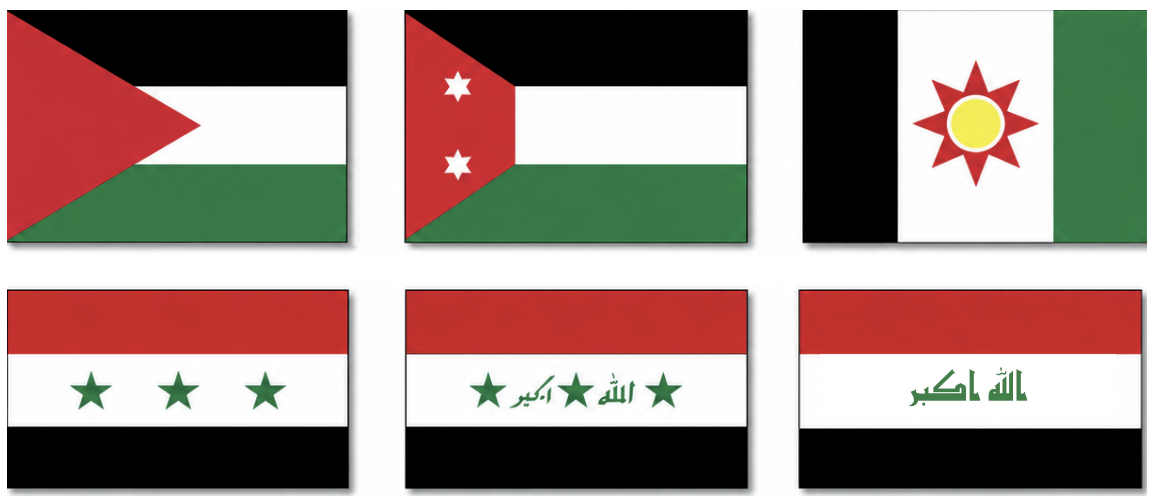
Top row, from left: 1921 - 1924: Following the establishment of the Kingdom of Iraq in 1921 under King Faisal I, Iraq adopted a flag inspired by the Arab Revolt. It consisted of horizontal black, white, and green stripes with a red triangle at the hoist. 1924- 1958: In 1924, the red triangle was replaced with a red trapezoid and two white sevenpointed stars were added. Often interpreted as representing Arabs and Kurds, this version remained Iraq’s national flag until the monarchy’s overthrow in 1958. 1958- 1963: Following the July 14 Revolution of 1958, Iraq adopted a new flag with vertical black, white, and green stripes. Its central emblem was widely associated with Kurdish identity and reflected the republic’s effort to create a more inclusive national symbol.
Bottom row, from left: 1963- 1991: The flag was adopted after the Ba’ath Party came to power in 1963. 1991 -2008: After the Gulf War the flag was modified to include “Allahu Akbar” between stars. 2008: The three green stars were removed while the phrase Allahu Akbar was retained.
Its evolution since 1921
By Adhid Miri, PhD
This article examines the origins, symbolism, and historical development of flags, with particular attention to the evolution of the Iraqi flag since the establishment of the modern Iraqi state in 1921. It explores the meanings associated with flag colors and symbols, the historical role of flags in shaping national identity, and the numerous transformations of the Iraqi flag over the past century.
Iraq is among the countries that have altered its national flag most frequently during the twentieth and twenty-first centuries. The country’s numerous flag changes reflect its turbulent political history, shifting ideologies, and ongoing debates about national identity.
History and Origins of Flags
The exact origins of flags remain uncertain. Early flag-like symbols appeared in ancient civilizations such as China, Egypt, and Rome as early as the eleventh century BCE. These banners were primarily used for military identification, religious symbolism, and royal representation.
The use of flags expanded significantly during the Middle Ages with the growth of trade routes, including the Silk Road, and the increasing availability of silk imported from China. Lightweight and durable, silk made banners easier to carry and display.
As warfare became more organized, flags played an increasingly important role in battlefield coordination and identification. European kingdoms developed distinctive banners and heraldic symbols for rulers and noble families, establishing traditions that continue today.
The Age of Sail further elevated the importance of flags. Ships relied on them for identification and communication across great distances when verbal communication was impossible. By the eighteenth century, the rise of nationalism and the emergence of modern nation-states transformed flags into powerful symbols of national identity.
Today, virtually every sovereign nation—and many regional governments and organizations—uses a flag as an official symbol of identity, unity, and political legitimacy.
Flag Designs and Symbolism
Flags are carefully designed symbols that often convey political, religious, historical, and geographic meanings. Each color, word, and emblem communicates a specific message rooted in a nation’s history and culture.
Certain colors have acquired widely recognized symbolic meanings:
• White often symbolizes peace, honesty, and purity.
• Red commonly represents courage, sacrifice, and struggle.
• Blue symbolizes loyalty, justice, vigilance, and perseverance.
• Green is associated with hope, prosperity, nature, and, in many societies, religious significance.
• Black often represents determination, strength, and resilience.
• Yellow or gold may symbolize wealth, sunlight, or fertile lands.
Throughout history, Arab political and religious movements have also associated themselves with specific colors. Black became linked with the Abbasids, white with the Umayyads, green with the Fatimids and later Shi’a traditions, and red with the Hashemites and various revolutionary movements.
Symbols likewise carry important meanings. Stars often represent unity, sovereignty, or aspirations for the future, while crescents are commonly associated with renewal, blessing, and Islamic civilization.
Red remains one of the most common colors found in national flags worldwide, appearing in approximately three-quarters of all national flags. It frequently symbolizes sacrifice, revolution, and historical struggle.
The Iraqi Flag: Colors, Symbols, and Historical Meaning
The Iraqi flag is among the most frequently altered national flags in modern history. Since the establishment of the Kingdom of Iraq in 1921, it has undergone numerous modifications reflecting political upheaval, regime changes, ideological conflicts, and competing visions of national identity.
For many Iraqis, these repeated redesigns symbolize the instability of the modern Iraqi state and the tendency of successive governments to reshape national symbols according to political priorities rather than enduring national consensus.
The current Iraqi flag consists of three horizontal bands of red, white, and black. Centered within the white band is the phrase Allahu Akbar (“God is Greatest”) written in green Kufic script.
The colors carry the following meanings:
• Red represents struggle and courage.
• White symbolizes peace, generosity, and hope.
• Black reflects Iraq’s historical heritage and forms part of the Pan-Arab colors.
• Green carries religious and cultural significance.
The Evolution of the Iraqi Flag
The history of Iraq’s national flag reflects the country’s political transformations over the past century. Since the establishment of the modern Iraqi state in 1921, successive governments have repeatedly modified the flag to reflect changing political systems, ideologies, and visions of national identity.
The Iraqi Flag (1921–1958)
Following the establishment of the Kingdom of Iraq in 1921 under King Faisal I, Iraq adopted a flag inspired by the Arab Revolt. It consisted of horizontal black, white, and green stripes with a red triangle at the hoist.
In 1924, the design was modified by replacing the triangle with a red trapezoid and adding two white seven-pointed stars. The stars have been interpreted in different ways, including as symbols of the Arab and Kurdish peoples or of unity within the kingdom. This version remained Iraq’s national flag until the monarchy was overthrown in 1958.
The Iraqi Flag (1958–1963)
The July 14 Revolution of 1958 overthrew the monarchy and established a republic. A new flag was adopted featuring vertical black, white, and green stripes. The central emblem featured an eight-pointed red star containing a yellow disc, often interpreted as representing the Kurdish people and the sun motif commonly associated with Kurdish identity. The design reflected the revolutionary government’s effort to create a more inclusive national symbol.
The Iraqi Flag (1963–1991)
Following the 1963 revolution and discussions of a political union among Iraq, Egypt, and Syria, Iraq adopted a new flag consisting of horizontal red, white, and black stripes with three green stars.
Initially, the stars symbolized the proposed union between the three Arab states. After the union failed to materialize, they were reinterpreted to represent the Ba’ath Party’s slogan: “Unity, Freedom, and Socialism.”
The design closely resembled the flags of Egypt and Syria, reflecting the influence of Pan-Arabism during the period.
The Iraqi Flag (1991–2004)
During the Gulf War in 1991, President Saddam Hussein ordered the addition of the phrase Allahu Akbar (“God is Greatest”) between the three stars. The phrase was rendered in his own handwriting and reflected the regime’s “Faith Campaign,” which sought to emphasize Islamic themes during a period of war and international isolation.
The flag remained in use until the fall of Saddam Hussein’s regime in 2003.
The Iraqi Flag (2004–Present)
Following the 2003 invasion, Iraq’s Governing Council proposed an entirely new flag in 2004 featuring blue stripes representing the Tigris and Euphrates rivers, a yellow stripe symbolizing the Kurdish people, and a blue crescent representing Islam. The proposal was widely criticized and never adopted.
Later in 2004, the existing flag was retained, but Saddam Hussein’s handwritten rendition of Allahu Akbar was replaced with a more neutral Kufic-style script.
In 2008, the three green stars were removed while the phrase Allahu Akbar was retained. This modified design remains Iraq’s official flag today.
The Flag of the United States of America
The enduring stability of some national flags provides an interesting contrast to Iraq’s experience. While Iraq has repeatedly redesigned its national flag in response to political change, the United States has maintained the core elements of its flag for nearly 250 years, adapting it only to reflect the addition of new states. This continuity has helped reinforce a strong and lasting sense of national identity.
As our nation approaches its 250th birthday, Americans continue to carry the ideals of freedom, opportunity, and self-government forward. Today, we have an opportunity to educate the next generation about America’s flag, founding principles, values, and achievements. Through powerful storytelling and civic education, we can help young Chaldean Americans better understand the flag and deepen their appreciation for the country they call home.
The flag of the United States consists of thirteen red and white horizontal stripes representing the original thirteen British colonies that declared independence from Great Britain on July 4, 1776. A blue canton containing fifty white stars represents the fifty states of the Union.
The American flag is displayed year-round on government buildings and is widely flown by private citizens. It is prominently featured during national holidays such as Independence Day, Memorial Day, Veterans Day, Presidents’ Day, and Flag Day.
These commemorations honor military sacrifices, celebrate national independence, and reinforce collective national identity. Flag Day was officially established as a national observance by President Harry S. Truman in 1949, commemorating the adoption of the first United States flag by the Second Continental Congress on June 14, 1777.
The American experience demonstrates how a stable national symbol can transcend political administrations and changing times. Although the nation has evolved dramatically over the centuries, the flag has remained a consistent representation of unity, continuity, and shared civic identity. This stability offers an instructive contrast to Iraq’s repeated flag redesigns and highlights the important role national symbols can play in fostering a sense of common purpose and historical continuity.
The Author’s Perspective
In the opinion of this writer, Iraq should adopt a neutral and inclusive national flag that reflects the country’s ancient civilizations, diverse cultural heritage, and multiethnic society without privileging any single political ideology, religion, or ethnic identity. A national flag should transcend sectarian, ethnic, and political divisions and represent all citizens equally.
The repeated redesign of Iraq’s flag has often reflected changes in political power rather than national consensus. A flag should remain stable despite changes in government, serving as a unifying symbol of the state and its people.
The current Iraqi flag is rooted in Arab nationalist symbolism and Islamic references, which some Iraqis argue do not fully represent the country’s broader historical and cultural diversity.
Given Iraq’s rich heritage—from the civilizations of ancient Mesopotamia to its diverse modern population—a national flag should incorporate symbols that reflect this depth and diversity.
If Iraqis cannot reach consensus on a new flag incorporating authentic Mesopotamian symbols such as palm trees, rivers, ziggurats, suns, or other ancient cultural motifs, then preserving the original flag of the modern Iraqi state may be preferable to continued politically driven redesigns.
Conclusion
Flags are more than national emblems; they are enduring expressions of a people’s history, values, and collective identity. The story of Iraq’s flag reflects the broader story of modern Iraq itself—one marked by political change, competing visions of nationhood, and an ongoing search for unity.
While governments and ideologies may rise and fall, national symbols are most effective when they transcend politics and speak to a shared sense of belonging. Whether Iraq chooses to adopt a new flag or preserve an earlier design, its national banner should honor the country’s ancient heritage, diverse communities, and common future.
A flag that unites all Iraqis could serve not only as a symbol of the state, but as a lasting reminder of the nation’s rich history and enduring aspirations.