
Christian Towns in the Nineveh Plain Region
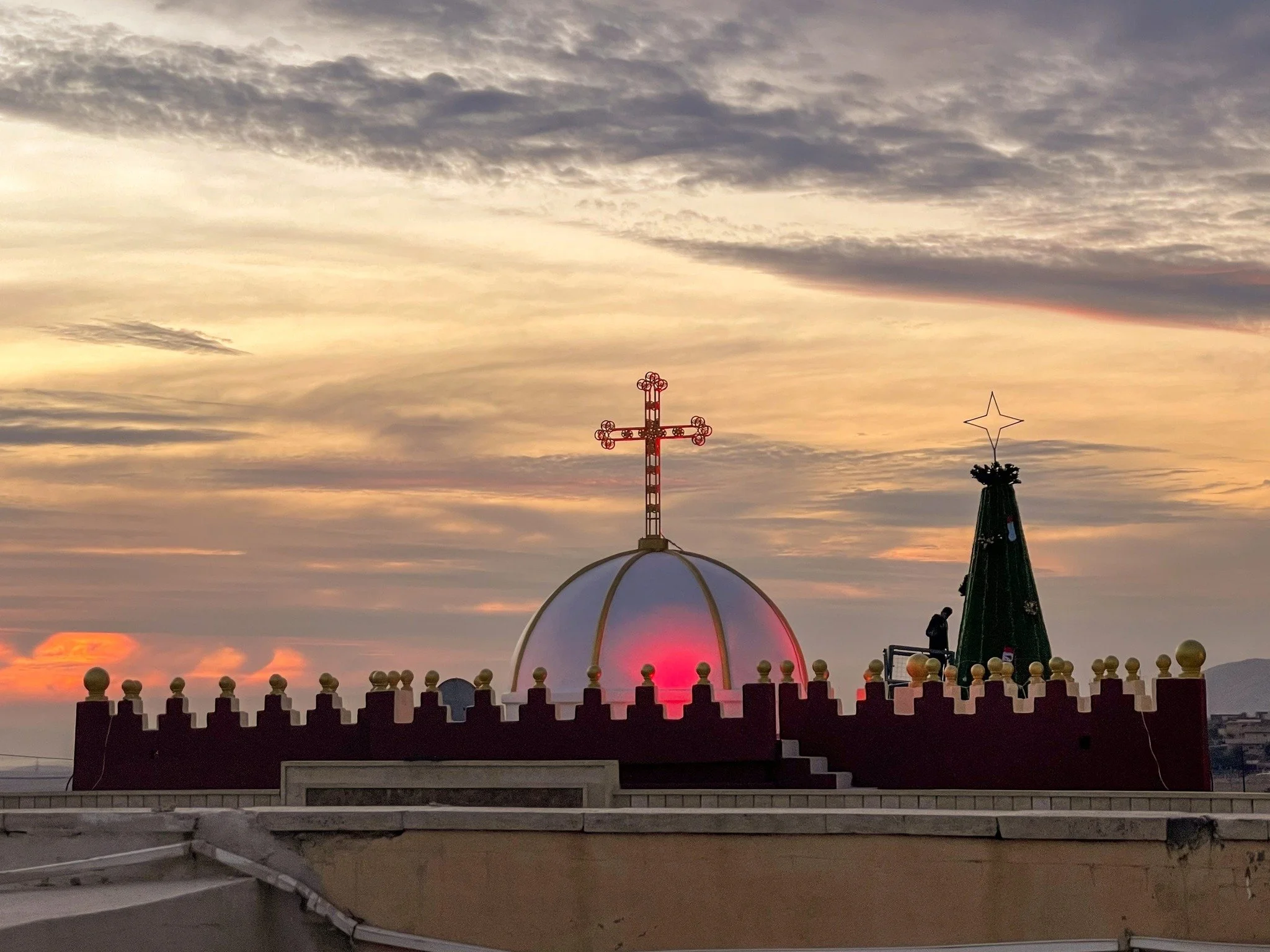
The dome of the Church of the Immaculate Conception in Qaraqosh (Bakhdida).
By Adhid Miri, PhD
Part One
The names of Iraq’s Christian towns and villages have ancient roots in Aramaic, Syriac, and Assyrian languages. Their meanings often reflect geographical features, agriculture, or religious traditions, preserving a rich linguistic and cultural heritage. Concentrating mainly in the Nineveh Plain and the Kurdistan Region, these communities form an essential part of the region’s unique historical mosaic.
Northern Iraq and the Nineveh Plain are home to countless archaeological sites, churches, monasteries, and historic towns inhabited by Chaldeans, Syriacs, Assyrians, Arabs, Kurds, Yazidis, and Turkmens. Their diverse languages—including Sureth (Neo-Aramaic), Arabic, Kurdish, and Turkmen—reflect the area’s remarkable cultural diversity.
Over thousands of years, this region witnessed the rise and fall of successive civilizations, including the Assyrians, Hurrians, and many others. Some settlements flourished, others declined with changing political and demographic conditions, yet together they preserve an extraordinary record of Mesopotamian history.
This series explores the most important Christian towns of the Nineveh Plain—their history, churches, monasteries, and notable figures. Part One covers Alqosh and Tel Keppe; later installments will turn to Baqofah, Batnaya, and Tel Skuf.
Alqosh
Alqosh lies about 45 km (28 miles) north of Mosul in Nineveh Province and is administratively part of the Tel Keppe District. Nestled at the foot of Mount Alqosh (also known as Mount Baadra), it is one of Iraq’s oldest continuously inhabited Christian towns.
The origin of the town’s name remains debated. Most scholars trace it to Aramaic, interpreting it as “God of the Bow” or “Village of the Sun God.” Others suggest an Aramaic-Akkadian origin derived from El (“God”) and Qushta (“truth” or “strength”), yielding the meaning “God of Truth” or “God of Strength.” One of the earliest Syriac references to Alqosh appears in the writings of the eighth-century Metropolitan Isho’dad of Basra. A manuscript copied in 1289 also mentions the nearby Rabban Hormizd Monastery.
Alqosh is renowned as both a religious and historical center. It is traditionally associated with the Prophet Nahum, one of the Twelve Minor Prophets of the Hebrew Bible and the Christian Old Testament and the author of the biblical Book of Nahum. His shrine, located in the town, has long made Alqosh an important destination for Jewish pilgrims. Scholars continue to debate whether the biblical Elqosh was this town or another village in Galilee, but Nahum’s detailed knowledge of Nineveh and his prophecy of its destruction in 612 BC have strengthened the case for identifying Alqosh in northern Iraq as his homeland.
Before the spread of Christianity, the inhabitants practiced the traditional Assyrian religion. During the Assyrian deportations of the eighth and ninth centuries BC, Jewish captives were resettled throughout the empire, including in Nineveh and Alqosh. Nearby Bashiba—whose name means “House of Captivity”—is believed to have served as one of these settlements. Over time, some local inhabitants embraced Judaism, and the town remained home to both pagan and Jewish communities until Christianity became dominant during the fourth century AD. Most Jewish families later converted to Christianity, while a small Jewish community continued to worship at the Shrine of Nahum.
Alqosh served as the seat of eleven Chaldean patriarchs, making it one of the principal centers of the Chaldean Church. Among its most important landmarks are the Monastery of Our Lady, Guardian of the Crops, at the entrance to the town, and the ancient Rabban Hormizd Monastery, carved into the mountainside and dating to the seventh century. For centuries, the monastery served as the spiritual center of the Church of the East and will be discussed in greater detail in a later article.
Alqosh is also home to several historic churches, including Mar Gorgis (St. George), believed to be the town’s oldest church; Mar Mikha al-Nuhadri Church, founded together with his monastery and school; and the Church of the Virgin Mary, built in 1806.
The town has produced many distinguished scribes, calligraphers, historians, and scholars. Among the earliest was the monk Isho’ of Alqosh, a scribe at Rabban Hormizd Monastery whose manuscript, dated 1200, is preserved in the Monastery of Our Lady. In more recent centuries, the priest and master calligrapher Fr. Yousif Eliya Homo became renowned for his elegant script and left several important manuscripts and inscriptions in the churches of Mosul and Alqosh.
In 1767, Alqosh had about 500 families, including roughly 100 Catholics, while the remainder belonged to the Church of the East. Opposition to the hereditary patriarchal succession eventually led church leaders to elect Yohannan Sulaqa, abbot of Rabban Hormizd Monastery, as patriarch. He traveled to Rome, where Pope Julius III consecrated him on April 21, 1553, as Patriarch of Babylon of the Chaldeans. His followers thereafter became known as the Chaldeans, marking the beginning of the Chaldean Catholic Church. By about 1780, only the patriarchal family (the Abuna family) remained affiliated with the traditional Church of the East in Alqosh.
Tel Keppe (Telkaif): The Historic Chaldean Heart of the Nineveh Plain
Tel Keppe (Telkaif) is one of the oldest and most prominent Chaldean Christian towns in northern Iraq. Located approximately 15 kilometers northeast of Mosul in the heart of the Nineveh Plain, it has long served as an important religious, cultural, and historical center. Over the generations, Tel Keppe has become closely associated with emigration and the Chaldean diaspora, as a large proportion of Chaldeans living abroad—particularly in the U.S. state of Michigan—trace their roots to this historic town.
Although its population exceeded 10,000 residents in the middle of the last decade, decades of migration have dispersed its people throughout Iraq and around the world. In the diaspora today, the total number of people of Tel Keppe origin is estimated to exceed 30,000.
The town’s name derives from the Aramaic/Syriac (Tel Kēpē), meaning “Hill of Stones” or “Rocky Hill.” The settlement was established beside an ancient archaeological mound that gave the town its name and remains one of the strongest indicators of its antiquity. According to archaeologists, including Dr. Behnam Abu al-Soof, the mound dates to the Akkadian and Assyrian periods, while evidence of human settlement extends back even further to the Ubaid and Uruk civilizations during the fifth and fourth millennia BC.
Because of its strategic location near ancient Nineveh, the capital of the Assyrian Empire, Tel Keppe is believed to have served as a defensive outpost or suburban settlement protecting the great city. The archaeological mound, whose slopes were once reinforced with massive stone blocks, later became the town’s cemetery, making systematic excavations difficult and leaving much of its archaeological wealth still concealed beneath the surface.
Situated only a short distance from Mosul, it maintained strong commercial and social ties with the city for centuries. Originally a large agricultural village surrounded by numerous smaller settlements, it was officially designated a district center in 1970. Between the seventeenth and twentieth centuries, the town also became renowned as a center for copying Chaldean and Syriac manuscripts, producing many distinguished scribes and calligraphers.
The history of Tel Keppe reaches far into antiquity. One of the earliest references to the area appears in the Anabasis of the Greek soldier and historian Xenophon in the fourth century BC. He records that the Greek army passed near a fortress four miles north of Mosul and camped beside a prosperous village rich in agricultural produce, where it gathered substantial provisions for the campaign.
Medieval sources also attest to the town’s early Christian presence. A manuscript preserved at the Monastery of Our Lady in Alqosh records that a Christian monk passed through Tel Keppe during the ninth century while traveling to Alqosh. The renowned Iraqi historian and manuscript scholar Korkis Awad also noted that the Berlin Museum preserves a Chaldean manuscript copied in Tel Keppe in AD 765. Other historians have referred to a parchment copy of the Holy Gospel dated AD 290, regarded as one of the oldest surviving Christian manuscripts. In addition, dozens of Chaldean manuscripts copied in Tel Keppe or by its scribes are preserved today in the museums of Berlin, London, Cambridge, Paris, and St. Petersburg, as well as in the monasteries of Our Lady, Kirkuk, and Aqra.
The town’s most prominent religious landmark is the Sacred Heart Church Complex, an impressive architectural ensemble consisting of three adjoining churches. The principal church, the Church of the Sacred Heart of Jesus, was built on the site of the ancient Church of Mar Qyriakos, itself once part of a monastery bearing the same name. Construction began in 1911 and was completed in 1931. Adjacent to it stands the Church of Saints Peter and Paul, built through the generosity of Trazia, daughter of Father Peter Asmar, who later died in Paris. The complex also includes the Shrine of the Virgin Mary, erected in 1940 on the foundations of an earlier church dating to 1846.
The archaeological mound of Tel Keppe, now serving as the town’s historic cemetery, remains one of its most significant landmarks. Beneath it lie archaeological layers spanning several thousand years, awaiting future investigation.
Tel Keppe is also home to several revered shrines that continue to attract worshippers for prayer, pilgrimage, and seasonal religious observances. Among the most notable is the Shrine of Saint Joseph in the Kizi Quarter, which contains the remains of children who perished during the devastating floods that struck the town in 1949. Other important sites include the Shrine of the Sons of Mart Shmoni and the ancient Mardniya Shrine.
The town has preserved its distinct Chaldean identity, language, and traditions. Its inhabitants have maintained their local dialect of Modern Aramaic (Sureth) for centuries and continue to observe the Ba’utha d-Ninwaye (Fast of Nineveh), a three-day annual fast commemorating the repentance of the people of Nineveh in the time of the Prophet Jonah.
Tel Keppe has also produced many distinguished religious leaders, scholars, writers, and artists. Among its most notable sons and daughters are Patriarch Joseph II Marouf, remembered as one of the great intellectuals of the Chaldean Church; the scholar Shmuel Jamil; the poet Toma Tiktak; the calligrapher Francis Miri; the teacher and author Yousif Miri; the celebrated writer and traveler Mary Theresa Asmar; the journalist Mariam Narmi; the historian Yousif Hermiz Jammo; the journalist and author Raphael Babu Ishaq; and Father Michael Jajo Bezi, among many others who enriched the town’s religious and cultural heritage.
In 1890, Tel Keppe was administratively divided into twelve neighborhoods, each headed by a mukhtar (local chief) responsible for representing its residents before the Ottoman authorities in Mosul. These neighborhoods were: Shango, Abrou, Kizi, Sha’yuta, Asmar, Oru, Qashat, Yalda, Dikho, Shamami, Mart Shmoni, and Samouna.
Throughout its long history, Tel Keppe has endured repeated hardships. It suffered invasions and plundering, devastating outbreaks of disease, including the plague of 1826—waves of displacement following the political upheavals of 1963, and, most recently, the mass exodus that followed ISIS’s occupation of the Nineveh Plain in 2014. Today, with demographic changes less than 50 Christian families live in Tel Keppe.
Despite these trials, the people of Tel Keppe have remained deeply attached to their ancestral homeland, preserving their faith, language, traditions, and cultural identity across generations, both at home and throughout the global Chaldean diaspora.
Sources: Babaana, Bishop Yousif, Alqosh Through History; Hannona, Habib, The Church of the East in the Nineveh Plain; Jammo, Yousif Hormiz, The Antiquities of Nineveh: A History of Tel Keppe; Kelleh, Mundhir, Various historical articles on the towns of the Nineveh Plain; Al-Awwad, Korkis, Historical and Archaeological Investigations of Towns and Villages Former Director, Library of the Iraqi Museum.