
Christian Towns in the Nineveh Plain Region
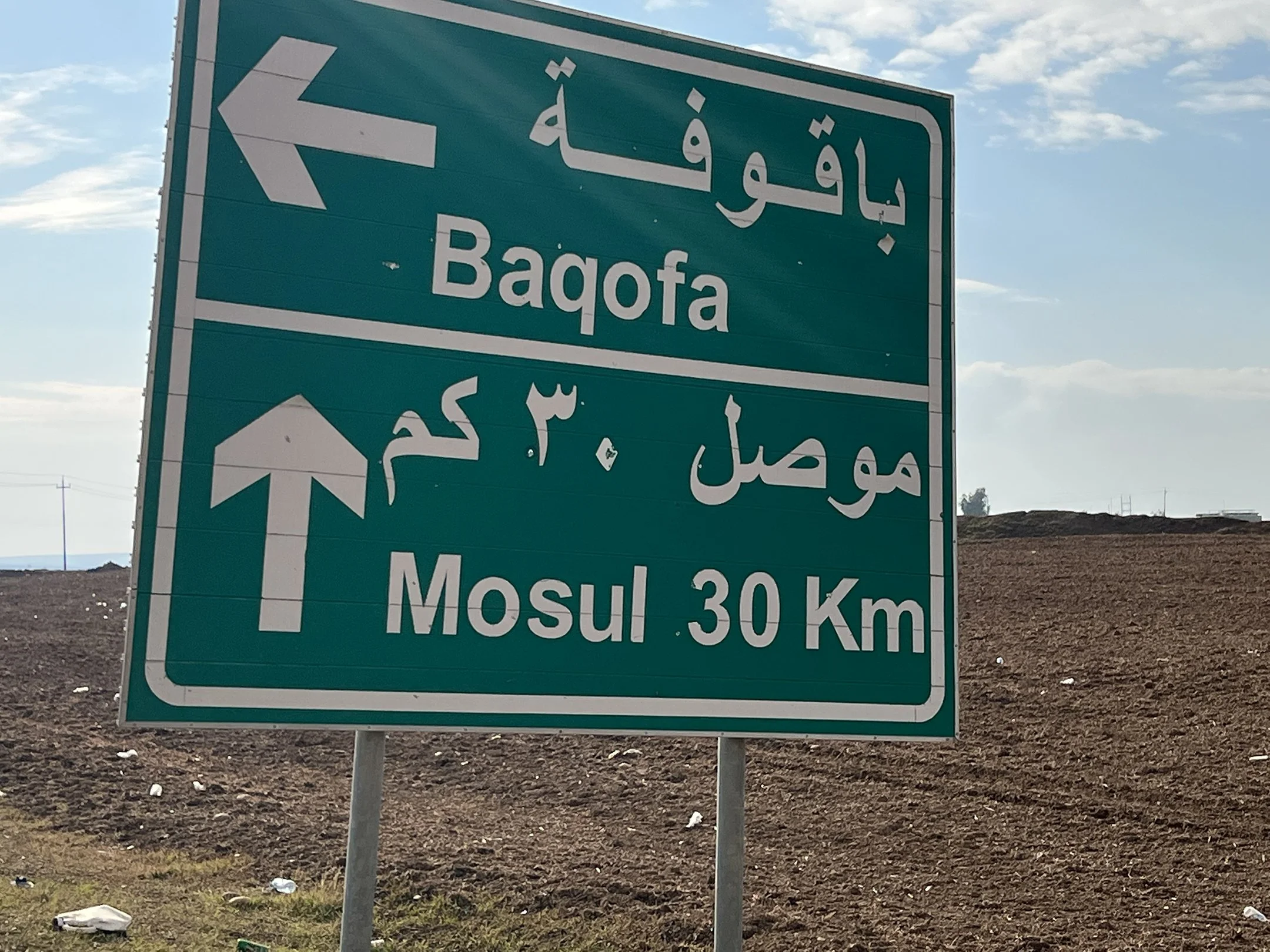
Road sign shows the way to the towns of Baqofa and Mosul.
By Adhid Miri, PhD
Part II
In Part One of this series, we explored the ancient Christian towns of Alqosh and Tel Keppe, communities whose histories stretch across centuries and whose churches, monasteries, traditions, and people have helped preserve the Christian heritage of the Nineveh Plain.
The story continues in three neighboring communities: Baqofah, Batnaya, and Tel Skuf. Though each town has its own history, landmarks and traditions, their stories share many of the defining experiences of Christians in the Nineveh Plain — ancient roots, a deep connection to the land, a rich religious and cultural heritage, and repeated periods of persecution, displacement, and rebuilding.
From the archaeological remains and historic churches of Baqofah, to Batnaya’s centuries-old monastery and agricultural traditions, and Tel Skuf’s enduring role as a center of Chaldean Christian life, these communities offer another window into the long history of Christianity in northern Iraq. Their stories also reflect the resilience of people who, despite migration and upheaval, have remained connected to their ancestral villages and worked to preserve their faith, language, and traditions.
Baqofah
Baqofah is a small, peaceful village in the Tel Keppe District of the Nineveh Plain, about 30 km (19 miles) north of Mosul. It lies opposite Tel Skuf and is approximately 3 km (2 miles) from Batnaya. Nearby is another village, known as Arab Baqofah, inhabited by Muslims. Although modest in size, Baqofah possesses a rich history stretching back thousands of years and is distinguished by its traditional architecture and cultural heritage.
The village’s name is derived from the Aramaic-Syriac Beth Qofa
(). Two principal interpretations have been proposed: “House of Baskets” (or “Place of Reeds and Wood”) and “Wooded Place” or “Place of Trees.” A less common interpretation renders the name as “Place of the Skull.”
Baqofah stands on and beside two adjoining archaeological mounds. Nineteenth-century excavations uncovered pottery, storage jars, and cuneiform inscriptions, indicating that the site was inhabited during the Assyrian period. The village is first mentioned in Syriac manuscripts of the seventh century in the Life of Rabban Hormizd, which records that its inhabitants helped construct the famous Rabban Hormizd Monastery near Alqosh.
Like many neighboring Christian towns, Baqofah suffered repeated invasions, including the temporary displacement of its population during the ISIS occupation of the Nineveh Plain in 2014.
The village’s principal landmark is the historic Church of Mar Gorgis (St. George), an ancient stone church built of rough masonry, plaster, and mud brick. Surrounded by a high wall and the old village cemetery, it features a finely carved royal doorway leading to the sanctuary, decorated with Syriac inscriptions dating from a restoration in 1868. The cemetery also contains the Shrine of St. Shmoni.
Baqofah is also home to the modern Church of the Virgin Mary, Refuge of Christians, whose altar was consecrated in 2024 through the efforts of the Chaldean Diocese of Alqosh. Built to strengthen the Christian presence in the region, the church features a prominent icon inspired by the ancient Marian prayer Under Your Protection. The village also has a convent of the Dominican Sisters (the Chaldean Daughters of Mary), which serves the spiritual and social needs of local families.
Among Baqofah’s most distinguished sons was Bishop Ya‘qub Eugine Manna (1867–1928), one of the foremost Chaldean scholars of his time. Ordained a priest in 1889 and consecrated a bishop in 1902, he is best remembered for compiling the influential Chaldean-Arabic dictionary Dalīl al-Rāghibīn fī Lughat al-Ārāmiyyīn (“Guide for Those Desiring the Language of the Arameans”).
The native inhabitants speak Sureth (Modern Aramaic) as well as Arabic. Today, the entire population belongs to the Chaldean Catholic Church, although historically the village was affiliated with the Church of the East.
Baqofah is renowned for the fertility of its land and its reliance on rain-fed agriculture. It produces some of the finest wheat and barley in the Nineveh Plain and provides excellent pasture for sheep and livestock.
Although many families have emigrated—particularly to the United States and Europe—the people of Baqofah remain deeply connected to their village. They continue to support its churches and preserve their religious traditions, especially Palm Sunday celebrations and the annual feast of their patron saint, Mar Gorgis.
Batnaya
Batnaya is a historic Christian town in the Tel Keppe District of the Nineveh Plain, about 24 km (15 miles) north of Mosul. It is bordered by Tel Skuf and Baqofah to the north, Tel Keppe to the south, the Monastery of Mar Oraha to the east, and the village of Kafrokh to the west. Its inhabitants are predominantly Chaldean Catholics who speak Sureth (Modern Aramaic). Traditionally, the town has depended on agriculture and is especially known for weaving mats from reeds that grow in the surrounding wetlands.
The town’s ancient name is believed to have been the Aramaic Beth Madaye (), meaning “House of the Medes” or “Village of the Medes,” reflecting a tradition that a group of Medes settled there in the seventh century under the guidance of the monk Abraham Oraha. Other scholars derive the modern name from the Aramaic Beth Tnana, variously interpreted as “House of Zeal,” “House of Diligence,” or “House of Clay.” Syriac sources also preserve alternative explanations, illustrating the uncertainty surrounding the town’s etymology.
Christianity is believed to have reached Batnaya during the seventh century through the missionary work of Rabban Oraha, a contemporary of Patriarch Isho’yahb II (628–644), who established a monastery west of the village. In 1729 the inhabitants joined the Chaldean Catholic Church, ending their former affiliation with the Church of the East.
Batnaya’s most important landmark is the Monastery of Mar Oraha, located about 1 km (0.6 mile) east of the town. Founded in the seventh century by Rabban Oraha, a disciple of Rabban Hormizd, it became an important spiritual center before falling into decline. During the mid-seventeenth century, Fr. Hormizd ibn Nur al-Din restored the monastery, rebuilt its church, added monks’ cells, and revived monastic life. Today, it remains a major pilgrimage site, attracting thousands of visitors each year on the second Sunday after Easter.
The town is also home to several historic churches, including the Church of Mar Qyriaqos (St. Cyriacus), the oldest and principal church of Batnaya, renovated in 1944 and again after recent conflicts. Other notable churches include the Church of the Virgin Mary, the Convent of St. Joseph, operated by the Dominican Sisters, and the Shrine of St. Shmoni, located within the town cemetery.
Historical records indicate that Batnaya had about 900 inhabitants in 1767. When the British scholar E. A. Wallis Budge visited in the nineteenth century, he recorded only sixty families. By the late twentieth century, however, the population had grown substantially, and today Batnaya has developed into one of the principal Christian towns of the Nineveh Plain, although emigration and recent conflicts have significantly affected its population.
For centuries, the town relied on three traditional water sources: rainwater reservoirs (kimatha), the Khosr River, and numerous wells, later supplemented by artesian wells. Agriculture remains central to the local economy, while education expanded steadily with the establishment of primary and secondary schools, enabling generations of students to pursue higher education at the University of Mosul.
Batnaya has endured repeated devastation throughout its history. It was destroyed during Nader Shah’s Persian campaign against Mosul in 1743 and again suffered severe destruction during the ISIS occupation of the Nineveh Plain in 2014. Following the fall of Mosul on June 10, 2014, and the assault on the Nineveh Plain on August 6, the entire Christian population was forced to flee. Churches, homes, and public buildings were looted and damaged, and the town remained deserted until its liberation.
Although reconstruction has restored much of Batnaya, many former residents remain dispersed across Iraq and the global diaspora. Some have returned to rebuild their ancestral homes, while many others have settled permanently abroad. Yet despite these hardships, Batnaya continues to symbolize the resilience of the Christian communities of the Nineveh Plain and their enduring attachment to their ancestral homeland.
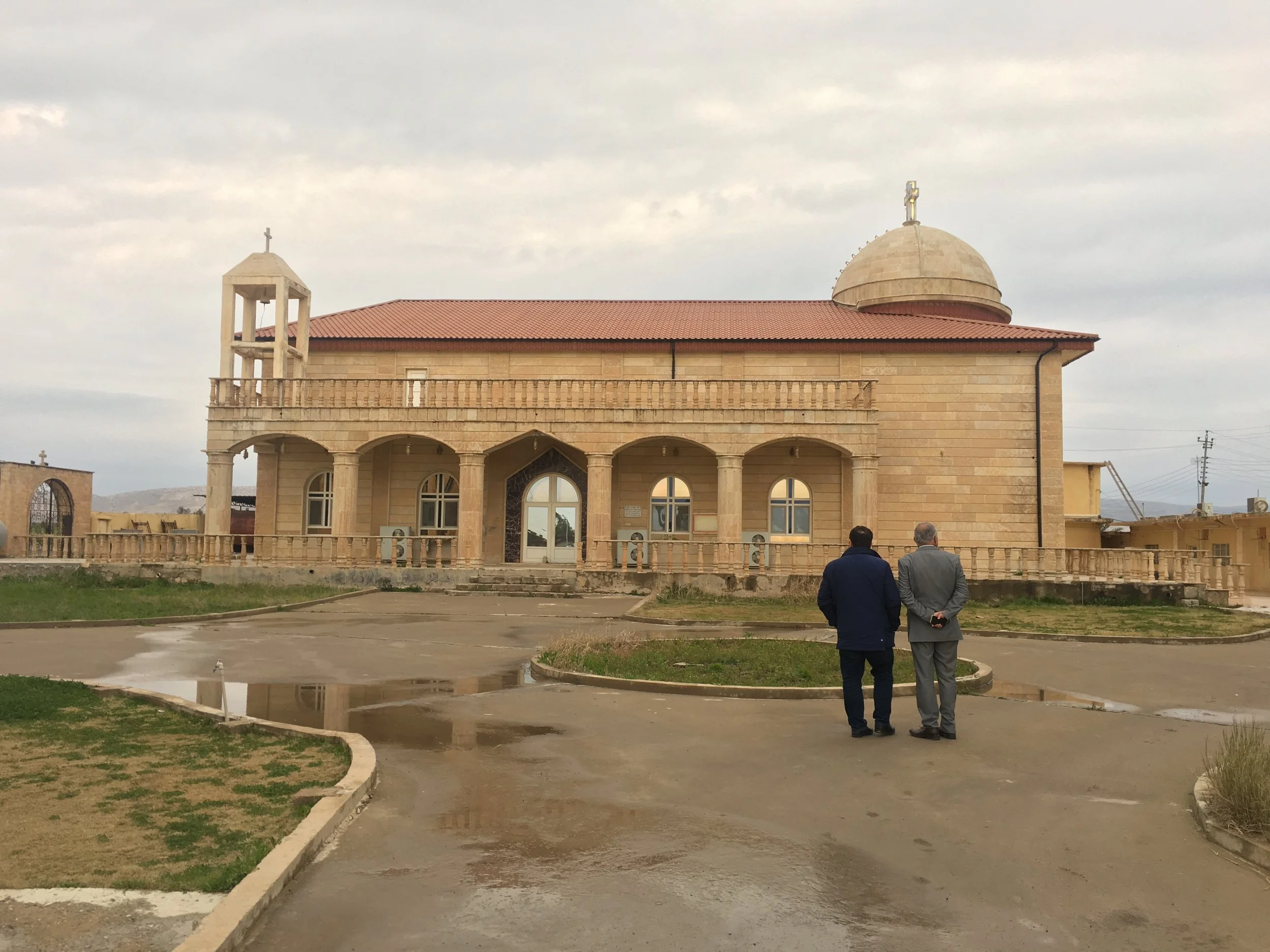
TeleSkuf grand church (Mar Gorgis) built in the late 18th century.
Telskuf (also known as Telleskuf, Telesquf or Tel Askuf)
Telskuf, located about 30 km (19 miles) north of Mosul and 7 km (4 miles) north of Batnaya, is one of the largest and oldest Christian towns in the Nineveh Plain, after Qaraqosh, Tel Keppe, and Alqosh. Throughout its history, it has maintained close cultural and historical ties with nearby Tel Keppe.
Its original Aramaic-Syriac name, Tella Zqipa (), means “Raised Hill” or “Hill of the Cross,” reflecting the elevated mound on which the town developed.
Archaeological evidence suggests that Telskuf dates back to the mid-third millennium BC. It was mentioned by the medieval geographer Yaqut al-Hamawi in Mu’jam al-Buldan as a large village in the Mosul district, and later Syriac and Chaldean manuscripts preserved in diocesan archives attest to its long Christian heritage. The inhabitants gradually joined the Chaldean Catholic Church during the eighteenth century after centuries of affiliation with the Church of the East.
Blessed with fertile farmland, Telskuf has long been known for cultivating wheat and barley. It also gained a regional reputation for producing pottery and large earthenware water jars, which supplied Mosul and many surrounding villages.
Among its principal landmarks is the ancient Church of Mar Jacob the Mutilated (Mar Ya‘qub al-Muqatta‘), one of the town’s oldest churches. Damaged during successive invasions, including the Mongol attacks, it has been rebuilt several times. Another important landmark is the Church of Mar Gorgis (St. George), originally constructed in the late eighteenth century and expanded in later years. The town also preserves a valuable collection of Syriac and Chaldean manuscripts, including a Hudra dating to 1698, while additional manuscripts copied in Telskuf during the nineteenth century are housed in the Berlin Museum.
East of the town lies the historic Monastery of Mar Benyamin, traditionally associated with Mar Benyamin, founder of the famous Monastery of Dayr al-Za‘faran (the Monastery of St. Ananias). The site, now part of the town cemetery, remains an important place of pilgrimage, especially on the second day of Easter.
Like many Christian communities of the Nineveh Plain, Telskuf endured repeated invasions and destruction. Mongol attacks in 1436 and 1508 devastated the town, destroying homes, churches, and farmland, and causing heavy loss of life. In modern times, it welcomed many displaced Christian families following the sectarian violence that erupted after 2003. On April 23, 2007, a car bomb killed more than twenty-five people.
During the ISIS offensive, Telskuf was briefly occupied in August 2014 and again attacked in May 2016 during a major assault on northern Iraq. Iraqi forces, supported by the U.S.-led coalition, quickly recaptured the town. Following its liberation in 2017, hundreds of families returned, assisted by extensive reconstruction efforts supported by the Hungarian government, which helped rebuild hundreds of damaged homes and restore churches and public buildings. Nevertheless, many former residents emigrated permanently to Europe, Australia, and the United States.
Today, Telskuf remains one of the principal centers of Chaldean Christian life in the Nineveh Plain, preserving its Aramaic heritage, religious traditions, and centuries-old cultural identity despite repeated cycles of displacement and renewal.
Conclusion
The histories of Baqofah, Batnaya, and Telskuf are more than accounts of ancient towns, churches, and monasteries. They are stories of communities that have endured centuries of upheaval while remaining deeply rooted in their faith, language, and traditions. Although war, displacement, and emigration have transformed the Nineveh Plain and scattered many of its people around the world, the connection to these ancestral towns remains strong. Through the preservation of churches and sacred sites, the continued use of Sureth, and the traditions carried on by families at home and throughout the diaspora, the legacy of these communities continues to endure.