
Learning Sureth
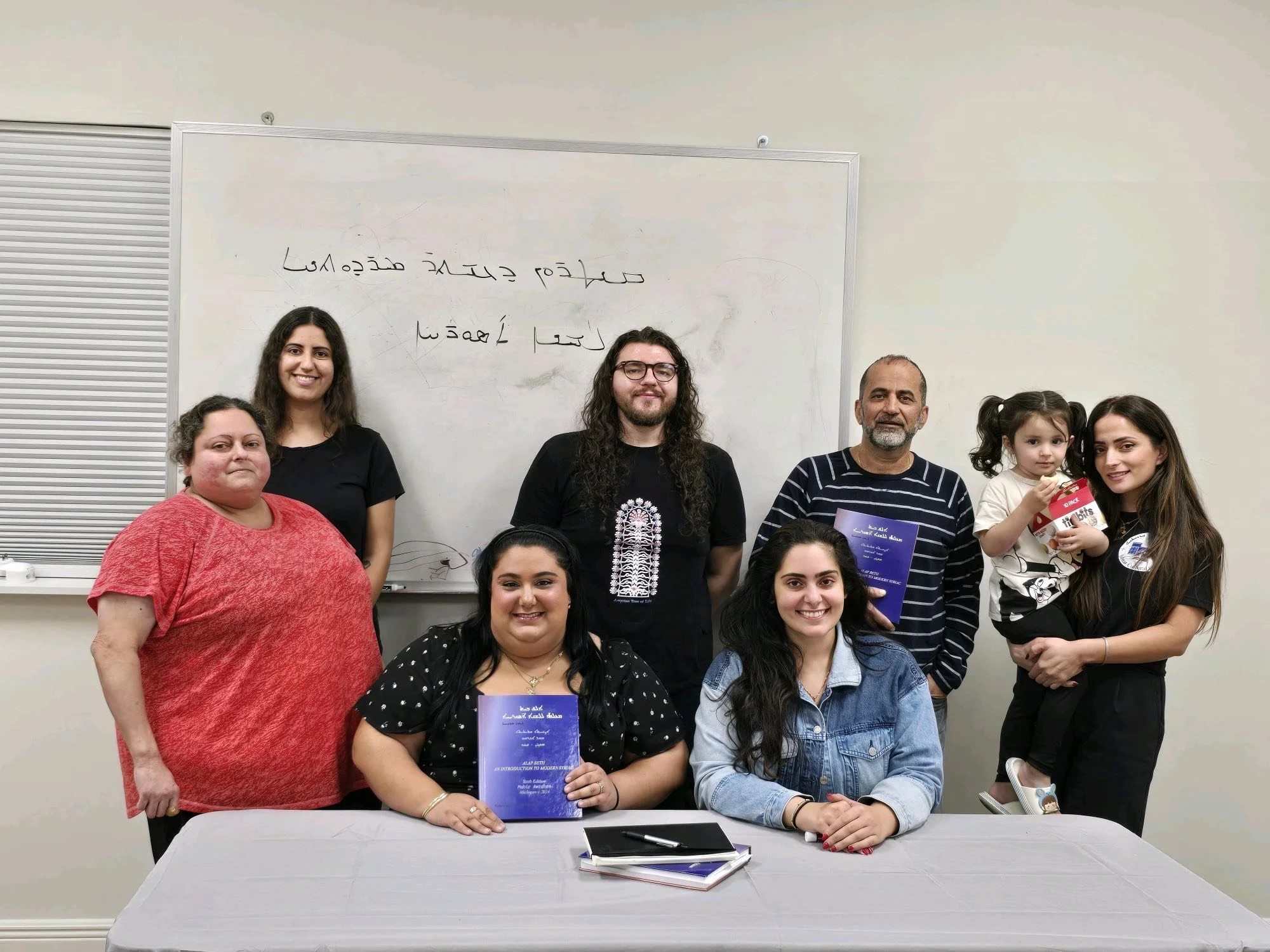
A student perspective
By Jenna Abroo
One of the many ways we connect through our culture is through language. The Chaldean people have spoken Syriac, or Sureth, for thousands of years. Many of our words trace back to ancient times, when Akkadian and Sumerian were widely spoken across our ancestral communities.
Our current dialect of Sureth has existed for more than 3,000 years—predating the time of Jesus Christ. Both our culture and language have transcended time, surviving into the modern day.
Flash forward to the 20th century: under the rise and fall of Saddam Hussein, our people were forced to assimilate into Arab culture. Teaching our language was prohibited and often met with persecution. My father and other family members were no strangers to this. As a result, they were unable to pass down Sureth to me or the other children in our family.
Now, as an adult, I’ve sought a deeper connection to our true Assyrian roots—and learning Sureth felt like a powerful first step. I signed up for a 12-week in-person class with a couple of friends and began my journey there.
At first, I didn’t know what to expect from the course. My Sureth was minimal at best, which made the idea of learning it feel intimidating. And while it hasn’t been easy, I’ve truly enjoyed the process—from learning the alphabet and vowels to forming basic phrases and sentences.
The highlight of the class, though, has been the sense of cultural camaraderie. Our instructor, Mahir Awrahem, is incredibly knowledgeable about both our language and history. He ends each class with a story about what life was like back home in Iraq, offering a personal and powerful connection to our roots.
After each language lesson, we take part in traditional dance sessions led by members of the Ishtar Cultural Center. So far, we’ve learned the khigga and several styles of bagiye, along with the stories and cultural origins behind each dance.
Exploring the traditions of our dance, music, and language has been one of the most meaningful parts of this course. As an indigenous people living in the diaspora, it’s our responsibility to stay rooted in our culture—and, one day, to pass that torch to the next generation.
While it will take time for me to become fluent and confident in speaking Sureth, this course has been a powerful and inspiring introduction to the language.
While speaking with some of my classmates, I had the chance to hear what inspired them to take the course. Justine Abbo, 27, of Detroit, shared:
“I was drawn to reading and writing in Sureth because my family has been in the United States for a couple of generations, and less and less spoken Sureth has been passed down. Both of my parents were born here, as well as one of my grandfathers. I believe we really have to take the initiative to keep our language alive in the diaspora.”
Abbo also recalled a poignant family memory: before her great-grandmother passed away at age 97, her aunt asked her to write the family’s last name—Abbo—in Sureth. Her aunt later had it tattooed.
While studying at the University of Michigan, Abbo took an Arabic language course and discovered something surprising: the tattoo was actually written in Arabic.
“It was clear that the language was losing its written form in the U.S. diaspora,” she said. “I decided to take Sureth to help preserve our ancient language—and maybe one day get a tattoo written in Sureth myself!”
Our classmate Mason Sitto, 29, shared his enthusiasm for the course, saying he loves learning Sureth because it’s “not only teaching us the language, but also how to read and write it—along with the historical context behind certain words.”
He added, “I think everyone in the Chaldean/Assyrian/Syriac community should take part in classes like this to ensure that our old and rich language doesn’t die out.”
Sitto is also active in the community through the Ishtar Cultural Center Youth Group and collaborates with fellow Chaldean artists in Metro Detroit as part of an art collective called Rooshma Arts.
Another classmate, Nicole Matti of West Bloomfield, shared her motivation for joining the class:
“As a first-generation American, I generally understood the gist of Sureth from hearing my family speak it at home—but not perfectly. And I couldn’t speak it fluently.”
Matti reflected on the often-cited idea that culture is typically lost within three generations.
“If we don’t learn our language, traditional recipes, art, and history to pass on to future generations, it will die with us,” she said.
She emphasized how important this feels, especially given the global diaspora:
“It’s even more urgent knowing that we now live in communities far from our homeland, spread across the globe—especially here in the U.S., where some of our Chaldean communities, like those in Michigan, are even larger than the indigenous communities still living in Iraq.”
One of the biggest takeaways from my classmates is that we are all committed to learning Sureth—not only as a way to connect with our culture but also to preserve it. Being removed from our ancestral homeland can make it difficult to maintain that connection, but language provides a powerful starting point.
From communities here in Metro Detroit to California, Canada, Sweden, Australia, and beyond—right back to the homeland and across the globe—studying Sureth brings joy to Chaldean students. It allows us to celebrate the beauty of our culture and pass the torch to future generations of Sureth speakers.
Information to enroll in local Sureth classes can be found online through the Chaldean Community Foundation, the Ishtar Cultural Center, or through your local church parish.