
Brother Daniel Says “Yes”
A new monk joins the Antonian Hormizdian Order
By Shamasha Michael Antoon
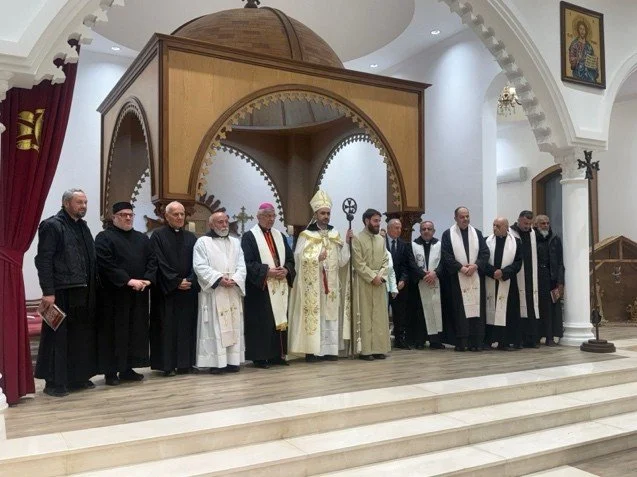
For the first time in over fifteen years, the Chaldean Antonian Hormizdian Order welcomed a new novice. On the third Sunday of the season of Subara (Annunciation), Daniel Orcen, a 31-year-old from France, received the beige cassock that marks the beginning of monastic life at the Monastery of the Servant of God Martyr Abbot Gabriel Denbo in Ankawa, Iraq.
In a region where Christian communities have faced displacement, violence, and exodus, one young man made the opposite choice. Rather, he came.
Abbot Dr. Samer Soreshow (SawrIsho) Yohanna, Superior General of the Order, spoke to the significance of the moment in his homily during the Divine Liturgy. “After years of drought that our monastery and monastic houses have endured, like Elizabeth, here is God’s grace suddenly bursting forth a new spring of life,” he said. “A vocation comes from distant lands, as a sign that the Spirit works where He wills, and that God does not forget His vineyard.”
From Paris to Iraq
Daniel Orcen was born to Chaldean parents from Turkey and raised in Sarcelles, just outside Paris. He served for years as a Shamasha, or subdeacon, in his local church. But his twenties looked like those of most young people. He worked, made money, went out, drove a nice car, and lived the kind of life that Paris offers.
At nineteen, Daniel suffered cardiac arrest. Through “a miracle and the intercession of the Virgin Mary,” he survived. The next decade passed in what he calls “the Paris lifestyle”—money, parties, and all the things success can buy.
Then, at thirty, something shifted. During a spiritual retreat called Agape, Daniel felt something awaken within him. He traveled to Jerusalem and stood in Gethsemane, where Christ endured His Passion. “I felt the Passion of Christ,” Daniel says. “This deeply shook me, and at that moment I understood that I had to give my life to Christ, as He gave His life for us sinners.”
The pull toward religious life grew stronger during a trip to Rome. Surrounded by hundreds of seminarians at an anniversary celebration, Daniel heard a voice inside him ask: “Why not me?”
He first tried joining the Chaldean monks in San Diego, but after months of discernment and waiting, it did not work out. Iraq seemed far away and uncertain. But a spiritual sister who knew of his desire reached out to Abbot Samer in Ankawa. The response was simple: “For Daniel, the door is open.”
After a fifteen-day visit in October and a retreat with the Jesuits in February, Daniel made his decision and left everything behind—his job, his car, his life in France.
“Yes, I must learn Arabic; it is another culture,” he admits. “There are disappointments, crosses to carry, patience to have. But the path of the Lord is filled with grace, with hope, with joy, with inner peace.”
A Monastery Rebuilt
The Chaldean Antonian Hormizdian Order has deep roots. It began in the seventh century with Rabban Hormizd, a Chaldean monk who carved a hermitage from the mountainside above Alqosh. The monastery grew over the centuries and eventually became the Patriarchal Seat of the Church of the East for over three hundred years.
But by the late 1700s, wars and invasions had left the monastery abandoned. That’s when Gabriel Denbo stepped in.
Abbot Gabriel was born in Mardin in 1775. He worked as a weaver and nearly died from malaria in his twenties. In his suffering, he made a vow: if God healed him, he would dedicate his life to serving Him. God answered, and Gabriel kept his word. On Palm Sunday in March 1808, he reopened the Monastery of Rabban Hormizd and refounded monastic life in the Chaldean Church, despite opposition and persecution.
Abbot Gabriel didn’t live to see his work flourish. In 1832, he and three other monks were killed during a Kurdish raid led by the Emir of Rawanduz. But the Order he refounded went on to educate clergy, preserve manuscripts, and serve the Chaldean Church for generations.
Today, the Order maintains six monasteries, including the historic Rabban Hormizd Monastery in Alqosh and the newly opened General Assembly complex in Ankawa. The Ankawa site houses the monastery, St. Anthony the Great Church, and the Scriptorium Syriacum, a center dedicated to preserving Syriac manuscripts.
But the numbers tell a difficult story. The Order once had over seventy members. Today, there are twelve monks.
“For over fifteen years, no new monks have entered the order,” Abbot Samer said in a previous interview with CN. “People are more focused on securing a livelihood or living comfortably, which has led many of our young people to seek migration rather than dedicating their lives to God.”
The beige cassock Daniel now wears symbolizes purity and the beginning of monastic formation. If he completes his year of novitiate, he will receive the black cassock—a sign of dying to the world to live fully in Christ. After that come three years of temporary vows, and then the possibility of perpetual profession.
Brother Daniel knows the road ahead won’t be easy. “I am truly not worthy to be here,” he says. “Through this monastic life, I also want to redeem myself for my years of sin.”
A Mission That Continues
Despite reduced numbers, the Order continues its work. Monks teach, lead spiritual retreats, and serve in Chaldean parishes. They are digitizing centuries of liturgical prayers and adding audio recordings of ancient chants for smartphone apps. They maintain St. Joseph’s Orphanage, care for the elderly, and preserve one of Iraq’s largest private collections of Syriac manuscripts, some dating back to the eighth century.
Most importantly, they continue to pray. “Prayer, focused on Scripture and liturgy, should be the foundation of both work and brotherly relationships within the community,” Abbot Samer explained. This rhythm of prayer and work has sustained the Order through invasions, martyrdom, and near extinction. This prayer still sustains them now.
In a region that has been emptied of Christians through violence and displacement, Brother Daniel’s decision to come instead of leave carries weight. For now, one beige cassock hangs in the monastery, while the door remains open for others to follow.