
Building Community Through Art
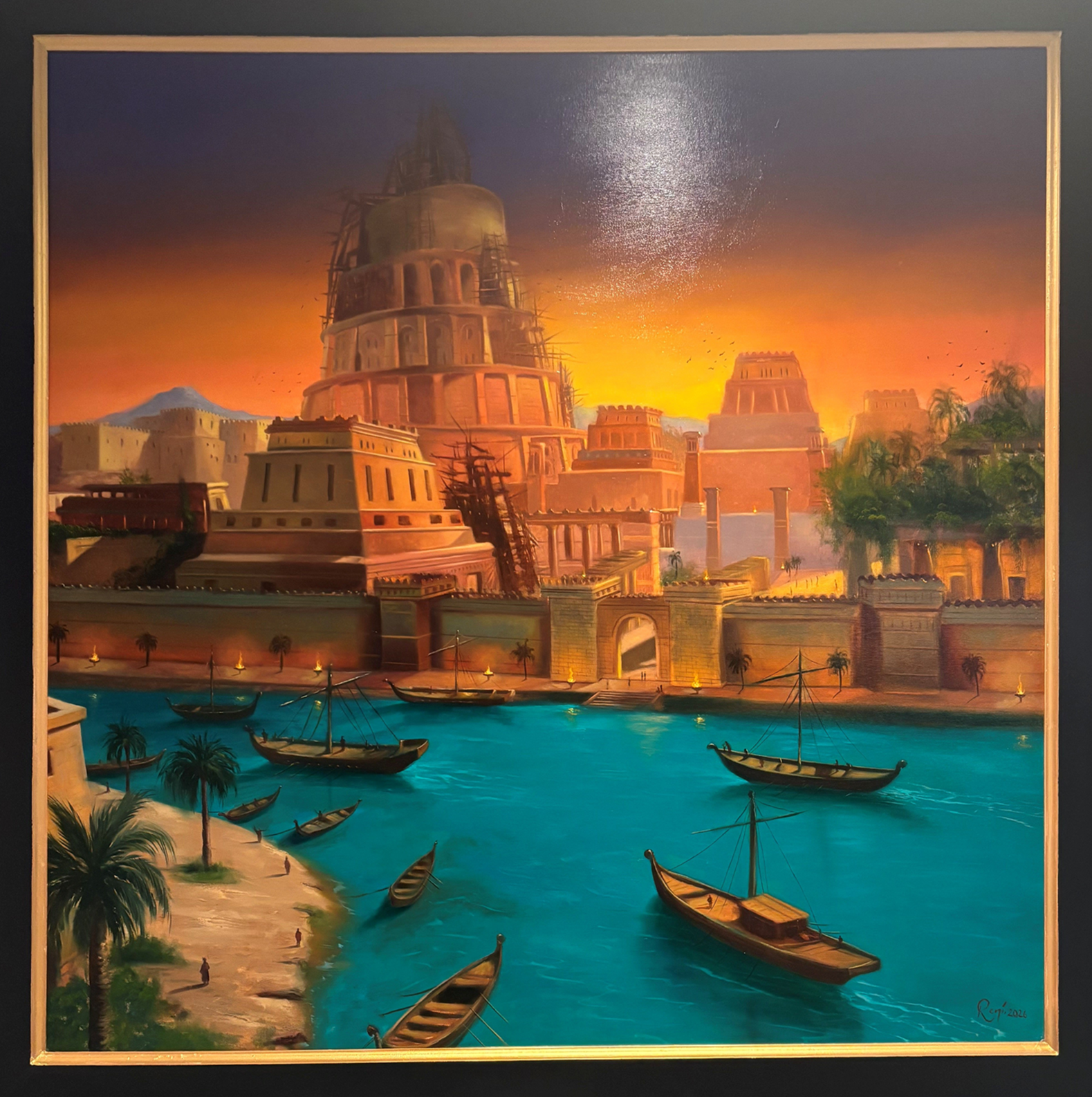
This artwork displayed in the hallway opposite the lounge depicts the building of the Tower of Babel in Babylon.
Celebrating Chaldean history, faith and culture through art at CCF West
By Adhid Miri, PhD
Part III
Art in buildings is more than just a visual treat; it’s a vital component of the character of the building and a celebration of community life and history. Art transforms ordinary places into vibrant cultural hubs, encouraging community engagement and fostering a sense of cultural identity.
This article explores the art displayed at the West Bloomfield Chaldean Community Foundation building spaces, highlighting their visual impact and serving as a mirror to reflect a community’s cultural heritage and diversity.
Martyrs Wall
CCF West leadership chose to dedicate a Martyrs Wall honoring nine individuals who gave their lives for their faith. Featuring their names and photographs, the wall was selected and designed under the direction of historian and engineer Habib Hannona.
The nine martyrs honored are: Mar Philippos Yacob Auraham, Mar Toma Audo, Mar Yacoub Augen Manna, Mar Addai Scher, Mar Benyamin Shimun XXI, Sister Cecilia Moshe Hanna, Mar Paulos Faraj Rahho, Father Ragheed Aziz Ganni, and Father Paulos Eskander.
The April 2023 issue of Chaldean News featured an in-depth article by editor Sarah Kittle, titled “A Wall of Martyrs: Catholics Murdered for Their Faith,” detailing their lives and sacrifices. The wall also includes the names of several Christians killed in Mosul between 2003 and 2010.
Chaldean Church of the Martyrs
The Chaldean Church has a long history of martyrdom, with generations of faithful who have sacrificed their lives for Christianity. Each year, the Church remembers its martyrs on the Friday following Easter, placing this solemn observance within the celebration of the Resurrection of Our Lord Jesus Christ.
Throughout history, the Church in Iraq has endured profound persecution and the loss of many of its faithful. Among them are Mar Shimon Barssaba’i and his companions in the early centuries, followed by bishops Addai Scher, Jacob Abraham, and Thomas Audo, along with hundreds of others. The devastating genocide of 1915 remains a painful chapter in this history, as do the killings in 2008 of Archbishop Faraj Rahho, Father Ragheed Ganni, and their companions by al-Qaida extremists.
Yet the memory of the martyrs is not only one of sorrow and sacrifice. Their faith and courage remain a source of spiritual inspiration, reminding us of the enduring power of hope, human dignity, tolerance, and peace. Remembering the martyrs during the Easter season connects their sacrifice with the promise of the Resurrection, renewing our faith in life and strengthening our hope for the future.
Paintings by Reni Stephan at CCF West
The Chaldean Community Foundation’s West Bloomfield campus, CCF West, celebrates the rich history, faith and culture of the Chaldean community through a collection of striking paintings by artist Reni Stephan. The artwork depicts the Hanging Gardens of Babylon, the Ishtar Gate, King Nebuchadnezzar II and prominent figures from Syriac Christianity.
Together, these paintings pay tribute to the enduring legacy of Mesopotamia and the deep-rooted traditions of the Chaldean people. Blending historical landmarks with religious imagery, the collection connects visitors to the region’s ancient past and the faith and cultural identity that continue to shape the community today.
King Nebuchadnezzar II Overlooking the Hanging Gardens
This painting captures King Nebuchadnezzar II seated in quiet authority upon his palace balcony, gazing over the legendary Hanging Gardens of Babylon. Suspended between earth and sky, the gardens symbolize both his devotion and his ambition— a ruler who shaped the skyline of an empire. In this moment of stillness, power meets reflection. The king overlooks not only his creation, but the legacy of a civilization that sought to touch the heavens.
Babylon Tower
This painting captures humanity’s ambition and unity in the construction of the great tower of Babylon. Workers labor together, raising stone upon stone in pursuit of a shared vision of reaching the heavens.
The tower symbolizes both human ingenuity and the limits of pride, reflecting the delicate balance between ambition and humility. Through its depiction of collective effort and aspiration, the painting invites reflection on the relationship between faith, achievement and the human desire to reach beyond earthly boundaries.
Road to Uruk
This painting portrays the long and storied path leading to the ancient city of Uruk—one of humanity’s earliest urban centers. The road stretches across dust and horizon, symbolizing trade, migration, and the birth of civilization.
In the distance, the rising walls of the city stand as a promise of culture, innovation, and human ambition. The journey toward Uruk reflects not only a physical passage, but the timeless movement of people toward progress, community, and destiny.
Sumerian Classroom
This painting captures a moment inside a Sumerian classroom, where young scribes sit with clay tablets in hand, carefully pressing cuneiform into wet clay. Under the guidance of their teacher, knowledge is shaped line by line—law, trade, poetry, and history preserved for generations.
The scene reflects the birth of formal education and written language, reminding us that civilization is built not only by kings and monuments, but by teachers and students shaping the future through learning.
Babylonian Merchants
This painting reflects the spirit of ancient Babylon—a civilization built not only on kings and temples, but on trade, movement, and human exchange. The merchants stand as symbols of connection: carriers of spices, textiles, metals, and stories across deserts and rivers.
Their presence represents ambition, survival, and the early pulse of global commerce. In their journey, we see ourselves—seekers of opportunity, builders of cities, and participants in a timeless exchange between cultures.
Hammurabi: Laws and Authority
This painting portrays King Hammurabi seated firmly upon his throne, delivering the principles of law to his closest advisors. His posture reflects authority not rooted in chaos, but in order—a ruler determined to shape justice for his people.
The two leopards at either side of his throne symbolize strength, vigilance, and the fierce protection of the law. In this scene, power and wisdom stand together, marking the birth of one of history’s earliest written codes—a foundation of civilization itself.
Ishtar Gate
This small replica honors the grandeur of the Ishtar Gate, one of the most magnificent entrances of the ancient world. With its deep blue glazed surface and symbolic reliefs of lions and dragons, it reflects the power, protection, and divine presence associated with Babylon. Though modest in size, the piece carries the spirit of a monumental gateway—a threshold between the ordinary and the sacred, echoing the strength and artistic brilliance of a great civilization.
Conclusion
Public art plays an important role in community life. It enriches our buildings, beautifies shared spaces, strengthens community identity, highlights cultural heritage, and helps generate support for local programs and initiatives.
At the Chaldean Community Foundation, we take pride in showcasing art throughout our CCF West campus, making these works accessible to the broader community. Through guided tours, visitors can learn about the stories, history, and meaning behind the artwork, deepening their appreciation for the culture and traditions it represents. These efforts reflect our commitment to making CCF West a vibrant, welcoming destination and an integral part of the community.
Ultimately, public art does more than enhance a space—it tells stories, preserves heritage, and brings people together. By celebrating and sharing these creative expressions, we can inspire curiosity, strengthen connections, and enrich the community for generations to come.