
The Beauty of the Chaldean Catholic Mass: A Teen Perspective
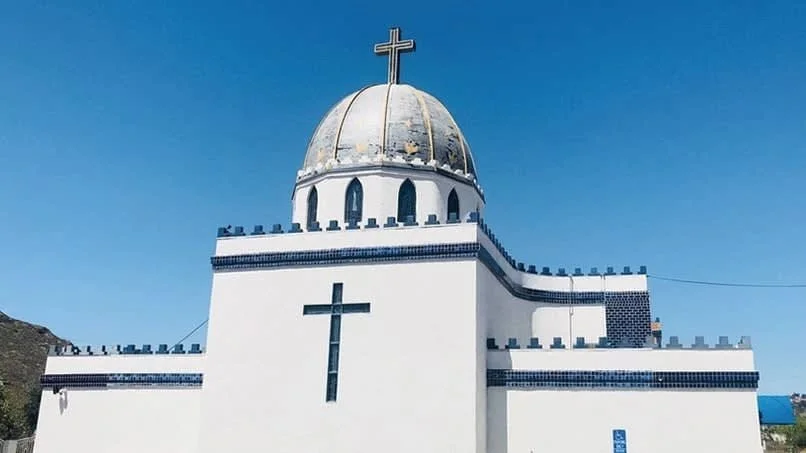
St. Peter Chaldean Catholic Cathedral in El Cajon.
By Lourde Bahoura & Olivia Hesano
Imagine walking into church on a Sunday morning. Light pours through the stained glass, and bells ring out as a sign of the Holy Spirit: Mass has begun. The choir starts to sing, the hymns fill the air, the priest walks up to the altar, and you can feel God standing in front of you.
For us, the Chaldean Catholic Mass is more than a Sunday routine. It is part of who we are. We grew up attending Mass, learning our prayers, and participating in traditions that connect us not only to God but also to our families, to our culture, and to the generations of Chaldeans who came before us.
The Chaldean Catholic Church is an Eastern Catholic Church with roots in ancient Mesopotamia, in what is now Iraq, and it is in full communion with the Pope. Its liturgy is celebrated in a form of Aramaic, the language Jesus spoke, which many of us simply call “Chaldean.” To learn more about the Mass, we interviewed two priests from the Chaldean Catholic Eparchy of St. Peter the Apostle in San Diego: Father Christopher Somo of St. Peter Chaldean Catholic Cathedral and Father Tristan Farida of St. Joseph Chaldean Catholic Church.
There are many ways for young people like us to strengthen their faith, whether it is reading the Bible, attending Mass, participating in church youth groups or Bible studies, or simply following the teachings of the Ten Commandments and receiving the Seven Sacraments. These practices are reminders that faith is not just something we believe in, but something we live out every day.
Olivia has said an intercessory prayer every day to Saint Luke the Evangelist for the past three years, asking for spiritual protection. It gives her a connection to the saints who were imperfect people and reminds her that everyone is called to be a saint. Lourde prays the rosary often; it helps her visualize and comprehend Mary’s thoughts and feelings throughout Jesus’ life.
Origins and Architecture
The Chaldean Catholic Mass traces its roots to Edessa, in northern Mesopotamia, where the East Syriac Rite developed. The Chaldean Church grew out of the ancient Church of the East and entered full communion with Rome in the 16th century.
The architecture of Chaldean churches reflects this rich history, with traditional designs continuing to influence the construction of modern churches. According to the Chaldean Community Foundation’s website, many Chaldean churches are built in the style of ancient Babylon, known as Babylonian Revival Architecture.
Common features include fortress-like towers, stepped rooflines, arched entrances, domes and monumental gate facades.
For us, walking into a church built this way is a reminder that our faith and our people trace back to Babylon and Mesopotamia.
Inside the Mass
The Chaldean Catholic Mass actually starts at home, where we are expected to fast from food for at least one hour before receiving the Eucharist, according to sjvchurch.net. When we arrive at church, it is customary to genuflect toward the altar before taking our seats in the pews.
Throughout the Mass, we make the Sign of the Cross, entrusting ourselves to the Father, the Son and the Holy Spirit. We use the first three fingers of our right hand to touch our forehead, then our stomach, representing Jesus in Mary’s womb, followed by our left shoulder and then our right. This sacred ritual reminds us of Christ’s sacrifice and reaffirms our faith.
The Mass begins with a procession of the priest, deacons and altar servers into the church. The priest then leads the opening hymn, accompanied by the choir. Usually, a deacon gently swings the thurible, releasing incense throughout the church. The incense represents the sweet scent of Jesus’ love and, according to Father Tristan Farida, “the rising of our prayers and offerings to God.”
We sing several ancient hymns during a Chaldean Mass.” After the hymns, a deacon reads a passage from the Old Testament, followed by another reading from the New Testament. The priest then proclaims the Gospel in Chaldean and, during an English Mass, in English as well. After the Gospel reading, the priest delivers the homily, helping us reflect on the Scripture and its meaning in our daily lives.
According to Father Tristan, “the priest reads the Gospel during Mass because the Mass begins with the Liturgy of the Word and continues on with the Liturgy of the Eucharist. We actively hear God’s word and interact with it every time we are attentive and listening to the Gospel at Mass.” Every week, he explains, there is a new Gospel reading aligned with the Liturgical calendar of the Church. This cycle repeats every year.
We enjoy the homily because it helps us better appreciate the Gospel and what it teaches us. The priest breaks down the Bible passages in a way we can understand. Afterward, we stand together and recite the Creed, professing our faith.
During the Rite of Peace, we hold our hands in a prayer position and open them to receive peace from another person. The altar servers line up near the altar to receive the sign of peace from a deacon before walking through the church to share it with the congregation. This exchange represents Jesus’ peace and love for all of us, and it is one of the parts of Mass we particularly enjoy.
As the Mass continues, the choir begins singing a hymn while the priest brings out the bread and wine. The priest then prays the Eucharistic Prayer, and the bread and wine are consecrated, becoming the Eucharist. Once this part is complete, the priest stands at the front of the altar and leads the congregation in the Our Father, which we pray together.
Once the Eucharist is blessed and prepared to be received, priests and deacons spread out throughout the church so people in every row can receive Communion if they wish. During this time, the choir sings a hymn that we can join in singing.
After everyone has had the opportunity to receive the Eucharist, the priest shares the Sunday announcements, including prayers for Chaldean Catholics who have passed away and updates about upcoming church events. He then concludes the Mass with the final blessing. According to the Chaldean Hymnal for English Choirs, the congregation responds with “Amen” as the priest asks God to “bless our assembly, protect our community, and sanctify our people.”
Through these prayers, responses, and traditions, we express our gratitude to God and strengthen our faith.
Importance of the Sacraments
The seven sacraments of the Catholic Church are Baptism, Confirmation, Confession, Eucharist, Holy Orders, Matrimony and Anointing of the Sick. Baptism welcomes a person into the Catholic Church through the use of holy water. Confirmation strengthens this bond by sealing the person with the Holy Spirit through holy oil. Confession is when we admit our sins to a priest, who forgives sins through the authority passed down from Christ to the apostles. We believe it is important to go to Confession regularly. For us, going at least once a month helps us feel spiritually renewed and closer to God.
The Eucharist is the consecrated bread and wine that become the Body, Blood, Soul and Divinity of Jesus Christ. Receiving the Eucharist commemorates Jesus’ sacrifice and His saving work. Holy Orders is the sacrament through which men are ordained to serve the Church as deacons, priests or bishops. Matrimony is the sacrament of marriage, while Anointing of the Sick provides spiritual strength, comfort and healing to those who are seriously ill or nearing the end of their lives.
The Eucharist is one of the most significant parts of a Chaldean Catholic’s life. Usually between the ages of 8 and 12, Chaldean Catholic children celebrate their First Holy Communion, receiving the Eucharist for the first time. Father Christopher Somo, a priest at St. Peter Chaldean Catholic Cathedral, explained that the Eucharist is kept in the tabernacle so it can be brought to people who are sick and unable to attend Mass. He also explained that the tabernacle is “a kind of vessel that is meant to store the Eucharist.” It is usually located in the sanctuary near the altar.
The monstrance is another important part of our lives as Chaldean Catholics. It is an ornate, often gold-colored vessel with an opening in the center used to display the Eucharist during adoration. Gold rays extend outward in a circular pattern, making it look like the sun radiating from the Eucharist. Each church may have its own unique design.
During adoration, we can reflect on the acronym ACTS, which stands for Adoration, Confession, Thanksgiving, and Supplication. We adore God, ask for forgiveness, thank Him for everything He has given us, and pray for His grace and guidance. Adoration gives us a chance to slow down, spend time in prayer, and reflect on God’s immense and unconditional love for us.
Called to Serve
Many Chaldean Catholic men feel called to the priesthood, which plays a vital role in our Church. Priests lead Mass, administer the sacraments and guide the faithful in their spiritual lives. Without priests, we would not be able to celebrate Mass and receive the Eucharist in the same way.
Father Christopher was inspired to pursue the priesthood by the way he was raised. As a child, he often “serv[ed] in the Church and witness[ed] the work of the clergy, particularly as they would celebrate the Mass.” As he grew older and began thinking about his future career, the priesthood remained on his mind.
Father Christopher spoke with several trusted priests and asked them questions until he gained “enough clarity to see that the best way for [him] to serve God was through the priesthood.” His experiences in the Church and his appreciation for its sacred mysteries helped him recognize his calling to serve God.
Father Tristan also felt drawn to the priesthood through his connection to his Chaldean culture and faith. He explained that he “fell in love with the beauty of our Church and Liturgy.” The sacraments were especially meaningful to him because they allowed him to “experience God’s love and mercy.” Father Tristan felt called to bring Christ to others through his ministry as a priest, reflecting the purpose of the Sacrament of Holy Orders.
Father Tristan’s journey to the priesthood was also unique. He was ordained at age 23, even though the usual minimum age requirement is 24. Bishop Emmanuel Shaleta, the former bishop of the Eparchy of St. Peter the Apostle, approved his early ordination.
There are many reasons we, as Chaldean Catholics, celebrate Mass, but one thing remains the same: Mass is a beautiful and sacred experience that brings us closer to God and to one another. Through the prayers we recite, the hymns we sing, the sacraments we receive and the traditions we continue to practice, we keep our faith alive while honoring the generations who came before us.