
A Living Legacy
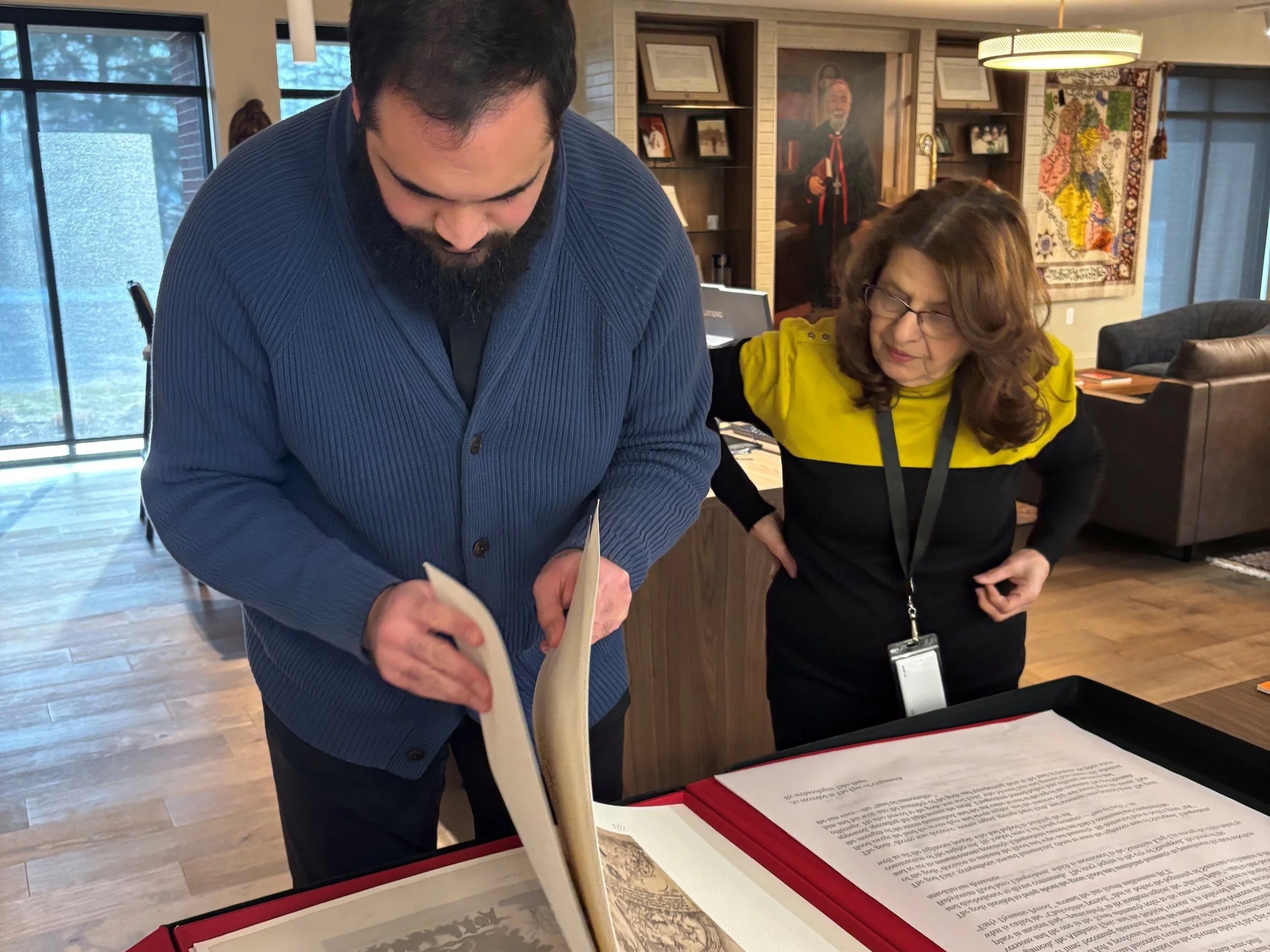
New history classes take root at Mar Ibrahim Library
By Sarah Kittle
In a quiet corner of the Chaldean Community Foundation in West Bloomfield (CCF West), something extraordinary is unfolding.
The Mar Ibrahim Library is not simply housing books. It is awakening memory. It is stirring questions. It is forming students. And for the first time, it is opening the history of the Church of the East to the wider community in a structured, academic course once reserved primarily for seminarians.
Preserved liturgical texts, newly digitized manuscripts, and eager students now share the same space. What began as a dream decades ago has become a living classroom, one that bridges Mesopotamia and Michigan, martyrdom and mission, memory and momentum.
At the heart of it all stands a legacy that began in a small village in Iraq.
His Excellency Bishop Ibrahim Namo Ibrahim, Bishop Emeritus of the Chaldean Eparchy of St. Thomas the Apostle, grew up in Tel Keppe, Iraq, in a life marked by simplicity and devotion. Like many in his generation, faith shaped his earliest memories. Daily Mass was not an obligation; it was rhythm. Service to the Church was not extracurricular; it was identity.
As a teenager, he made the defining decision of his life: he entered the seminary. Ordained at just 25 years old, he would eventually travel far from Tel Keppe—not to abandon his roots, but to plant them elsewhere.
Long before becoming the first bishop and leader of the Chaldean Catholic Church in the United States, Bishop Ibrahim was a teacher and spiritual director. In Tel Keppe, he established a seminary dedicated to forming future priests. He has often said that fostering vocations is a moral duty of the Church and one of his proudest accomplishments.
Yet another dream would follow him across the ocean: the creation of a library that would safeguard the spiritual and intellectual inheritance of his people.
For centuries, in one of the most ancient Catholic regions of the Middle East, manuscripts were protected at great personal risk. Monks copied texts by hand, preserving theology, philosophy, liturgy, and science without the benefit of modern technology. Many did so amid persecution.
Today, that legacy is safeguarded in a temperature-controlled archival space at the Mar Ibrahim Library. It is not a typical library. It is a living archive of faith, language, and identity.
A Course Born from Questions
Leading the library’s programming is Father Marcus Shammami, who also teaches at Sacred Heart Major Seminary. His eight-week course, A History of the Church of the East, marks a turning point for the community.
The idea did not begin as a formal initiative. It began with personal questions.
“When I was in my last few years in the seminary,” Father Marcus recalls, “I had questions about the Church of the East, the Church that I belonged to. And nobody really had a lot of answers.”
He began researching on his own. Notes became lectures. Lectures became a seminary course. And eventually, the course expanded beyond seminarians and into the broader Chaldean community. Now, in a condensed eight-week format, students journey from the apostolic age to the modern diaspora.
The class begins with St. Thomas the Apostle and the evangelization of Mesopotamia by Addai and Mari. It traces the Church’s expansion under the Persian Sassanian Empire, through Islamic rule, the Mongol period, Ottoman persecution, genocide, displacement, and into the present-day diaspora. Not merely a timeline, it is a story of endurance.
When asked whether the course is academic or spiritual formation, Father Marcus answers without hesitation: “It’s both. You can’t separate your spirituality from your history.”
The Chaldean Church is often described as the Church of the Martyrs. Its theology and liturgy were shaped in persecution. Its prayers carry the tone of survival and hope because they were formed in fire. One of the most powerful examples discussed in class is the Eucharistic prayer of Addai and Mari, among the oldest Eucharistic prayers still in use in the universal Church. For more than two millennia, it has been prayed through triumph and tragedy alike.
“It’s living history,” Father Marcus says. “That Eucharistic celebration has been done for 2,000 years—through persecution, through mourning, through jubilation.”
To lose the liturgy, he argues, would be to lose the rhythm of our ancestors.
For many students, one of the most surprising revelations is the global reach of the Church of the East. At one time, it stretched from Mesopotamia to India, Central Asia, and China. It was arguably more geographically expansive than the Western Church during certain periods.
Scholars of the Church of the East were central to major translation movements. Greek philosophical and scientific texts, including works of Aristotle, were translated into Syriac and Arabic by its scholars, later reentering Europe and contributing to intellectual renewal.
Archaeological discoveries continue to shed light on this history. In China, inscriptions referencing the 7th-century Syriac-speaking monk Alopen describe Christianity as the “Luminous Religion.” It was a faith that flourished there for over two centuries.
“This was not a small, insular community,” Father Marcus explains. “It was missionary.”
A Library with a Mission
For a people whose recent centuries have been marked by survival, this reminder matters. The story is not merely one of loss but one of preservation and global impact. Alongside the history course, Surath (Neo-Aramaic) language classes offered at CCF West are filled. The hunger to know more is unmistakable.
Young Chaldeans born in the United States are asking deeper questions as they mature:
• Where do I come from?
• What makes me Chaldean Catholic?
• Why does our liturgy sound the way it does?
Language is more than communication. It is inheritance, theology embedded in syllables. Father Marcus believes stewardship of both history and language is a moral responsibility. “Our responsibility is not to lose it,” he says, “but to become stewards of that faith.”
The Mar Ibrahim Library was never meant to be a quiet storage space for aging books. It was envisioned as a living center of encounter and inspiration. The archival room houses liturgical books brought by some of the earliest Chaldean families to settle in the United States; volumes passed down through generations. Works associated with Bishop Ibrahim and community leaders are preserved here, some dating back to the early 1800s.
At the same time, the library looks forward. Nearly 4,000 manuscripts from collections in the Vatican, London, Paris, and Iraq have been digitized through collaborative efforts. As they are printed and catalogued, they will become accessible to scholars and community members alike.
The monks who once painstakingly copied manuscripts by hand understood they were preserving something for generations they would never meet. Today’s technology may make copying easier, but the responsibility remains unchanged.
“I want it to be a place where people can come, learn, and experience,” Father Marcus says. “A place that makes us proud to be Chaldean.”
The eight-week history of the Chaldean Church course is held at CCF West on Monday evenings from 6:30–7:30 p.m. The course fee is $125, which covers all materials.
The program is offered in partnership with the Mar Ibrahim Library, the Chaldean Diocese, and the Chaldean Community Foundation. Classes have already begun, but registration remains open although space is limited. The current course started on February 16 and will run until April 27.
At the end of the course, students receive a certificate of completion. But Father Marcus hopes they leave with something far greater. “I don’t want you to worry so much about memorizing this or that,” he told students on the first day. “I want you to have a deeper appreciation for the Church of the East.” He wants them to understand how the Church grew, how it suffered, how it evangelized continents, and how it continues to thrive. He wants them to see that their story is not one of extinction, but of endurance.
A Monument and a Movement
The Mar Ibrahim Library stands as both monument and movement. It honors the vision of Bishop Ibrahim, who established the first Chaldean parish in the United States and envisioned a flourishing future for his people here. And it looks forward toward new scholarship, new translations, new vocations, and new generations.
Families are encouraged to donate books and manuscripts. Children will soon find expanded resources in a developing Children’s Corner. Scholars will have access to digitized archives. Community members can walk in and rediscover their roots.
For a Church that once carried the Gospel from Mesopotamia to China, perhaps this moment in West Bloomfield is simply another chapter in that long story.
A library filled with manuscripts once carried through persecution.
A classroom filled with questions once whispered in seminary halls.
A community rediscovering its rhythm—and realizing that its inheritance is not behind it, but alive and growing.