
Celebrating Neurodiversity
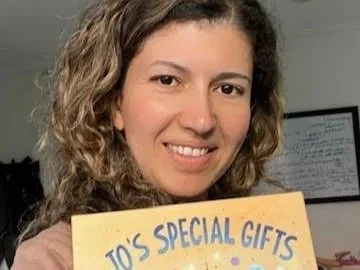
Mariam Shapera with her second book about kids with autism.
A conversation with author Mariam Shapera
By Eemi Toma
Chaldean American physician and mother Dr. Mariam Shapera never set out to write children’s books—but her love of storytelling, combined with her experiences as a parent and physician, inspired her to create stories that celebrate the unique strengths of autistic children. Writing was always something she enjoyed, but her career first took her down a very different path. “As a teenager, I always loved writing fiction and poetry,” she says.
Still, she went on to study medicine, graduating from medical school in the United Kingdom before eventually moving to the United States. “I then moved to the US, where I completed my family medicine training in Michigan and got married,” she explains. Today, she balances her work as a family physician with raising three children.
Being a mother ultimately inspired her first book. “I have three children, and it was my middle child, Joseph, who is autistic and inspired my first children’s book,” she says. Watching the way he experienced the world led her to think more deeply about how children see and understand things around them.
Her work in medicine has also shaped that perspective. As a physician who sometimes treats younger patients, she has learned to approach children with curiosity rather than assumptions. “As a family physician (who occasionally encounters pediatric patients) and as a mother, I try to see the way children envision the world and also question why they say and do things the way they do,” she explains.
Medical training and motherhood, she says, offer two very different but important insights. “Medical training helps me see how children work, and motherhood helps me understand how children feel.”
Joseph’s interests helped spark the idea behind her first book, Up, Up, You Go Jo!. “My autistic son has special interests in both outer space and music,” she says. She often noticed how much happiness those interests brought him. Over time, the idea for a story began to form. “I combined these two themes and came up with the storyline of the lost music notes for my first book.”
Shapera’s children continue to influence the stories she writes. Although her books have the same inspiration, they take slightly different approaches. “Both of my books were inspired by my autistic son Joseph,” she explains, describing the first as more of a traditional story while the second focuses more directly on autism. “I would call my first book a children’s fiction book and the second a children’s autism book.”
Writing the second book came from something she felt was missing in children’s literature. “I felt there was a huge gap in the children’s book market for books that center on and celebrate autistic children,” she says. Too often, she believes, autism is talked about only in terms of challenges.
“Over the years, autism has been associated with a lot of negativity, and we have done very little to highlight the strengths and qualities of autistic people,” she says. For Shapera, it was crucial for autistic children to be reflected favorably in media. “It is important that autistic children see themselves represented in a positive light through children’s books.”
She also hopes the books help parents better understand their children. “I hope they presume competence in their child and continue to follow their lead,” she says.
For many families, learning to see the world through a child’s perspective can make a meaningful difference. She encourages parents to keep advocating for their children and supporting them as they grow.
Publishing her first book was something she approached cautiously at first. “After I wrote my first story, I was hesitant to get it published,” she says. Her husband encouraged her to take the step. For that book, she worked with a self-publishing company and found the process fairly straightforward.
By the time she began her second book, she decided to take a more hands-on approach, searching independently for an editor and illustrator. It took longer, but she enjoyed being more involved in each stage of the process.
Her experience as a mother has also been shaped by loss. Reflecting on that time, she says, “Stillbirth is something no mother should ever have to go through, but it does happen.”
The experience changed the way she views motherhood and made her more aware of how fragile life can be. It also deepened her empathy for other parents who have experienced similar grief. “Right after my stillbirth, I began to appreciate the smaller things that I see in my children,” she says.
That awareness of everyday moments also shapes the way she thinks about childhood curiosity. “Curiosity is one of the most important qualities in a child because it sparks learning and growth,” she explains. Children who ask questions begin to understand more about the world and about other people. She believes that curiosity can help children grow into adults who are compassionate and understanding.
Reading also played an important role in her own childhood. “I loved growing up reading classic fiction novels, especially Jane Austen,” she says. After becoming a parent herself, she began paying closer attention to children’s authors. Writers like Mo Willems and Julia Donaldson stand out to her because of their humor and imagination, qualities that connect naturally with the way children think.
Balancing writing with medicine and family life can be challenging. “It’s not easy, that’s for sure!” she admits. She works part-time as a physician, and most of her writing happens late in the evening once her children are asleep. When an idea comes to mind, she has learned to write it down immediately so it doesn’t disappear.
Despite the busy schedule, writing has become something that brings her closer to the children around her. “Honestly, it’s the fact that it brings me closer to my children and other children,” she says. Watching how children think continues to shape both her stories and her outlook. “I believe we have just as much to learn from children as they have to learn from us.”
One response to her work stands out as especially meaningful. A parent once shared that she used Shapera’s second book, Jo’s Special Gifts, to explain autism to her daughter. The child immediately recognized herself in the character Jo, which opened the door to conversations about identity and understanding.
For Shapera, moments like that confirm the purpose behind her work: helping children recognize themselves in stories and reminding families that every child deserves to feel seen.