
Sisters of the Most Sacred Heart of Jesus
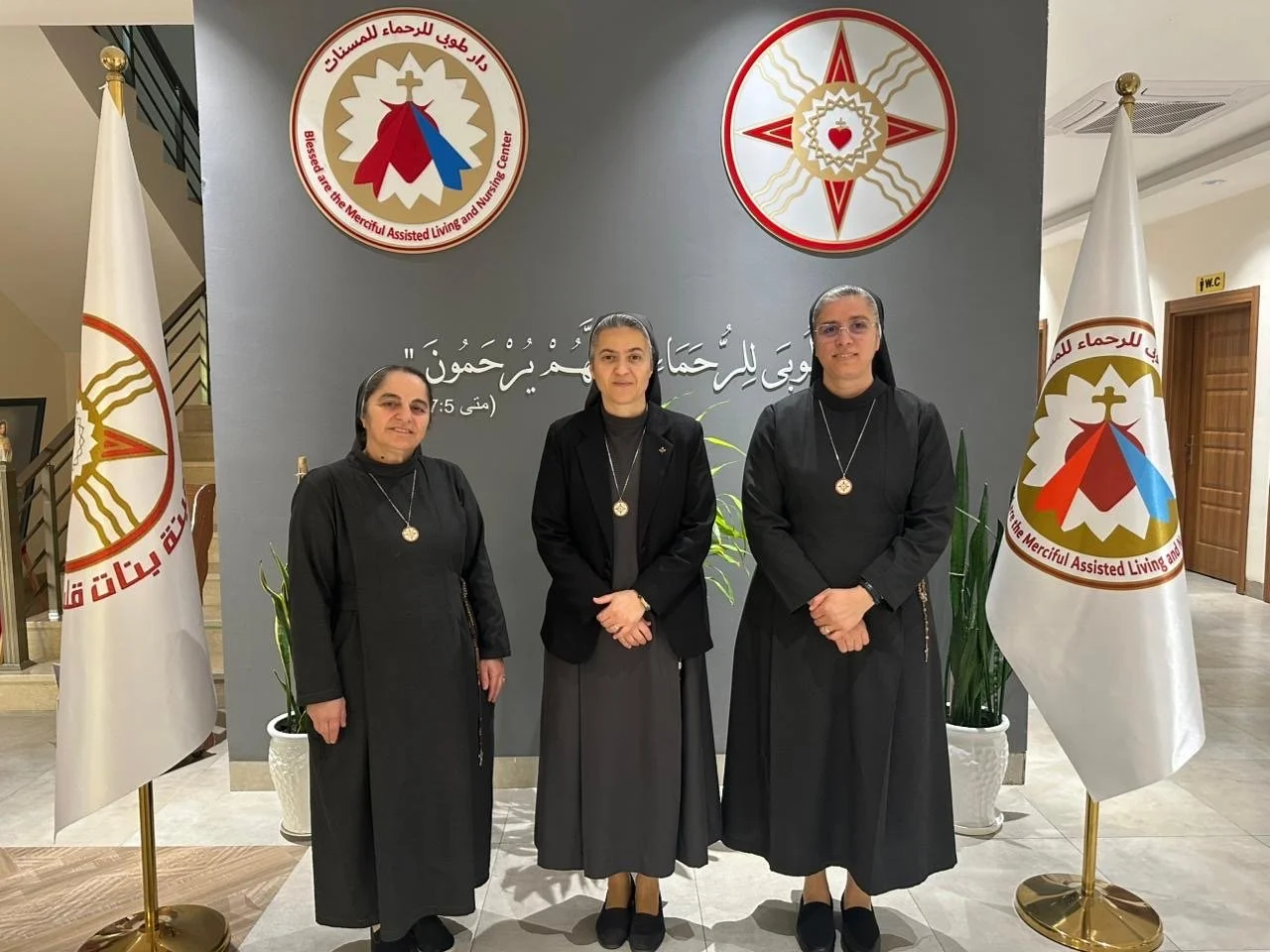
Sister Samar Kamil Mikha, head of the order, in center, with sisters flanking.
More than a century of service and sacrifice in the heart of Iraq
By Hanan Qia
The Congregation of the Daughters of the Most Sacred Heart of Jesus is one of the Chaldean women’s religious communities in Iraq. Founded and rooted in the country, it has carried out an uninterrupted mission of service for decades despite wars, displacement, and profound loss.
I met with Sister Samar Kamil Mikha, the Superior General of the congregation, and she answered my questions clearly about the history of this institution, its challenges, and its aspirations.
The congregation was officially founded on Aug. 15, 1911, in the village of Araden in northern Iraq by Father Abd al-Ahad Rais, under Bishop Francis Dawud, under the name “Congregation of the Daughters of the Most Sacred Heart of Jesus.” From the start, its path was marked by hardship—World War I broke out in 1914 while the sisters were in the midst of their service, visiting the sick, guiding women, and helping the poor, relying on simple handicrafts and the generosity of benefactors for their livelihood.
The founder himself paid a heavy price, dying in 1916 from typhoid fever contracted while performing priestly services for the sick. The challenges did not stop there; waves of displacement continued decade after decade, the last of which was what ISIS committed in Mosul—expelling its Christians, closing its churches and monasteries, and demolishing them.
In 1998, the religious constitution was renewed in light of the Second Vatican Council, and the congregation transitioned from episcopal to patriarchal jurisdiction on May 26 of that year, entering a new phase in broader harmony with others working in the Church.
The charism upon which the congregation was founded from its very first day was born of deep spiritual inspiration, drawing from the mission of Saint Margaret Mary Alacoque, who inspired the founder Father Abd al-Ahad in building this institution. He focused on the pierced side of Jesus, making the congregation’s first duty to make the Most Sacred Heart of Jesus known and to plant His love in all hearts, coupled with devotion to the Holy Eucharist and evangelical simplicity in embodying Christ’s humility and the gentleness of His heart.
This mission has been expressed across a wide range of ministries, shaped from the beginning by an openness to the needs of Iraqi society.
In pastoral service, the sisters took on Christian education, managing confraternities and choirs and home visits to families. In the educational field, the congregation managed kindergartens, schools, institutes, and even colleges — such as the Babel College of Theology, which the congregation managed for many years and continues to serve to this day.
Social service extended to guiding mothers and women in child-rearing and family management. Alongside this, the sisters practiced handicrafts such as sewing, embroidery, organizing spiritual retreats, and responding to the everyday needs of the Church and the faithful.
The congregation has an emblem presented to a sister when she makes her simple vows. Rendered in red and white, it carries a series of layered spiritual symbols.
At its center is the Most Sacred Heart of Jesus with the flame of love surrounded by the Cross of the Resurrection, signifying unconquerable love. The heart is encircled by a crown of thorns as a reminder of the suffering Jesus, with a call to each sister to strive to replace that crown with a wreath of roses of love.
The white circle surrounding the heart symbolizes the congregation itself as the closest to His heart and striving to follow His teachings. The red Babylonian star affirms that this mission originates from Iraq; a symbol of witness through both word and life, a witness every Daughter of the Sacred Heart must embody.
Rays extend from the emblem in all four directions, expressing a mission that aspires to reach every corner of the earth.
Perhaps what best captures the spirit of this congregation is the story of Sister Cecilia Mushi Hanna.
She was born in the village of Bibozi, one of the predominantly Chaldean Christian villages on the slopes of the Kurdistan mountains belonging to the Diocese of Amadiya. She made her simple vows on Dec. 12, 1948, taking the name Cecilia in honor of the Italian martyr, then made her perpetual vows on August 15, 2000, and later professed her perpetual vows on Aug. 15, 2000, as part of the first group of sisters in the congregation to do so.
She lived faithfully as a simple nun, taking on the responsibility of several monasteries until she became Superior General of the congregation. Her journey ended in martyrdom on the night of Aug. 15–16, 2002, at the “Monastery of Love” on Palestine Street in Baghdad, at the hands of a group of extremists.
On Oct. 10, 2018, the Vatican’s Dicastery for the Causes of Saints declared her a “Servant of God,” advancing her cause for sainthood.
The congregation marks its heritage through annual celebrations that anchor its spiritual life. Each June, it observes the Feast of the Sacred Heart. On Aug. 15, it commemorates its founding in Araden. On Aug. 16, it remembers the martyrdom of Sister Cecilia, and on Feb. 16, it recalls the death of its founder, Father Abd al-Ahad Rais.
Today, the congregation continues its mission with 21 sisters in perpetual vows and one postulant, serving in monasteries in Ankawa, Mangesh, Araden, and Baghdad. It also maintains a presence in France (Sarcelles) and Canada under the name “Mission of the Servant of God Sister Cecilia Mushi Hanna.”
Although the Monastery of Al-Nassar in Mosul and the Monastery of Love in Baghdad were abandoned, the congregation continues its work through active ministries, including the “House of the Child” in Ankawa, “Dar Tuba for the Merciful,” a home for elderly women in Dohuk, and liturgical workshops in Ankawa and Baghdad.
At the close of the interview, Sister Samar said, “Continuing this journey that has surpassed 100 years is a great trust and responsibility.” She extended an open invitation through the magazine: “Our doors and hearts are open to every young woman who sees in herself a spirit of service and wishes to dedicate her life to the Most Sacred Heart of Jesus. Belonging to this congregation is a call to love and sacrifice for others — a journey we live together as one family to be witnesses of hope in our land.”
Contact the Congregation
General Monastery: Sacred Heart Monastery, Kariz 415, next to
Mar Eilia Church, Ankawa, Erbil
P.O. Box: 54/981, Ankawa, Erbil
Email: fscg.iraq19@gmail.com
Phone: +964 750 745 8196
Website: https://www.d-sacredheart.com
Facebook: https://www.facebook.com/dsacredheart.official