
Historic Recognition
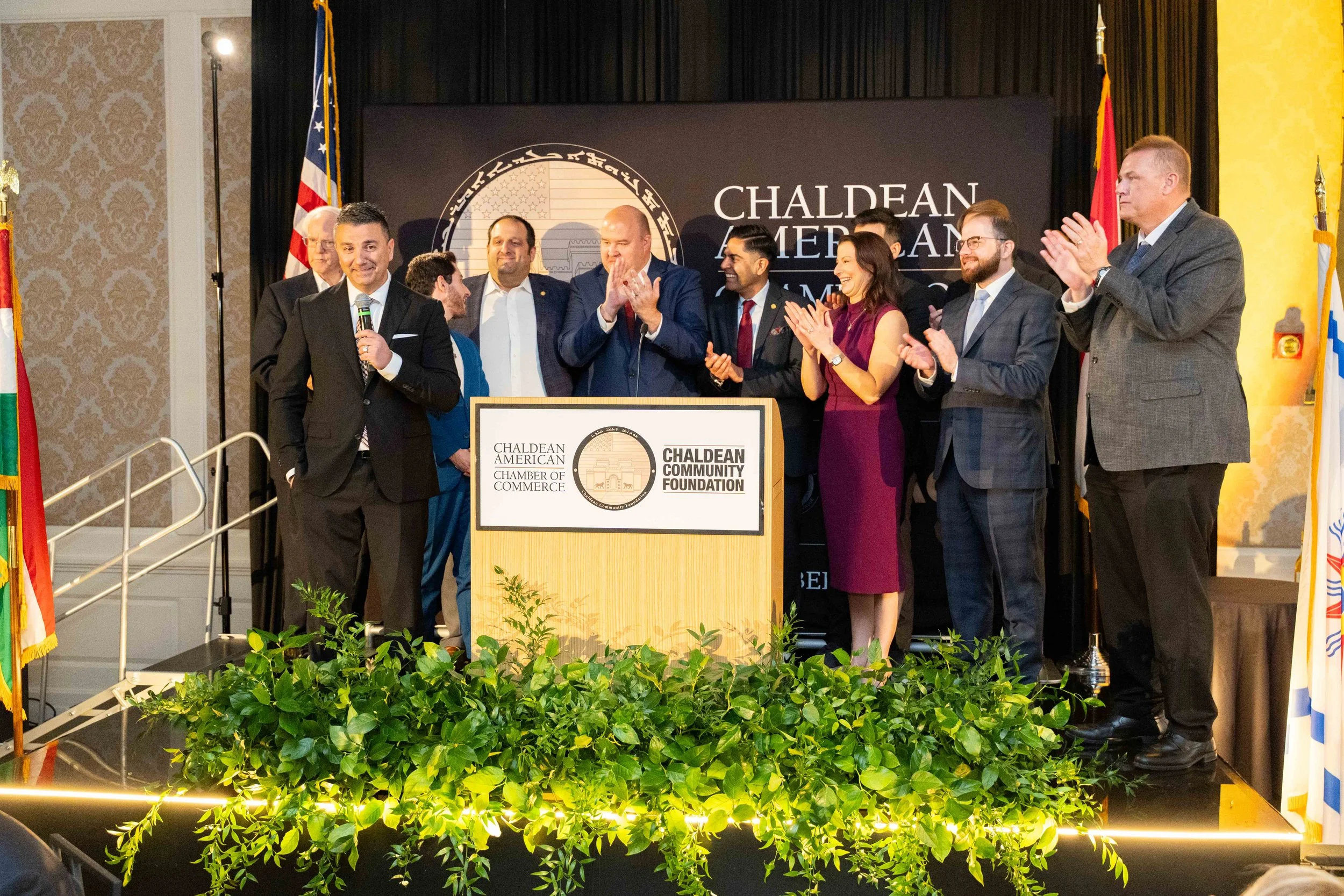
State legislators joined CACC president Martin Manna on stage for the announcement at the Annual Awards Dinner.
Michigan establishes Chaldean American Month
By Sarah Kittle
Beginning in 2026, the month of May will officially be recognized as Chaldean American Month across Michigan, marking a historic acknowledgment of the cultural, economic, and civic contributions of Chaldean Americans throughout the state.
The announcement came during a defining moment for the community. At the 23rd Annual Awards Dinner hosted by the Chaldean American Chamber of Commerce (CACC) in April, President Martin Manna brought state legislators to the stage to share the news, turning a celebratory evening into an historic milestone.
The designation comes through House Bill 4303, introduced during the 103rd Michigan Legislature. The bipartisan legislation—sponsored by State Representatives Tom Kuhn, Ron Robinson, Joseph Aragona, Matthew Bierlein, Donni Steele, Alicia St. Germaine, Douglas Wozniak, Steve Frisbie, Gregory Markkanen, and Luke Meerman—received broad support in the Michigan House, passing overwhelmingly before advancing through the legislative process.
This achievement did not happen overnight. Over the past several years, the Chaldean American Chamber of Commerce worked closely with state legislators to champion the effort, helping bring House Bill 4303 across the finish line with strong bipartisan support. The Chamber played a critical role in advocating for formal recognition—building relationships, raising awareness, and ensuring that the voices of Chaldean Americans were heard throughout the legislative process.
At its core, the legislation recognizes Chaldean Americans as one of Michigan’s most influential immigrant communities, with deep roots in entrepreneurship, faith-based community building, and public service. Home to one of the largest Chaldean populations outside of Iraq, the state of Michigan has become a central hub for Chaldean life in the diaspora.
The new law also marks an important shift. In recent years, Chaldean American Month had traditionally been recognized in April through annual proclamations by Governor Gretchen Whitmer, including in 2022, 2023, and 2026. While those proclamations were meaningful, they were temporary and required renewal each year. House Bill 4303 formalizes the recognition in state law and permanently designates the month of May, ensuring consistency, longevity, and a place in Michigan’s official civic calendar.
Supporters emphasize that Chaldean Americans have played a vital role in shaping Michigan’s economic landscape, especially through small business ownership, family enterprises, and contributions to the retail, food, and service industries. With nearly 60 percent of Chaldean households in Michigan owning at least one business, the community’s entrepreneurial influence is both visible and measurable.
Organizations like the Chaldean American Chamber of Commerce have been instrumental in that success. For decades, the Chamber has supported business owners by providing resources, advocacy, networking opportunities, and guidance to help entrepreneurs start, grow, and sustain their businesses. From navigating regulatory challenges to fostering connections between business leaders and policymakers, the Chamber has served as a backbone for economic growth within the community. Its work has helped transform small, family-run operations into thriving enterprises that contribute significantly to Michigan’s economy.
Yet the significance of this recognition extends beyond economics. During committee discussions, legislators and advocates stressed the importance of preserving cultural identity and ensuring that future generations understand their heritage. A designated month creates space not only for celebration, but for education—offering schools, institutions, and communities an opportunity to learn about Chaldean history, traditions, and contributions.
This is why state recognition matters.
When a state formally acknowledges a community, it affirms that community’s place within the broader story of the region. It signals that their history is not separate or peripheral, but integral. For Chaldean Americans, many of whom arrived as immigrants or refugees fleeing instability, this recognition represents a deeper sense of belonging. It is a public validation that their resilience, faith, and achievements are part of Michigan’s identity.
The bill itself formally states that May is designated “in recognition of Chaldean, Assyrian, and Syriac Americans, who have made significant and valuable contributions to this state and the United States.” For supporters, the measure is both symbolic and deeply meaningful. It reflects not only pride in what has been accomplished, but confidence in what lies ahead.
Who Are the Chaldeans?
Indigenous to southern Iraq, Chaldeans are an ancient people who endured and remained steadfast in their faith through centuries of hardship and migration. After the fall of Babylon and the rise of successive empires, their ancestors did not disappear; they rebuilt their communities and preserved their identity through language and tradition.
For generations, the Church has been central to Chaldean life, serving not only as a place of worship but as a pillar of education, culture, and unity. Through centuries of upheaval, Chaldeans maintained a direct connection to early Christianity, preserving their Syriac language and ancient liturgical traditions.
The last century brought immense challenges. War, instability, and persecution forced many Chaldean families to leave their ancestral homeland. In response, a global diaspora emerged—one that carried forward a shared identity rooted in faith, family, and resilience.
In the United States, Michigan became one of the most important centers of Chaldean life. Early immigrants, many arriving with limited resources, built livelihoods through determination and hard work. Small businesses, particularly grocery stores and family-run enterprises, became a defining feature of the community’s presence.
As in the past, the Church and community institutions remained anchors, helping families navigate a new country while preserving their heritage. Chaldeans in Michigan learned to balance two identities—proudly American while deeply connected to their roots.
Today, with the enactment of House Bill 4303, that journey is formally recognized.
Chaldean American Month is more than a designation; it is a lasting acknowledgment of a community that has helped shape Michigan’s economic and cultural fabric. Each May will now serve as a reminder of the Chaldean story: one of perseverance, contribution, and enduring identity.