
Speaking Their Heritage
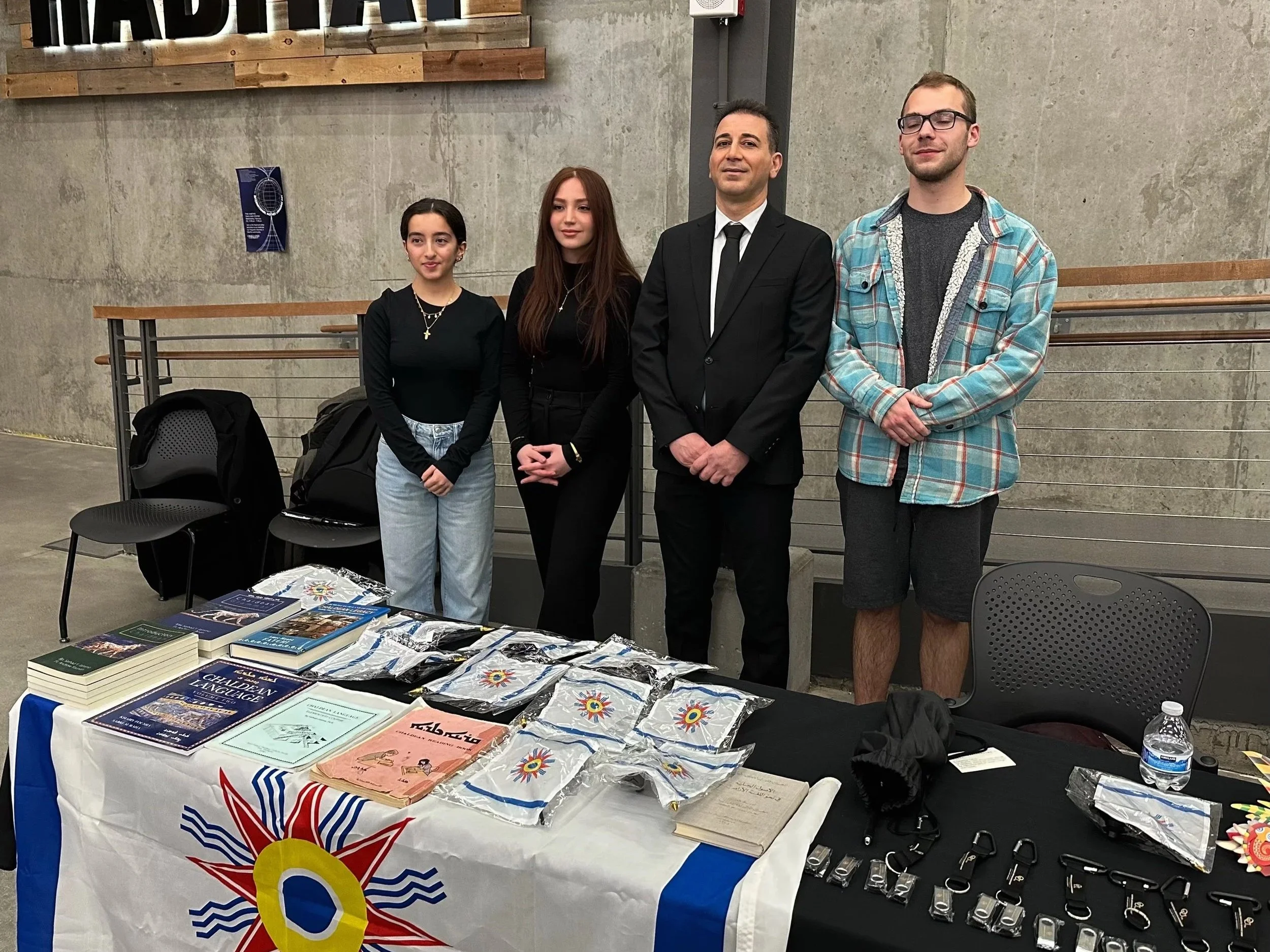
Hannawi (in suit) with OU reps behind a display table.
First Chaldean language cohort graduates at OU
By Weam Namou
On Friday, Apr. 17, 2026, at 6:00 p.m., Oakland University hosted the graduation ceremony for the Chaldean Language Workshop in The Habitat at the Oakland Center. Thirteen students completed the introductory and intermediate levels of Chaldean, receiving certificates of completion. This marked an achievement that was both academic and deeply cultural.
A Vision That Sparked a Movement
The Workshop was founded by Stephen Hannawi, a Master of Science in Artificial Intelligence graduate student at Oakland University. His passion for preserving the Chaldean language has grown into a campus-wide and community-driven initiative.
In recognition of his leadership, the Office for Student Involvement presented Hannawi with a Certificate of Honor at its 48th Annual Student Activities and Leadership Awards, acknowledging him as Outstanding New Student Organization President. The certificate was awarded two days before the ceremony, on behalf of the Office for Student Involvement staff.
“You’re so important for the survival of the language,” Hannawi told his students. “You took this class and not even for credit. You came despite your busy schedules… You are part of the revival movement. You will take this and share it with your relatives and others. This is a community project. It’s not just about me. I’m nobody. It’s about the language.”
Hannawi often speaks about the profound historical legacy of the Chaldean people—from writing on clay tablets to contributing to mathematics, astronomy, and law. “The loss of Babylon was not just a loss for Chaldeans but for the whole world,” he said. “When we lose sovereignty, someone else replaces your culture.”
For Hannawi, the language is not only historical, it is sacred. “Jesus spoke it and He chose it from over 7,000 languages. My belief is that He will never let it disappear.”
He reflected emotionally on the uprooting of his hometown, Telkeppe. “It has been painful. My Chaldean town no longer exists. This country gave me more rights than my native country, where we have a history of 10,000 years.”
Now, he says, the responsibility rests with the next generation: “We are relying on you to pass it to the next generation so the language does not die.”
Language as Identity and Action
Brandy A. Randall, Ph.D., Dean of the Graduate School and Professor of Psychology at Oakland University, praised the students and the movement they are building.
“It takes somebody to start something,” she said in response to Hannawi’s humble attitude. “It takes everyone else to lift that initiative and create the momentum and keep it going.”
Randall emphasized that language is foundational to human experience: “Language is a central part of being human, a tool for communication. Language carries culture, it preserves heritage and it affects how we see the world.”
Chaldean is considered an endangered language. But the Workshop demonstrates that preservation is possible—and it’s already making a difference.
Several students are using what they have learned to help Chaldean-speaking patients communicate with English-speaking doctors. In clinics and medical offices, language is removing barriers, building trust, and improving lives.
The Science of Saving a Language
Professor Jason Overfelt, Associate Professor of Linguistics at Oakland University, highlighted both the urgency and hope surrounding endangered languages.
“It only takes one generation for a language to go extinct,” he said. Of the approximately 7,150 languages spoken worldwide, survival depends on transmission. “They have to be acquired by children.”
But extinction is not inevitable.
“Revitalization is a possibility,” Overfelt explained. “There are methods and best practices… we can keep languages alive, resuscitate them.”
He emphasized the simplicity and power of preservation.
“The most important and crucial thing that we can do for a child is just use the language around them,” he said.
He described language being a cornerstone piece of the culture, something worth fighting for, worth saving.
“If it survives,” he added, “it will be a community effort. So advocate for the language everywhere. Use it everywhere. Languages can be brought in, but it’s harder to revive than it is to preserve it.”
Students Carrying the Torch
The true heart of the Workshop lies with its students.
Rotana Sabri shared how, for her, the program built more than language skills.
“We wanted to be more part of OU, and Stephen recruited us because he was very passionate about the language,” she said. “He chose to highlight his students and have us shine. It shows how selfless he is. We really grew as a community.”
Sarah Kenetha, Vice President of the Workshop, recalled how it began informally as a small group. “We saw Stephen in the library… we learned it’s Chaldean, Jesus’ language. We waited to learn more. Word spread. The club became famous and popular.”
Today, she applies what she has learned in her work at a medical clinic, helping patients navigate care.
Rosemary Rais, already fluent in Chaldean, joined to learn reading and writing. “My mom always spoke it at home and my dad spoke English. Learning how to read and write was an opportunity and it was very special.”
Joseph Dallal said the experience has been an amazing opportunity—one he never knew was possible—and one he and his family are grateful to see come to life.
Mariam Jaoo said she loves how the language has connected her more deeply to her Chaldean culture and shared that, despite starting as a small class, “we grew quickly to where we are today and achieved our goal.”
Nicholas Saffo, a mathematics student, said he was recruited as well. Despite schedule conflicts, he stayed committed. “I knew more Arabic… but now I’ll be sharing Chaldean with family.”
What began as one graduate student’s vision has grown into a revival movement, rooted in history but lived in the present.
From ancient clay tablets to modern classrooms, from Babylon to Michigan, the Chaldean language continues its journey.
And on Apr. 17, 2026, at Oakland University, that journey was celebrated, not as a relic of the past, but as a living language carried forward by a new generation.