
Making Our Mark
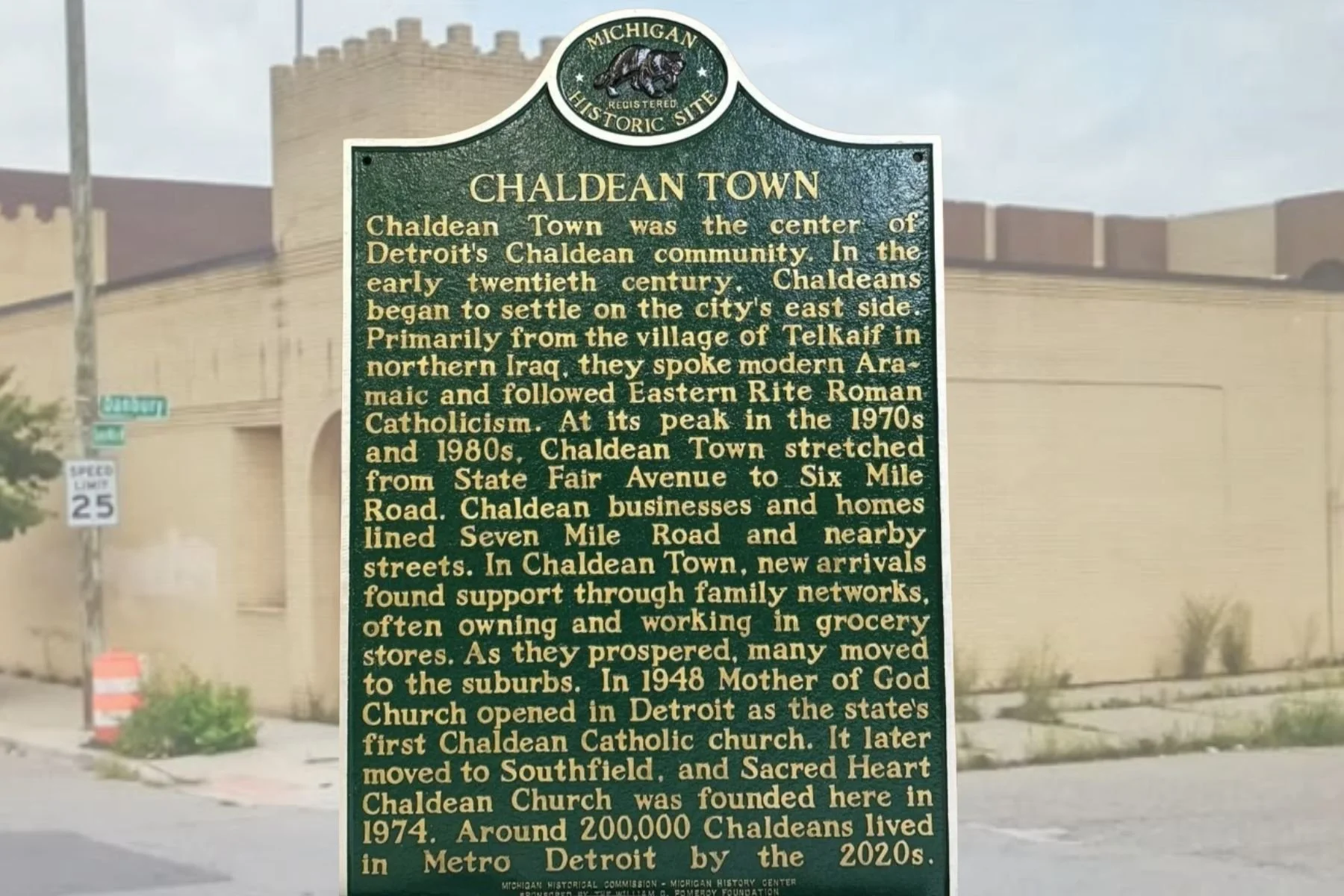
Tens of thousands of Chaldeans passed through or lived in Chaldean Town, building businesses, raising families, and establishing institutions that would later expand across southeast Michigan.
Chaldean Town historic marker erected in Detroit
By Adhid Miri, PhD
Across Michigan, green historical markers line roadsides, neighborhoods, and public spaces. They are quiet but powerful reminders of the people and places that shaped the state. Each one represents more than a moment in history; it reflects a deliberate, research-driven effort to ensure that Michigan’s diverse stories are recognized, preserved, and made visible to the public.
In May 2026, a new marker joins this landscape, formally recognizing a stretch of 7 Mile Road in Detroit as “Chaldean Town.” This designation is more than symbolic. It affirms the historical, cultural, and economic impact of a community whose story has long been central to Detroit yet often underrepresented in official narratives.
The effort to establish the Chaldean Town marker began in January 2024 with the formation of a Community Advisory Board, following a 2023 grant awarded to the City of Detroit to document Arab and Chaldean histories. The board, composed of historians, community leaders, and representatives from the Michigan History Center, was tasked with identifying historic sites and shaping how these communities would be publicly remembered.
That work reflects a broader truth: history is not just what is remembered privately, but what is recognized publicly. A state marker transforms community experience into permanent record.
The Roots of Chaldean Town
Chaldean immigration to the Detroit area began in earnest in the early 20th century, with many arriving in search of economic opportunity and religious freedom. The city had an established Middle Eastern community during this period, consisting primarily of Christian immigrants from Lebanon and Syria.
Drawn by the promise of jobs in the growing automobile industry, families—many from the village of Tel-Keppe in Iraq, settled in neighborhoods along 7 Mile Road near Woodward Avenue.
Through a process of chain migration, the community grew rapidly. By the mid-20th century, this area had become a dense and vibrant enclave, where homes, businesses, churches, and social spaces were closely intertwined. Small grocery stores, bakeries, restaurants, and coffeehouses, most often family-owned, formed the backbone of a thriving local economy.
Many settled in the Penrose neighborhood, which flanks 7 Mile between Woodward and John R. Here some streets had homes so old that they didn’t have driveways because they were built before cars were invented. The crowded housing meant a life intertwined with the neighbors. Many were already family; the whole community was right within reach.
By the 1970s and 1980s, Chaldean Town had become a central hub for newly arrived immigrants. For many, it was their first stop in America and a place where language, culture, and community offered a bridge into a new life.
At its peak, Chaldean Town was more than a neighborhood. It was an anchor of identity. Tens of thousands of Chaldeans passed through or lived in the area, building businesses, raising families, and establishing institutions that would later expand across southeast Michigan.
Over time, as economic success enabled mobility, many families moved to suburban communities. Like many historic urban enclaves, Chaldean Town experienced decline in the late 20th century due to broader economic shifts, population loss, and disinvestment.
Yet even as the physical landscape changed, its legacy endured, carried by the generations who began their American journey there. A Google map search in 2026 still shows the Chaldean Town area.
This Marker Matters
The designation of Chaldean Town as an official historical site is a critical step in preserving that legacy.
Historical markers serve as public acknowledgment, validating that a community’s story is not only meaningful, but essential to the broader history of the state. For the Chaldean community, this recognition ensures that their contributions are no longer confined to memory but embedded in Michigan’s historical record.
It also restores visibility to a place that, while physically diminished, remains deeply significant. Where storefronts may now be vacant, the marker stands as a reminder of what once was and what it made possible.
Michigan’s Historical Marker Program, established in 1955, relies on rigorous research and community initiative. Markers are not easily granted; they require documentation, verification, and careful interpretation. The fact that Chaldean Town has met these standards underscores its historical importance.
More importantly, the marker ensures that future generations—whether Chaldean or not—will encounter this history in the landscape itself. It transforms a stretch of road into a site of learning, reflection, and recognition.
Chaldean Town is no longer just a memory passed down through families. It is now a recognized chapter in Michigan’s shared heritage.
And that recognition matters.
Many people were a part of the effort to make this marker happen. The driving force behind the project were: Rebecca Binno Savage, Ian Tomashik, and Kelsey Mass with the Historic Advisory Board; and Stephanie Arwady and Michelle Davis from the Michigan History Center. The Chaldean members of the advisory board (besides Rebecca Binno Savage) were Crystal Jabiro, Zina Lumelsky, Dr. Adhid Miri, Weam Namou, and Mary Romaya. The Chaldean community is indebted to them all.