
Fortunes, Future, and Fate
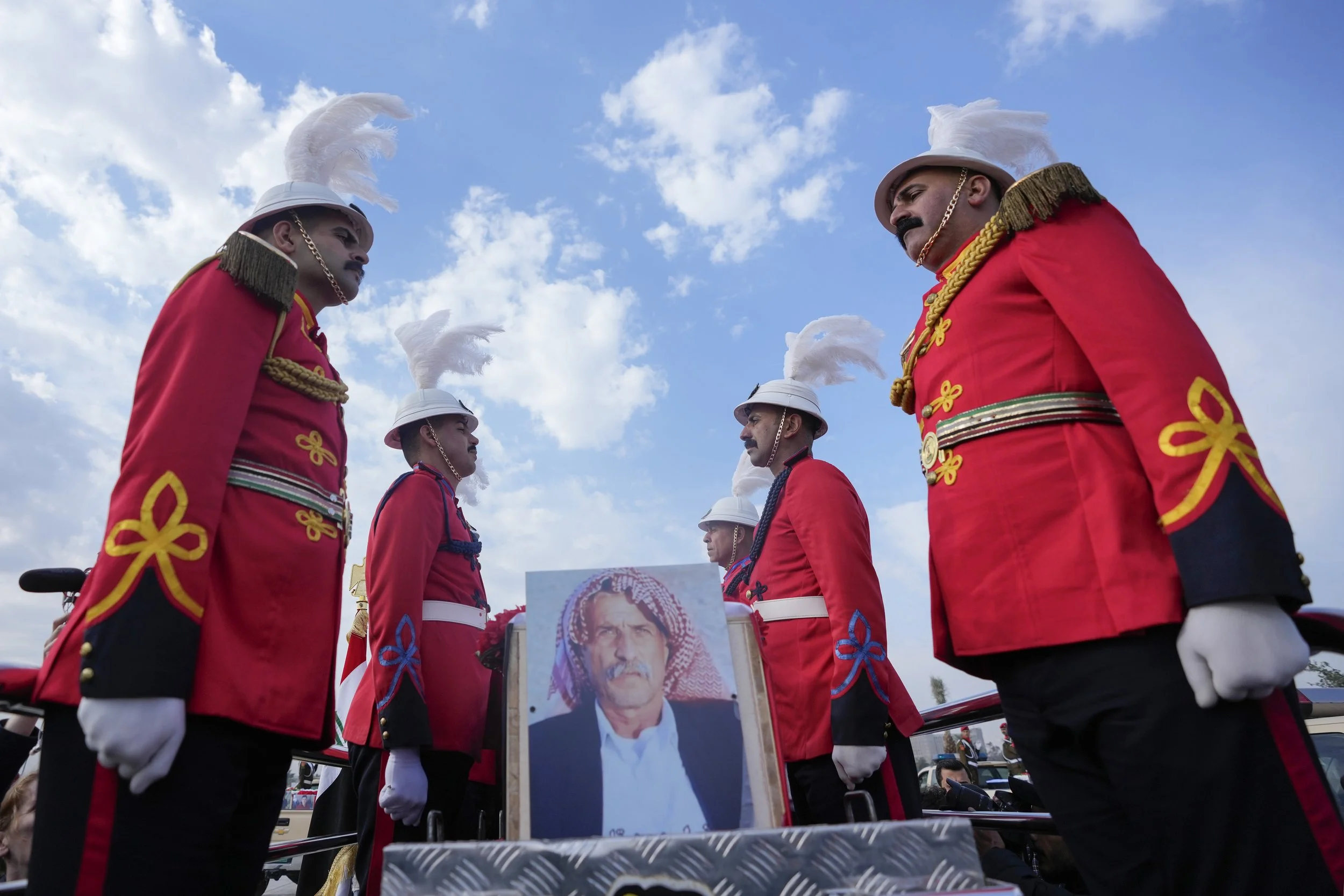
Yazidi victims of Islamic State militants, exhumed from a mass grave in Sinjar, are carried during a 2024 funeral ceremony in Baghdad, Iraq. Photo by Hadi Mizban / AP
Iraqi minorities face an uncertain environment
By Adhid Miri, PhD
Iraq is a land of profound religious, ethnic, and sectarian diversity—a place where some of the world’s oldest faiths first emerged, where civilizations flourished for millennia, and where communities coexisted long before the formation of the modern nation-state. From the plains of Mesopotamia to the mountains of the north, Iraq’s mosaic of peoples has shaped the country’s culture, language, traditions, and identity for centuries.
Yet today, many of Iraq’s minority communities face uncertainty about their future. Decades of war, political instability, extremism, displacement, and emigration have dramatically altered the demographic and cultural landscape of the country. Communities that once thrived now struggle to preserve their presence, traditions, and identity in their ancestral homeland.
Under United Nations classifications, these groups are identified as “minorities,” though many are indigenous peoples whose roots in Iraq stretch back thousands of years. Others arrived later as settler populations but became woven into the fabric of Iraqi society over generations. Together, alongside Iraq’s broader population, they have played a vital role in shaping the modern Iraqi state.
This article explores the fortunes, future, and fate of Iraq’s minority groups, examining both their historical experiences and the contemporary challenges they continue to face.
Early History
Iraq has long stood at the crossroads of empires, civilizations, and political transformation. Throughout its history, the region has been ruled by numerous powers, including the Babylonians, Hittites, Kassites, Chaldeans, Greeks, Romans, Persians, and, beginning in the early seventh century, Muslim Arab forces.
The Islamic conquest, completed around 650 A.D., dramatically reshaped the region’s religious and cultural landscape. Soon afterward, a major division emerged within the Muslim community. Those who supported Ali—the cousin and son-in-law of the Prophet Muhammad—as his rightful successor became known as Shi’a Muslims, while those who rejected his leadership formed what later became the Sunni tradition. This historic schism continues to influence Iraq’s political and social dynamics to this day.
From 1534 until the end of World War I, Iraq remained under the rule of the Ottoman Empire. Following the empire’s collapse, Britain assumed control under the 1920 San Remo Agreement and established a mandate over Iraq. In an effort to stabilize relations among the country’s diverse communities, the British installed King Faisal I, a descendant of the Prophet Muhammad, as ruler of the newly formed Iraqi state.
On July 14, 1958, Iraq’s monarchy was overthrown in a military coup that established a republican government. The decades that followed were marked by continued political instability and successive coups. In 1963, Arab nationalists seized power, and in 1968 the Ba’ath Arab Socialist Party assumed control of the government.
Although interim constitutions were adopted in 1968 and 1970, meaningful democratic institutions and constitutional restraints on the regime never fully developed. Ba’athist rule continued for decades under increasingly authoritarian leadership, culminating in the regime of Saddam Hussein. The Ba’ath government ultimately collapsed following the 2003 U.S.-led invasion of Iraq.
Iraq Today
Modern Iraq is a complex mosaic of ethnic and religious identities. While Arabs and Kurds make up the majority of the population, the country is also home to numerous minority communities, including Turkmen, Chaldeans, Assyrians, Syriacs, Armenians, Sabean-Mandaeans, Shabak, Yazidis, Zoroastrians, Bahá’ís, and Kakai.
As of 2025, Iraq’s population is estimated at approximately 47 million people. The country is predominantly Muslim and divided primarily between Shi’a and Sunni communities, alongside smaller religious minorities. Current estimates suggest that roughly 60–65% of Iraqis are Shi’a Muslims and 32–37% are Sunni Muslims, though precise demographic data remains uncertain due to the lack of recent census information and the political sensitivities surrounding population statistics.
Before the rise of ISIS, Iraq was home to an estimated 1.5 million Christians—including Chaldeans, Assyrians, and Syriacs—along with approximately 600,000 Yazidis, 200,000 Kakai, 70,000 Sabean Mandaeans, 20,000 Armenians, and a small Bahá’í community. Ethnically, Arabs account for roughly 75–80% of Iraq’s population, while Kurds comprise an additional 15–20%. Some minority groups identify as distinct ethnic communities, while others consider themselves connected to the broader Kurdish population.
Human Rights Challenges
Iraq’s minority populations have long faced political, cultural, and social pressures, including campaigns of forced Arabization and Kurdification in disputed territories. Although the 2005 Iraqi Constitution guarantees certain protections and rights, many minority communities continue to report inadequate security, political underrepresentation, and limited access to education in their native languages.
Human rights concerns remain widespread. Insecurity, displacement, unresolved property disputes, and economic marginalization continue to affect many minority communities. Thousands remain unable to return to their ancestral homes due to destroyed infrastructure, occupied property, or ongoing instability in contested regions.
Reports from international human rights organizations have also documented discrimination, obstacles in obtaining civil identification documents, and exclusion from full participation in public life. For many minorities, these challenges have contributed to continued emigration and concerns about the long-term survival of their communities within Iraq.
Lack of Religious Freedom
Islam is the official religion of Iraq, and the constitution guarantees freedom of religious belief and practice for Muslims, Christians, Yazidis, and Sabean Mandaeans. However, these protections do not fully extend to followers of all religious traditions.
The constitution defines Islam as both the state religion and a “foundational source” of legislation, prohibiting the enactment of laws that contradict the “established provisions of Islam.” At the same time, it states that no law may violate democratic principles or the rights and freedoms guaranteed by the constitution.
The constitution also explicitly protects the “Islamic identity” of the Iraqi people. In personal status matters—including marriage, divorce, child custody, inheritance, and charitable endowments—Islamic law takes precedence whenever one of the parties belongs to a faith not officially recognized by the state. When disputes involve only non-Muslims, civil courts are required to consult the appropriate religious authorities and apply the relevant religious laws of that community.
In addition to the faiths recognized by Iraq’s federal government, the Kurdistan Regional Government (KRG) officially recognizes the Bahá’í, Jewish, Kaka’i, and Zoroastrian religions.
Iraq’s civil status laws also reflect religious restrictions. Women identified as non-Muslim in official documents may marry Muslim men, but Muslim women are prohibited from marrying non-Muslim men. Muslim men may marry non-Muslim women only if the women belong to the Christian, Jewish, or Sabean Mandaean faiths.
Additional economic pressures have also affected minority communities. The 2023 law banning the possession and sale of alcohol significantly impacted the livelihoods of many Christian, Yazidi, and Sabean Mandaean merchants, who have historically worked within the alcohol trade.
Squeezing Vulnerable Minorities
Historically, Iraq was celebrated for its remarkable religious and sectarian diversity—much like India in the ancient world or the United States in the modern era. For centuries, the region served as a homeland for some of the world’s oldest religions and belief systems, including Christianity, Judaism, Mandaeism, Islam, Yazidism, Kaka’i traditions, Zoroastrianism, Naqshbandi Sufism, and the Bahá’í faith.
Its many communities—including Chaldeans, Assyrians, Syriacs, Armenians, Sunni and Shi’a Muslim Arabs, Shabak, Kurds, and Faili Kurds—coexisted across generations and contributed significantly to Iraq’s cultural, intellectual, and historical identity.
Some of these communities are indigenous peoples whose ancestry reaches back to the earliest civilizations of Mesopotamia. Others arrived later as migrant or settler populations and gradually became woven into the social fabric of Iraqi society. Together, they played an essential role in shaping the modern Iraqi state and preserving the country’s rich civilizational heritage.
The Christians: Chaldeans, Assyrians, and Syriacs
Iraq’s Christians—Chaldeans, Assyrians, and Syriacs—trace their roots to the ancient civilizations of Mesopotamia and were once the majority population in Iraq and Persia before the rise of Islam. Over centuries, they endured persecution under various empires, including massacres such as the 1915 Sayfo Genocide, the 1933 Simele Massacre, the 1969 Sorya Massacre, and most recently the atrocities committed by ISIS in Mosul and the Nineveh Plains. Once numbering more than 1.5 million, Iraq’s Christian population has declined to fewer than 125,000, primarily living in Baghdad, the Nineveh Plains, Erbil, and Duhok.
The Yazidis
The Yazidis are an ancient indigenous religious community centered in northern Iraq, particularly around Lalish, their holiest site. Their faith blends elements of older Mesopotamian traditions, Zoroastrianism, Christianity, and Islam, with Melek Tawus, the Peacock Angel, at the center of their beliefs. Yazidis have endured centuries of persecution, culminating in the 2014 ISIS genocide in Sinjar and the Nineveh region. Today, many remain displaced, though communities continue to exist in Sinjar, Shekhan, Duhok, and surrounding areas.
The Mandaeans
The Mandaeans, also known as Sabians, are the world’s last surviving Gnostic religion and have lived for centuries along the Tigris and Euphrates rivers. Their faith centers on monotheism, spiritual knowledge, and repeated baptism in flowing water. They revere John the Baptist as their greatest prophet and preserve their teachings in the sacred text Kanza Rba. Once numbering around 70,000 in Iraq, most Mandaeans fled after 2003, with many now living in Sweden, Australia, and the United States.
The Armenians
Armenians have lived in Iraq for centuries, with communities established in Basra, Baghdad, Mosul, and Kirkuk. Many fled to Iraq during the 1915 Armenian Genocide under the Ottoman Empire. Despite their relatively small numbers today—estimated at around 3,000—Armenians have made important contributions to Iraqi society in commerce, medicine, engineering, and the arts. Most now live in Erbil, Duhok, and Zakho.
The Zoroastrians
Zoroastrianism, one of the world’s oldest monotheistic religions, predates both Christianity and Islam. Its teachings emphasize “Good Thoughts, Good Words, Good Deeds.” Many Kurdish Zoroastrians preserved their faith quietly for generations until the Kurdistan Regional Government officially recognized the religion in 2015. Today, Zoroastrian communities and temples operate openly in Erbil and Sulaymaniyah.
The Yarsan–Kakai
The Kakai, also known as Yarsan or the “People of the Truth,” are a religious minority concentrated in northern and eastern Iraq. Their faith blends elements of Islam, Zoroastrianism, and ancient Mesopotamian traditions and is largely passed down orally. For years, they have faced persecution from extremist groups such as ISIS and al-Qaeda, prompting some communities to form self-defense groups to protect their villages and identity.
The Bahá’ís
The Bahá’í Faith has historical ties to Iraq through Bahá’u’lláh, the religion’s founder, who lived in the Sulaymaniyah region during his exile. While the faith remains restricted under Iraqi federal law, Bahá’ís are officially recognized in the Kurdistan Region, where they are able to practice openly and celebrate religious holidays.
The Jewish Community
Jewish communities lived in Iraq for more than 2,500 years and once played a major role in the country’s cultural and economic life. Cities such as Baghdad and Basra were home to thriving Jewish populations before mass emigration in the mid-20th century.
Today, those echoes are fading. According to unofficial estimates from the KRG Ministry of Endowments and Religious Affairs, only 100 to 250 Jewish individuals remain in the Kurdistan Region, and none in Baghdad or Iraq’s other provinces. They do not worship publicly. Many do not reveal their identity, fearing discrimination or violence from extremist actors. Their presence is quiet, almost invisible—a reminder of a community that once shaped the cultural and economic life of Iraq. Their survival is an act of courage.
Fractured National Identity
Iraq’s national identity remains deeply fractured, shaped by competing religious, ethnic, and political narratives. Sunni, Shi’a, and Kurdish visions of Iraq’s past and future often conflict, making national reconciliation difficult and weakening a shared sense of belonging. As a result, many Iraqis place loyalty in tribe, sect, or political faction rather than in the state itself.
Minorities often bear the greatest burden of this instability. Religious extremism, fragile institutions, discrimination, and insecurity continue to fuel fear and uncertainty among vulnerable communities. Despite their deep historical roots and loyalty to Iraq, many minorities have faced repeated violence, displacement, and marginalization.
Since 2003, external influence—particularly from Iran—has further intensified these divisions. Many Iraqis believe growing Iranian political, religious, and militia influence has weakened Iraq’s sovereignty and diluted its national identity. The widespread presence of Iranian political imagery and affiliated armed groups has heightened fears among many citizens of increasing foreign domination over Iraqi public life.
The 2003 U.S.-led invasion also deepened sectarian divisions by institutionalizing a quota-based political system that tied political power to sectarian and ethnic identity. Rather than fostering unity, this system reinforced mistrust and competition among communities.
Iraq’s diversity could have served as the foundation for a strong and inclusive national identity. Instead, decades of conflict, foreign interference, and sectarian politics have deepened social fragmentation. Until Iraq can build a national identity that embraces all of its communities equally, the country will likely continue to struggle with instability, mistrust, and division.
Is There Still a Future for Iraq’s Minorities?
Across the Middle East, minority communities are increasingly asking a painful question: Is there still a future for us here?
For many minorities in Iraq, daily life remains marked by fear, uncertainty, and instability. Religious extremism persists, institutions remain fragile, and Iraq’s national identity continues to be deeply divided. In this environment, minority communities—despite their deep historical roots and loyalty to their homeland—often bear the brunt of violence, displacement, and discrimination.
Christians, in particular, have watched their numbers decline dramatically. Families have sold homes that had belonged to generations of ancestors, leaving behind churches, villages, memories, and centuries of history in search of safety and stability abroad. Each family that leaves represents not only a loss for the Christian community, but also a loss for Iraq’s cultural and historical richness.
This reality has forced many minorities to confront difficult and deeply personal questions:
• What is our future in Iraq?
• Who will protect us from persecution or displacement?
• How can equal rights and genuine religious freedom be guaranteed?
• How can minorities participate politically in ways that serve the common good rather than sectarian interests?
These questions remain largely unanswered. Yet they are essential to Iraq’s future because minorities are not outsiders or temporary guests in the country. They are indigenous communities whose histories are woven into the foundations of Mesopotamian civilization and the modern Iraqi state.
Their languages, traditions, faiths, and cultural heritage continue to enrich Iraq’s identity. Protecting these communities is not simply a humanitarian obligation—it is vital to preserving Iraq’s diversity, stability, and future as a pluralistic society.
Despite decades of hardship, many minorities continue to hold onto hope: hope for equal citizenship, hope for security, and hope that future generations may still live freely in the land of their ancestors.
References: Patriarch Louis Sako; Ivan Nassir Hassan; Wikipedia.