
Chaldean Center for Culture and Arts
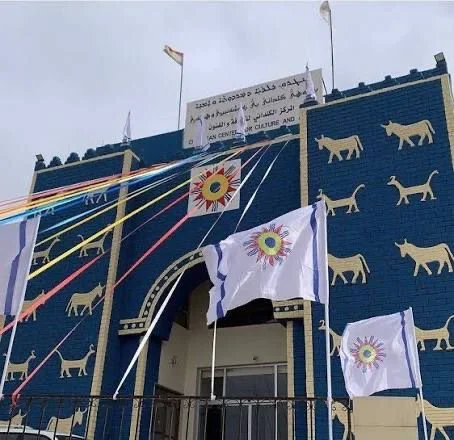
The Chaldean Center for Culture and Arts in Duhok.
Three decades of dedication to identity and heritage
By Ghazwan Al-Qass Younan
In the heart of the city of Duhok stands a distinctive building that catches the eye of passersby and visitors alike featuring a façade inspired by the ancient Chaldean-Babylonian legacy. Its architectural details, ornaments, and harmonious color palette lend the site a unique visual identity, reflecting the depth of history and the enduring civilization from which it draws inspiration.
Upon approaching this edifice, the visitor immediately realizes that this is no mere venue for events; rather, it is a comprehensive cultural project dedicated to preserving Chaldean memory and identity through sustained effort and diverse programming.
In an exclusive statement to Chaldean News, Mr. George Toma Isho, head of the Chaldean Center for Culture and Arts, outlined the Center’s journey and key milestones. He discussed its objectives, achievements, and the challenges it has faced since its inception, emphasizing that the Center has successfully maintained its presence despite difficult circumstances and limited resources.
Mr. Isho explained that the Center was established in 1996 through an initiative by Mr. Ablahad Afram Sawa with the participation of a group of intellectuals and individuals dedicated to Chaldean affairs.
He added that the post-1991 era in the Kurdistan Region of Iraq witnessed a period of significant openness, enabling various communities to establish their own cultural institutions; this served as a primary impetus for creating the Center, which was founded to fill a vital void in the Chaldean cultural landscape.
Mr. Isho explained that the primary goal of establishing the Center was to preserve Chaldean cultural heritage and foster national consciousness among the Chaldean people while also instilling a sense of cultural identity in new generations. He further noted that, from its inception, the Center has strived to serve as a space for dialogue and openness with various segments of society, thereby promoting the values of coexistence.
Regarding the organizational structure, Mr. Isho stated that the Center comprises a General Assembly and an Administrative Board, alongside specialized committees covering youth and children, media, donations and funding, and women’s activities. He emphasized that these committees have contributed to expanding the scope of cultural work and engaging diverse groups in the Center’s programs and events.
Discussing activities, he noted that over the past years, the Center has organized a wide range of festivals, seminars, and cultural events focused on Chaldean heritage and identity in addition to diverse sports and social activities.
Efforts were also made to establish a cultural library, housing significant books and reference materials on history and culture, as well as to organize courses for teaching the mother tongue—viewed as fundamental to preserving identity.
The Center places special importance on youth by involving them in cultural and sports activities, aiming to cultivate a generation connected to its cultural roots and capable of carrying the mission forward into the future.
Mr. Isho noted that cultural work is not limited to mere events but extends to fostering long-term awareness that strengthens a sense of belonging and identity.
Despite these achievements, the Center’s president did not hide the fact that challenges persist—most notably, a lack of national consciousness among some members of the Chaldean community, alongside financial constraints.
The cessation of government subsidies in 2013 forced the Center to rely on its own resources and leverage some of its assets to ensure the continuity of its activities. Mr. Isho also noted intellectual challenges, such as attempts to cast doubt on the Chaldean cause, emphasizing that these must be countered through serious cultural work and by fostering greater awareness of Chaldean history and heritage.
In conclusion, Mr. Isho expressed his pride in the achievements realized over nearly three decades of work, emphasizing that the Center’s continued operations are a testament to the efforts of its administration and their deep belief in its mission.
He also underscored the importance of engaging with the Chaldean community in the diaspora—particularly in Michigan, home to the largest Chaldean population outside the homeland—with the aim of connecting generations to their cultural roots.
The Chaldean Center for Culture and Arts in Duhok steadfastly continues to fulfill its cultural mission, maintaining its status as a key institution within the Chaldean cultural landscape and persisting in its efforts to preserve heritage and strengthen identity for future generations.
Ghazwan Al-Qass Younan is the Iraq Office Director for Chaldean Community Foundation.