
Proudly Chaldean, Fully Australian
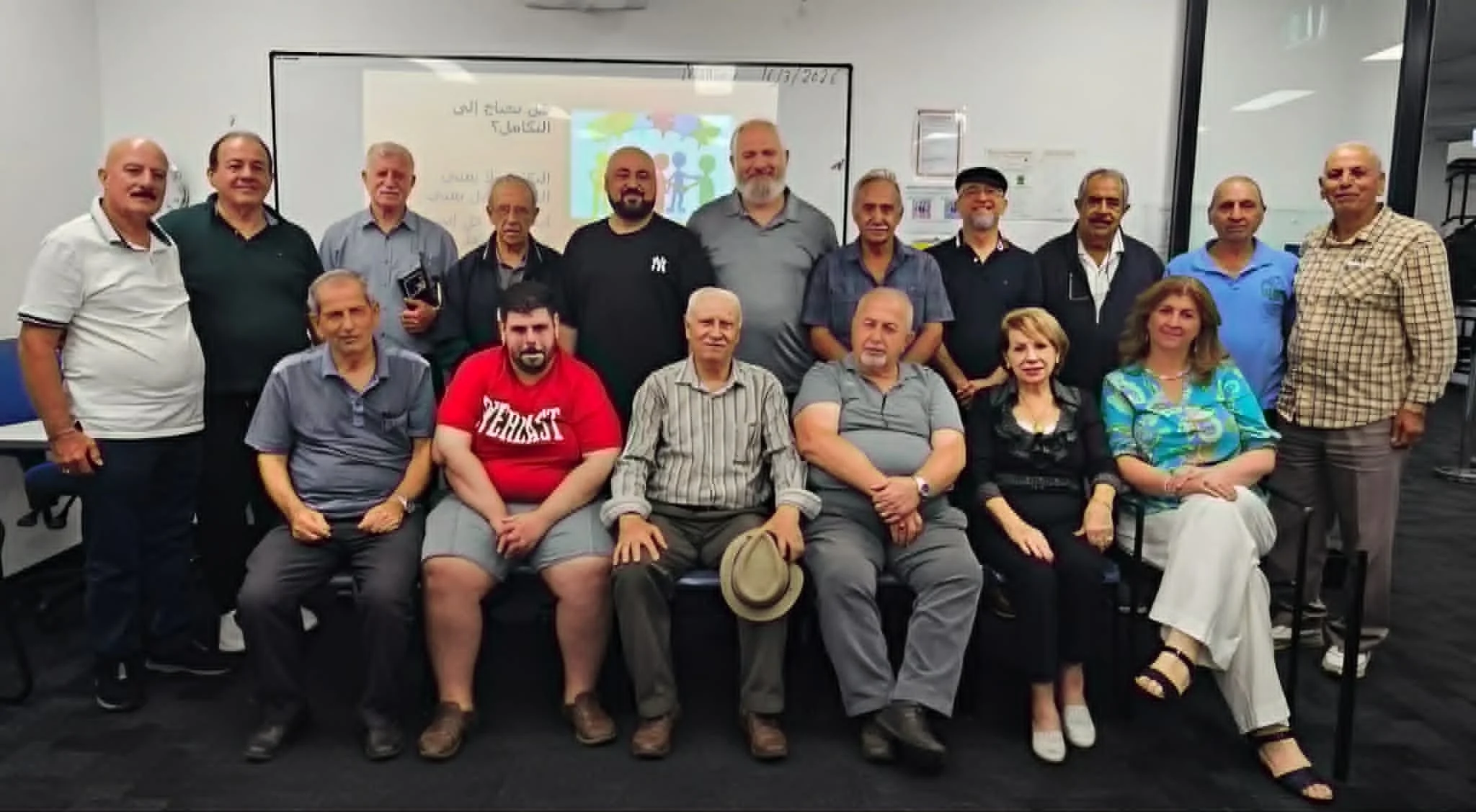
Bashar Hanna, back row center with black t-shirt, leads Chaldean community efforts in Australia.
Balancing cultural preservation with integration
By Weam Namou
Chaldeans began arriving to Australia in significant numbers during the 1990s, driven by war, persecution, and the gradual unraveling of life in Iraq. The population grew quickly, and by the 2021 Australian Census, more than 60,000 people identified with Neo-Aramaic origins, settling primarily in Sydney and Melbourne.
While Australia’s Chaldean community is smaller than the one in Michigan—which is estimated at nearly 200,000 people—the two communities share remarkably similar stories. Both were built by immigrants who arrived seeking safety and opportunity, and both have worked hard to preserve their language, faith, and traditions while establishing themselves as active contributors to their adopted countries.
One of those immigrants is Bashar Hanna, of Syriac-Chaldean heritage, who arrived in Australia from Baghdad in 1998. Like many of his generation, his journey was shaped by conflict, uncertainty, and the grief of leaving behind everything familiar.
“Starting again in a new country taught me how important community, belonging, and cultural identity are,” he says. “It also showed me the challenges migrants face when they are trying to rebuild their lives.”
Those challenges were not only practical—finding work, navigating unfamiliar institutions, and building new networks—but deeply personal. Hanna reflected on the emotional weight of migration that outsiders rarely see: leaving behind family, lifelong friendships, and a way of life that can never be fully recreated.
For Hanna, those early years of displacement became the foundation of a life’s work.
In 2014, he established an Arts and Community Development Centre in Fairfield City in Western Sydney, one of Australia’s most culturally diverse regions and home to a large Iraqi population. Five years later, he founded the Australian Mesopotamian Cultural Association in New South Wales, creating what he describes as a platform to celebrate and preserve Mesopotamian culture while introducing it to the broader Australian community.
“Our community has a rich history,” he says, “but there were limited platforms dedicated to promoting that heritage through arts, culture, education, and community engagement.”
The work is both cultural and deeply practical. Through music, theater, storytelling, and visual arts, the center creates spaces where younger generations—many of them born in Australia with no direct memory of Iraq—can encounter their heritage in ways that feel alive rather than ceremonial.
It is a challenge familiar to Chaldeans in the United States as well. Whether in Sydney, Melbourne, Detroit, or San Diego, diaspora communities face the same question: How do you pass on a culture that was lived by one generation but inherited by the next?
When asked how Chaldeans in Australia balance maintaining a distinct cultural and linguistic identity while integrating into Australian society, Hanna was clear that he does not see cultural preservation and integration as competing goals.
“Chaldeans can be fully Australian while also maintaining their language, traditions, faith, and cultural practices,” he says. “They preserve their identity through family, church, community events, language, music, and cultural education. At the same time, they participate actively in Australian society through education, employment, business, and civic life. That’s what successful multiculturalism looks like.”
His answer could just as easily describe the Chaldean experience in the United States. In both countries, churches remain at the center of community life, family ties remain strong, and entrepreneurship continues to be a defining characteristic of the diaspora.
That dual identity—proudly Chaldean, fully Australian—is increasingly visible. Chaldeans have established themselves as business owners, educators, artists, healthcare professionals, and community leaders across the country. Their contributions, Hanna argues, reflect both the opportunities Australia has offered and the resilience migrants bring with them.
“Australia has given us opportunities, and in return we are proud to contribute to Australia’s future.”
In 2024, Hanna was awarded the Medal of the Order of Australia (the OAM) in recognition of his contributions to the community.
“Receiving the OAM was a great honor,” he says. “But I see it as recognition of a collective effort rather than an individual achievement. It reflects the contributions of many people who have worked tirelessly to strengthen our communities and support others.”
At the same time, he acknowledges what the recognition means beyond his own accomplishments—a signal, particularly to those who still feel like outsiders, that their presence and contributions matter.
“For people who sometimes feel like outsiders, it is a reminder that they belong here and that their stories matter.”
Today, Hanna is a Ph.D. researcher at Central Queensland University, where his work examines how arts and cultural participation contribute to community development, social inclusion, and well-being among Iraqi migrant and refugee communities.
In many ways, his academic research is simply a continuation of the work he has spent decades doing on the ground. It seeks to demonstrate something many immigrant communities already know instinctively: culture is not a luxury. It is the glue that holds communities together.
Looking ahead, Hanna’s vision for the Chaldean community in Australia is one of confidence and continuity.
“Success means having a community that is confident, connected, and thriving,” he says. “It means young people succeeding in education and leadership while remaining connected to their language, culture, and heritage.”
The greatest obstacle, he believes, is not hostility from the outside but the quieter erosion that comes with time and assimilation—the gradual loosening of the ties that bind a community to its past.
“As communities become more established, there is always a risk of losing connections to heritage. Maintaining those connections requires ongoing effort and investment.”
That concern may sound familiar to many Chaldean Americans. As second-, third-, and fourth-generation families become further removed from the immigrant experience, questions about language retention, cultural identity, and community engagement become increasingly important. The challenge is not unique to Australia; it is one faced by Chaldean communities throughout the diaspora.
For a people whose culture has survived empires, invasions, and centuries of displacement, that effort is nothing new. It is, in many ways, simply what Chaldeans have always done.
Sometimes that continuity reveals itself in unexpected ways.
As Iraq’s national soccer team competed for a World Cup berth in June under Australian coach Graham Arnold, Iraqis across Australia found themselves glued to their television screens. The excitement reflected something much deeper than sports.
“This was about a connection to our homeland, to shared memories, and to a sense of national pride,” Hanna says. “People from different regions, backgrounds, and generations came together to support the team. Football becomes a way of maintaining community ties and celebrating something positive about the country we come from.”
Whether in Australia, the United States, or elsewhere around the world, that connection to heritage remains a defining part of the Chaldean experience. Different countries may offer different opportunities, but the goal remains remarkably similar: to build a successful future without losing sight of the past.