
Deportation Fears
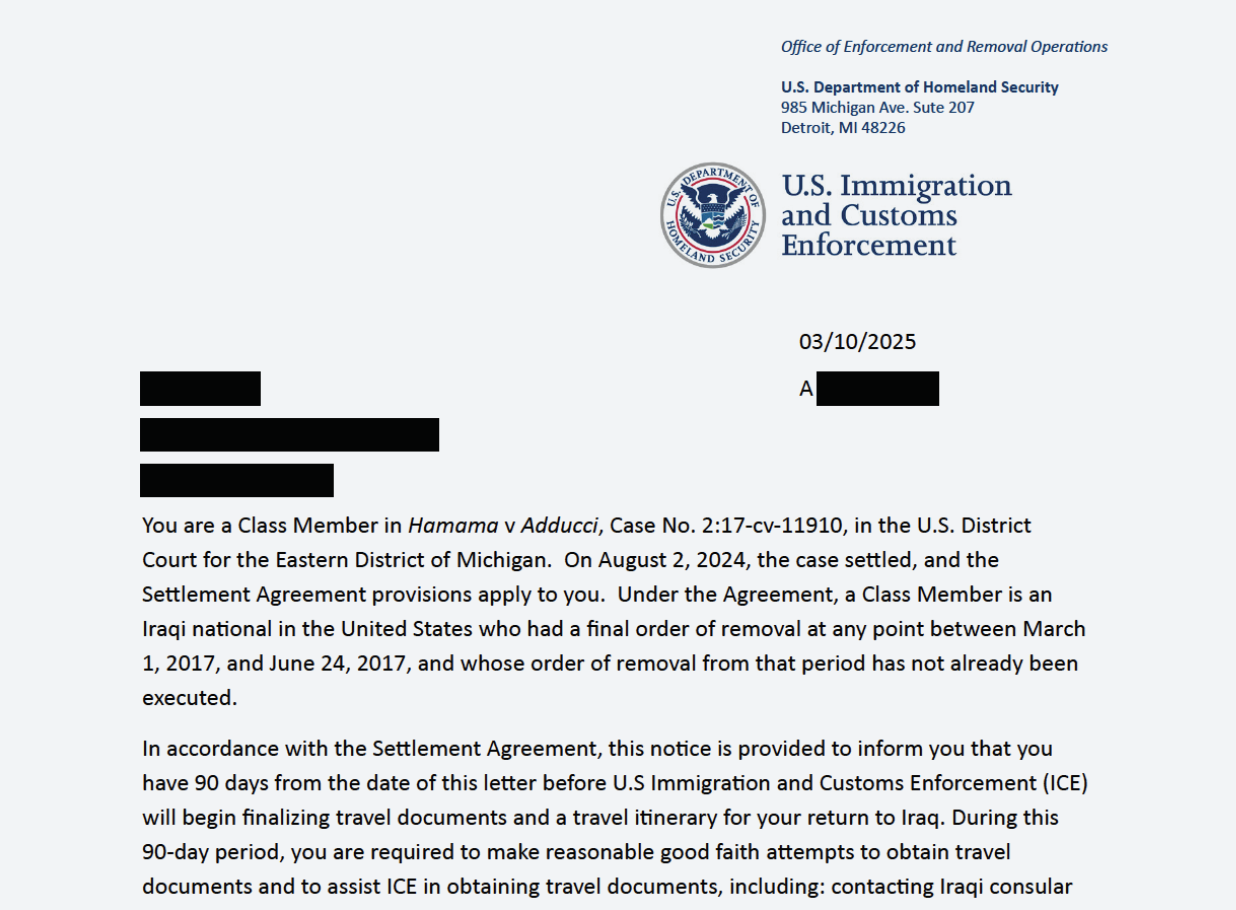
How to respond to a 90-Day notice from ICE
By Sarah Kittle
The Hamama v. Adducci lawsuit—a landmark class-action lawsuit filed in 2017 by the ACLU of Michigan and partner organizations to block the mass deportation of Iraqi nationals—provides important protections for certain Iraqis living in the United States.
The settlement applies only to Iraqi nationals who had a final order of removal between March 1, 2017, and June 24, 2017, and who were not already deported under that order. It does not apply to all Iraqi immigrants.
Ewurama Appiagyei-Dankah, a West Michigan Legal Fellow with the American Civil Liberties Union of Michigan explains, “As an example, if you had a final order of removal to Iraq from 2006 and your final order was still in place from March 1 to June 24, 2017, you are a member of the class.
“The case settled in 2024; the settlement places limits on under what circumstances and for how long ICE can detain class members it seeks to remove. It also provides protections—for example, it limits what counts as a violation of an order of supervision.”
If you are part of this case, US Immigrations and Customs Enforcement (ICE) cannot arrest you for deportation right away. In most cases, ICE must first give you 90-days’ written notice before taking you into custody.
If you have received a 90-day notice, it means ICE is actively trying to deport you. You should contact an immigration lawyer immediately.
“The government has agreed to rescind 90-day notices it issued to class members who do not have a final order of removal, or who cannot be removed to Iraq because they have withholding of removal to Iraq or protections under the Convention Against Torture (CAT),” says Appiagyei-Dankah. “If you have CAT or withholding, or if you do not have a final order of removal, you should email hamama@aclumich.org.”
Of special note is although ICE has agreed to rescind some notices of removal, they may still try to remove class members with CAT or withholding of removal to a “third country;” the Hamama case does not prevent this.
The Hamama settlement only gives you extra time and certain legal protections. It does not cancel your deportation order. The only way to stay in the US is to win your own immigration case. If you cannot afford a lawyer, you can look for free legal help.
Depending on your case, your attorney may recommend filing a Motion to Reopen your immigration case and asking for a Stay of Removal, which asks the court to temporarily stop your deportation.
During the 90-day period, ICE may ask you to attend appointments or interviews, provide documents and information, and make a good-faith effort to get Iraqi travel documents.
They cannot, however, force you to sign papers saying you agree to be deported.
Within those 90-days, you should be safe from arrest, as long as you follow the rules of your supervision, such as attending ICE check-ins.
“If you received a 90-day notice, it is extremely important that you continue to follow all conditions of your order of supervision, including attending any report dates, as failure to do so is grounds for detention,” explains Appiagyei-Dankah.
Do not give them any reason to detain you. ICE may only arrest you early in rare situations, such as if they believe you are a serious danger to national security or public safety.
They may assign you as Category 1 if they believe you are a threat to national security, were arrested attempting to illegally enter the US, were released from criminal custody within the past five years or have committed new crimes.
That doesn’t mean you have no recourse, however. “ICE must review the facts and circumstances of your case,” says Appiagyei-Dankah. “The settlement agreement includes a list of things that ICE must consider (for example, how serious your crime was, how old you were, how long you have been in the US, etc.)”
If ICE detains you before the 90-days end, you or your family should contact an immigration lawyer and the Hamama legal team immediately.
After 90 days
After the 90-day period, ICE may begin making final travel plans to deport you. If you are detained, there are rules that limit how long they can keep you in custody. Depending on your situation, you may ask for release while your case continues.
If you have not left the US or obtained travel documents by the end of the 90 days, you must report to the ICE office on the date listed in the notice.
The Hamama settlement gives you time and legal protections, but it does not stop deportation. If you receive notice, do not ignore it. Acting quickly gives you the best chance to explore your legal options.
Rescission Letters
Recently, formal rescission letters were sent out to two categories of class members: those that have CAT protections or no formal notice of removal; and a large group of 300 or more who have a notice of removal that wasn’t included in notices sent to the ACLU (required by law). If you received one of these letters, it does not mean your case is resolved. You should still contact an immigration lawyer.
The ACLU of Michigan has a list of immigration attorneys in Michigan, and for people who are not in Michigan, they can find immigration attorneys located near them at this website: https://www.immigrationadvocates.org/legaldirectory/.