
Chaldeans of Syria
A rich history and an uncertain future
By Hanan Qia
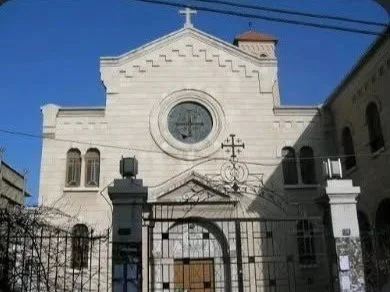
In Aleppo, St. Joseph’s Cathedral stands as a witness to a diocese built by its bishops, stone by stone, over years—from the Hall of the Virgin to the churches of Qamishli, Hasakah, and Tell Shamiya. Today, only a small number of Chaldeans remain in all of Syria, concentrated in a few cities, after young people and business owners have left.
These churches, built for a community that is shrinking, are the image that prompted me to write this article. I wanted to learn more closely about the Chaldean community in Syria and explore its long history. To that end, I had the opportunity to speak with two prominent figures among Syria’s Chaldeans. I began with His Excellency Bishop Antoine Audo, the Chaldean Bishop of Aleppo, who gave me an overview of their presence and the broad outlines of their history.
However, his pastoral commitments left him little time to discuss the details. He was participating in events surrounding His Holiness Pope Leo XIV’s visit to France, followed by the ecclesial communion Mass in Rome in mid-October, presided over by His Beatitude Patriarch Mar Paul III Nona.
He would then attend the Chaldean Synod, followed by his pastoral visits. He therefore advised me to contact Deacon and researcher Nuri Ishou’ Mando, a member of a well-known Chaldean family, assuring me that he would have the details and figures. The following is what the deacon told me; I have updated his information and figures in this article.
Deacon Nuri Ishou’ Mando was born in Qamishli in 1957. He is a deacon, researcher, and well-known figure in Chaldean Church circles.
Roots Reaching Back to the Beginnings of Christianity
The deacon says that the presence of members of the Church of the East in Syria dates back to the earliest Christian centuries, for two reasons. The first was political and military: the brutal wars between the Persian and Roman empires. The victor would take large numbers of prisoners from the defeated side and settle them in territories under its control so that they could not escape. The second reason was religious: persecution of Christians by Persian kings drove many of them to seek refuge in areas under the Christian Roman Empire, in order to protect their lives and preserve their freedom of belief. As their numbers grew and their livelihoods prospered, they established dioceses and parishes to provide for their spiritual needs.
Historical evidence of their early standing includes an event in 630 AD, when the Persian queen Boran sent a diplomatic mission to Emperor Heraclius, who was then residing in Aleppo, to conclude peace between the two empires. The mission was headed by Mar Ishoyahb, the Catholicos of the East, and included a high-ranking delegation of metropolitans and bishops. The bishop of the Chaldean community in the Levant joined them. Heraclius received them warmly, and peace was concluded through the Catholicos. On that occasion, the True Cross was returned to Jerusalem after having been in Persian hands.
The participation of the Bishop of Damascus in that delegation suggests that members of the Church of the East had settled in Damascus by the mid-fifth century, and that some belonged to Arab tribes. They had two churches in Damascus: one near the house of Abu al-Mashki in the district now known as al-Qaymariyya, and the other at the entrance to the coppersmiths’ market, about one hundred meters east of the Great Mosque. Both remained standing after the Islamic conquest, until they were converted into mosques before the end of the first millennium.
During the Abbasid Era, Chaldean Damascus became particularly prominent. Its metropolitan took part in the ordination of the Catholicos Timothy I in 780 AD, who granted him the title of “Maphrian” and broad authority over the bishoprics of Aleppo, Jerusalem, Manbij, al-Massisa, Tarsus, and Melitene. Around 800 AD, the renowned scholar Elijah al-Jawhari, author of many works, assumed this see.
When Caliph al-Ma’mun came to Damascus in 830 AD, the church’s metropolitan, Mar Sabrisho, welcomed him warmly and hosted him as a guest. Twenty-eight years later, Caliph al-Mutawakkil visited the city and was given a grand reception. When he asked who had organized it, he was told it was “Sarkis,” the Metropolitan of Nisibis, who was in Damascus at the time. The caliph immediately granted him ten thousand dirhams.
Aleppo Between Prosperity and Decline
At the beginning of the second millennium, the members of this Church grew considerably in number. In Aleppo alone, in 1380 AD, they numbered approximately 5,700 families, served by a metropolitan named Mar Mattai, assisted by two bishops and forty priests. They had three churches: the Forty Martyrs, Mar Quriaqos, and Mar Ishaya of Aleppo. However, when a section of the Church of the East joined the Catholic Church under the Catholicos Sulaqa in 1553 AD, this opened the way for intense rivalry. Because of their large numbers, Aleppo became an arena of conflict over patriarchal control.
One notable story concerns an event in 1630 AD, when the Catholicos Elijah VII sent Latin missionaries to administer the affairs of the Chaldeans in Syria. Since the missionaries were unfamiliar with Eastern rites, they read the word “baptized” in the baptismal formula as a past-tense verb and considered the formula invalid, demanding that the baptism be repeated. The case was referred to the Apostolic See in Rome. After examination, the formula was declared valid, and the Church reprimanded the missionaries for disturbing the peace of Aleppo’s congregation. This reflects the historical importance of this Church.
The eighteenth century, however, saw a prolonged decline. In 1729 AD, the Sublime Porte in Istanbul issued an edict establishing a kind of agreement between two rival authorities: the Nestorians were granted authority over the dioceses of Mosul and Aleppo, while the Chaldeans were granted authority over the dioceses of Diyarbakir and Mardin. This negatively affected the Church in Syria, since Nestorian patriarchs did not allow our Chaldean Church to send bishops and priests to care for its communities. As a result, many were forced to join the Latin, Greek Orthodox, and Maronite Churches, where they were absorbed.
Nevertheless, the flame did not die out. In the early nineteenth century, Chaldean families began migrating from Baghdad, Mosul, and Diyarbakir, and their numbers increased over the years. They had neither churches nor priests of their own rite, so Franciscan fathers took responsibility for serving them in Aleppo and Damascus.
From Patriarchal Vicariates to a Diocese
The deacon adds that the Chaldean Patriarchate subsequently turned its attention to establishing patriarchal vicariates. In Aleppo, Patriarch Joseph Audo established the vicariate in 1872 AD. He had passed through the city in 1870 and purchased land in the Aziziyah district from the respected al-Homsi family. There he built a small church, inaugurated in 1876 under the patronage of the Apostles Peter and Paul.
In Damascus, a vicariate was established in 1895 during the tenure of Patriarch Abdisho Khayyat. In 1897, Father Abd al-Masih al-Mardini purchased property in the Bab Touma district and built a church there dedicated to the Sacred Heart of Jesus.
By the first quarter of the twentieth century, the vicariates had expanded to Deir ez-Zor in 1904 and Alexandretta in 1920, during the tenure of Patriarch Joseph Emmanuel Thomas. In each place, he bought a spacious house to serve as a chapel and residence for the parish priest. Alexandretta remained under the care of the Chaldean Church until its district was detached from Syria and annexed to Turkey in the late 1930s.
During the same period, after wars and persecutions had killed vast numbers of Chaldeans in Sa‘رت, Diyarbakir, Mardin, al-Jazira, and Van, the survivors migrated to Upper Jazira. The Church sent Father Augustin Kharmoush to Hasakah and Father Gabriel Kanni to Qamishli. In 1936 AD, Rome appointed Father Philip Shouriz as apostolic administrator of Upper Jazira (Hasakah, Qamishli, and al-Malikiyah). He travelled among these towns, carried out charitable projects, and established new centers until his death in 1938 AD.
In addition, in 1939 the Patriarchate appointed Mar Gabriel Naamo as administrator bishop for the Chaldeans of Syria and Lebanon, with his see in Aleppo. He served until 1957. That year, the Chaldean Patriarchal Synod, meeting in Baghdad, decided to establish a Chaldean diocese in Syria, with Aleppo as its permanent see. Bishop Paul Cheikho, transferred from Aqra and the Zibar region, was chosen for the post and served Aleppo diligently. He was then elected Patriarch of the Chaldean Church in 1958 and led it for thirty-one years, until his death in 1989.
In 1959, he was succeeded by Bishop Stephen Bello, born in Alqosh in 1910, who served the diocese energetically and wisely for thirty years. During his tenure, St. Joseph’s Cathedral and a large bishop’s residence were built in Aleppo, along with a large hall named after the Virgin. The old church was converted into a major commercial complex called the Patriarch Joseph Audo Building. He also built the Church of Mar Gewargis in al-Malikiyah, the Chaldean al-Kifah School in Qamishli, and a priest’s residence, catechism classrooms, and a hall for youth activities in Hasakah.
In 1989, Bishop Antoine Audo took over. Born in Aleppo in 1946, he entered the Jesuit order in 1969, earned a doctorate in modern Arabic literature from the Sorbonne, and obtained a diploma in biblical studies from the Pontifical Biblical Institute. He built a hall in al-Malikiyah, a monastery in the village of al-Battar near Homs, the Church of Mar Jacob of Nisibis in Qamishli, the Church of Christ the King in Hasakah, the Church of Mar Zaya in Tell Shamiya, and a hall in Tell Arabush; he also renovated the Hall of the Virgin in Aleppo. He gave considerable attention to arrivals from the Church of Iraq and to priestly vocations. During his tenure, seven priests were ordained.
The Present and a Painful Picture of Reality
Today, Deacon Nuri Ishou’ Mando presents a stark and painful picture based on updated figures for the Chaldean population. He says that approximately 1,000 Chaldean families remain in Syria across all centers, concentrated in Aleppo, Qamishli, al-Malikiyah, Hasakah, and Damascus. The diocese has lost most of its members through emigration, particularly young people and wealthy business owners, as a result of the events that began in 2011 and continued thereafter.
More broadly, the deacon explains that over 70% of Syria’s Christians have left the country, while those who remain are also considering emigration because of economic hardship and security concerns. He also spoke of key events that drove Christian emigration, including attacks by ISIS on the villages along the Khabur River, a strip that comprised 35 Christian towns and villages. These attacks brought displacement, killings, and destruction to their inhabitants, and today only a very small number have returned. He also pointed to cities that have become entirely devoid of Christians of every denomination, such as Deir ez-Zor, which today has no Christians left.