
Finding His Voice
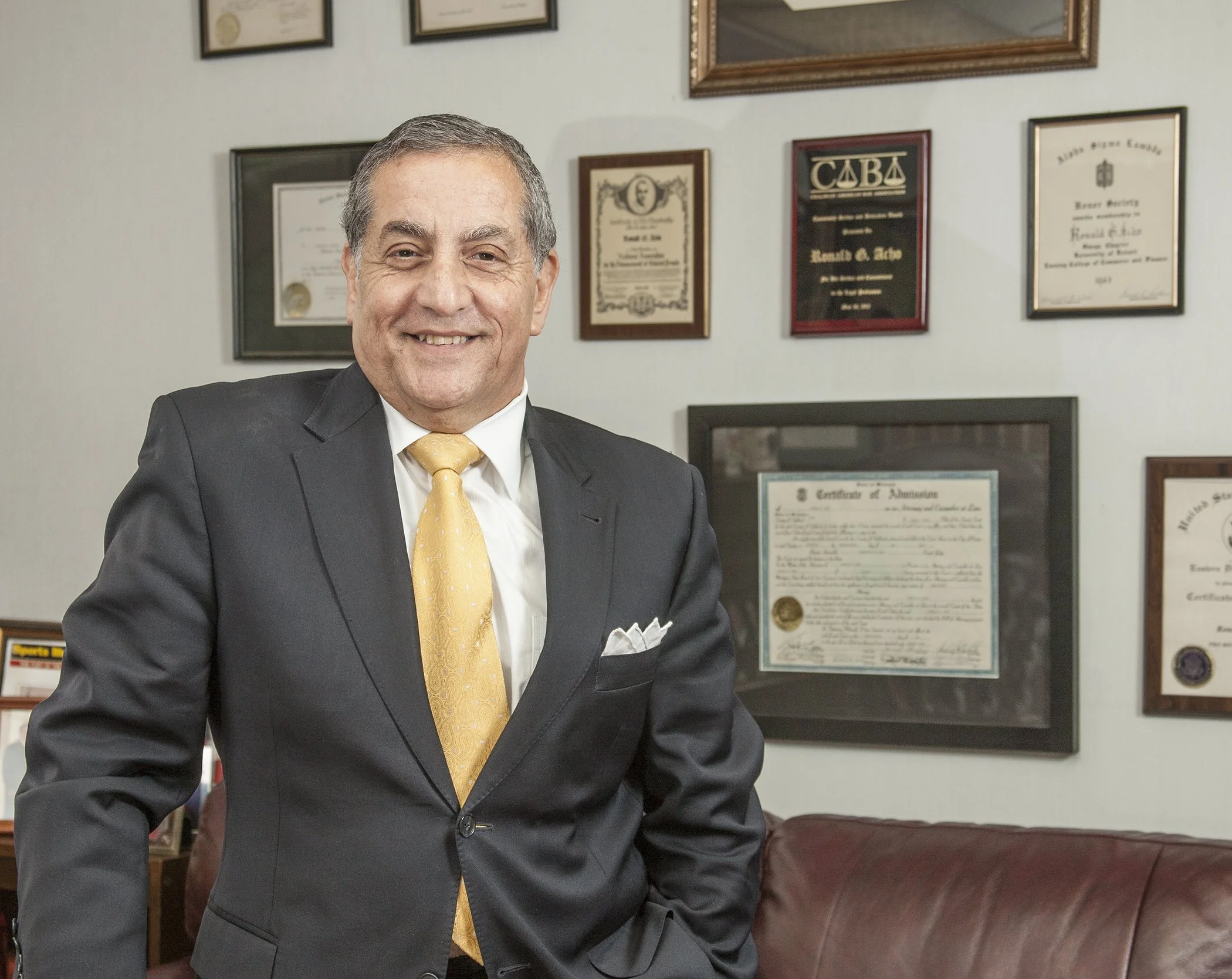
Ron Acho (December 18, 1945 - August 18, 2026) Photo by Larry Peplin
The life and legacy of Ron Acho
Ron Acho’s life was a testament to what can happen when perseverance is met with opportunity and when success is understood as something to be shared, not simply as something to be achieved.
I had the distinct honor of interviewing Ron and his lovely wife Rita last year as he was being honored by the Chaldean American Chamber of Commerce as Businessperson of the Year. Ron was honestly the humblest man of consequence I have ever met. He was kind and funny and generous—with his talent, his time, and his compliments.
One of Michigan’s pioneering Chaldean attorneys and one of the community’s most trusted leaders, Acho received his heavenly reward on Aug. 18 at age 80. He leaves behind his wife of more than half a decade, Rita; his children, Jim, Stephanie and Greg; four grandchildren, Anne, Michael, Meghan and Mary Katharine; and an example of integrity and humility for the entire Chaldean American community.
Ron’s journey began in Baghdad in 1945. He spent his early childhood in Tel Kaif (Tel Keppe) before his family immigrated to the United States in 1949. His father had only a fifth-grade education and had worked menial jobs in Iraq, but he dreamed of providing his children with opportunities he had never had.
America, however, was not immediately easy for the Acho family.
Ron arrived as a child speaking neither English nor Arabic. He later recalled that he did not speak in class during his first two years of American school. Short, skinny and quiet, the boy who would one day become a formidable courtroom advocate hardly appeared destined for a career in law.
But the qualities that would define him were already taking shape: perseverance, humility, and an extraordinary work ethic.
The Acho family became part of the growing Chaldean community in metro Detroit, where newly arrived immigrants relied heavily on one another. Ron experienced firsthand the strength of a community that supported its own, and he carried that lesson throughout his life.
His first ambition was not to become a lawyer. He wanted to operate a chain of grocery stores.
That dream changed after the family store was destroyed during the 1967 Detroit uprising. With the future he had envisioned suddenly gone, Ron went to work for Ford Motor Company. At the same time, he attended night school and eventually earned his law degree.
As hard as Ron worked to get that degree, he experienced discrimination because he had attended evening lessons at a less prestigious law school. Rather than allowing that experience to embitter him, he turned it into a guiding principle: He would never treat others the way he had been treated in that instance.
That conviction became evident in the way Ron approached people throughout his career. He personally read resumes and offered advice to those looking for work or seeking to advance themselves. He understood what it meant to be overlooked, and he made a point of helping others find a door that might otherwise have remained closed.
In 1976, Acho became a partner at Cummings, McClorey, Davis & Acho, P.L.C., the firm with which he remained throughout his career. He ultimately handled more than 8,000 cases, tried more than 200 and lost only eight. His reputation as a tough and strategic litigator was well earned.
Yet for all his courtroom success, Ron did not see himself as the person who “won” cases.
“Lawyers don’t win cases, clients do,” he said.
The statement reflected his larger philosophy. His role, he believed, was to guide people through difficult circumstances and give them the knowledge and tools to make informed decisions. He was a fierce advocate, but those who knew him also remember his gentleness, generosity, and measured manner.
Michael Sarafa described him as a pioneer—comparing his significance to the Chaldean community and legal profession to figures such as Louis Brandeis and Thurgood Marshall in their respective communities. Sarafa observed that as one of the first Chaldeans sworn into the Michigan Bar, Ron understood that law could be more than a profession.
It could be a calling.
“For more than five decades, Ron was a trusted counselor and steadfast presence to generations of Chaldean leaders,” said Sarafa. “He advised and stood by my late Uncle Michael George, my brother, Joe Sarafa, Martin Manna, and nearly every president of the Chaldean Iraqi American Association since the opening of Southfield Manor. He was there when counsel was needed, when difficult decisions had to be made, and as an advisor for every major threshold of community progress and expansion.
“He didn’t simply represent members of our community,” Sarafa said. “He represented the community itself.”
That commitment shown through in his work with the Chaldean American Chamber of Commerce. Ron was a founding member and served as its general counsel from its inception. He drafted the Chamber’s bylaws and provided legal guidance during its formative years.
Frank Jonna remembered him as “a tenacious fighter,” saying Ron provided good leadership and sound legal advice. His counsel also proved important to Shenandoah Country Club and the institutions surrounding it, particularly during periods of significant growth and uncertainty.
Dr. Adhid Miri worked closely with Acho during Miri’s tenure as president of the Chaldean Iraqi American Association of Michigan (CIAAM) from 2003 to 2005. He recalled one particularly consequential event.
During the transition from Southfield Manor to Shenandoah Country Club, several CIAAM board members were initially reluctant to include the Chaldean Cultural Museum as part of the new club’s design. Ron used his charisma and legal knowledge to help persuade them to support the museum.
“At the time, the decision may have appeared primarily cultural or architectural,” recalled Miri, “In retrospect, it was far more consequential.”
The museum helped preserve the identity and purpose of the property and became an important factor in the club’s ability to survive the severe financial difficulties that followed the 2008 financial crisis. The decision ultimately contributed to saving the club from foreclosure.
Ron understood something that extended well beyond the immediate legal question: preserving the community’s institutions and heritage was an investment in generations yet to come.
That same instinct defined his broader service.
“Many times, God intervened and used me to help people,” Ron once said.
Those words offer a window into how he viewed his success. He was not interested merely in accumulating professional accomplishments. He wanted his knowledge and position to be useful to others.
Rita knew perhaps better than anyone the person behind the attorney and community leader and said during the 2025 interview: “I thank God for 56 years of being with this man.”
Despite his professional achievements, Ron remained grounded in the lessons he learned from his father. The man who had come to America with little education but enormous determination taught his son the value of hard work and humility.
Ron carried those lessons into his own family—what he saw as his greatest accomplishment. His son Jim followed him into the legal profession at Cummings, McClorey, Davis & Acho. His daughter Stephanie leads The Detroit Chocolate Company, while his son Greg works in public relations and marketing.
And beyond his immediate family was another extended family—the Chaldean community.
Sarafa recalled how Ron followed people’s careers and milestones, often making them feel seen and appreciated.
“On a very personal note, he was dear to my late parents, my siblings and me,” Sarafa said. “He never failed to reach out with a congratulatory note of praise or an uplifting conciliatory gesture. He tracked my career just as a brother or parent would do in a most genuine manner, always in the most positive light. Ron had a way of making people feel seen and appreciated that I will never forget.”
That ability to make people feel valued was part of what made Ron’s influence so enduring. His contributions were often given without expectation of recognition or compensation. As Sarafa noted, Ron shared his time and talents with the community “most often gratis.”
His generosity was not limited to financial support. He mentored young people, advised leaders, helped institutions navigate difficult moments, and used his professional standing to advocate for causes he believed would strengthen the community.
Robert George remembered his unwavering desire “to do well and do right.”
That may be the simplest way to understand Ron Acho’s life.
The quiet boy who once could not speak in an American classroom became a lawyer whose voice carried weight in courtrooms, boardrooms and community institutions. The child of immigrants became one of Michigan’s pioneering Chaldean attorneys. The young man whose family’s grocery store was destroyed found another path forward. And the attorney who experienced discrimination chose to spend much of his life opening doors for others.
“He represents the very best qualities of a professional and community leader: integrity, generosity, dedication, sound judgment, and a profound commitment to service,” Dr. Miri said.
For a man who began life as a silent immigrant child and became a relentless advocate, perhaps there is no more fitting legacy than this: Ron Acho spent his life using his voice to help others find theirs.