
Getting Chosen
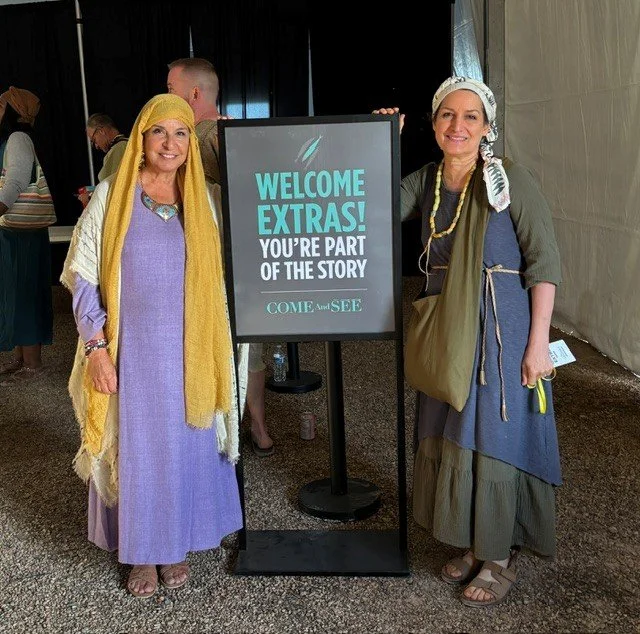
Good friends become extras in faith-based series
By Sarah Kittle
There is something undeniably surreal about driving down a Texas highway dressed like a first-century Christian.
For Dr. Marisa Abbo and her longtime friend, Jenny Dickow, it was the beginning of an experience neither could have imagined when they first met as teenagers at Our Lady of Mercy High School.
The two women have spent decades traveling the world together, navigating careers, family and life—and, as Abbo jokingly puts it, their “younger disco queen years.” Now, they can add something entirely unexpected to their shared history: becoming extras on The Chosen, the faith-based television series depicting the life of Jesus.
For Abbo, a family medicine physician who has practiced for more than 30 years, serving on staff at Beaumont, now Corewell Health, the experience offered a remarkable departure from her life in Michigan.
For Dickow, who spent 31 years in the automotive industry before retiring and now works part-time on special projects at Dash Diamonds, the opportunity was another example of what happens when she says yes to something interesting.
“I love staying active, trying new things, and saying YES to interesting opportunities,” Dickow said. “Which is probably a good explanation for how I eventually found myself on the set of The Chosen.”
Getting Selected
The journey actually began with a little disappointment.
The friends had hoped to become extras during Season 6, the season depicting the crucifixion. Dickow learned about the opportunity through one of the programs associated with The Chosen and assumed that, with thousands of extras needed, their chances were good.
She was wrong. “By the time I got home an hour later, it was sold out!” she recalled.
Undeterred, they set their sights on Season 7. Dickow wasn’t about to make the same mistake twice. When the opportunity to participate in the final season opened, she was ready. Only about 250 extras were needed, making the competition considerably tougher. She cleared her calendar, sat in front of her computer when registration opened and repeatedly refreshed the page.
Eventually, the message appeared: “Congratulations!” She had registered for both of them, and this time, they were in.
For Abbo, who had also tried for the previous season, making it into the resurrection season felt especially meaningful. “Making it into the resurrection season felt right — like a true blessing,” she said. “This is the season of living hope.”
Once they received confirmation, excitement quickly turned into logistics: flights, a hotel and a rental car for the trip to Midlothian, Texas.
And then there was the heat. Anyone familiar with Texas in August, Dickow said, knows what that means. “HOT!!!” she recalled.
But neither woman cared. They were going to be part of The Chosen.
Chaldeans On Set
By the time she arrived on set, Dickow was already intimately familiar with the series. She had watched all five seasons and knew the characters and stories well.
Abbo’s journey as a viewer was somewhat different. She had heard people recommend the show but doesn’t watch much television. Eventually, she gave it a chance. After two episodes, she was hooked.
Both women were drawn to the same quality: the show’s ability to make the people in the Bible feel human. “The show brought the Bible to life for me by humanizing the apostles and other biblical figures,” Abbo said. “Watching The Chosen has helped me with my own study of the Bible.”
Dickow sometimes jokes that she learned more about the Bible watching five seasons of The Chosen than she did during 12 years of Catholic schooling. There is a lot of truth behind the joke, she said. The series helped her understand the people, circumstances, and sequence of Biblical events in a way she had never experienced before.
That made becoming part of the production all the more meaningful.
Welcome to the First Century
The illusion begins long before the cameras roll. The women had to arrive at the set by approximately 6:30 a.m., already dressed in first-century clothing. That meant driving through Texas looking like they had stepped out of another era.
One of Dickow’s favorite memories came from those drives. She and Abbo started laughing about what would happen if they got into a car accident and had to climb out of their vehicle dressed as first-century Christians.
“We were laughing so hard we were practically hyperventilating,” Dickow said.
Fortunately, there were no accidents.
Once they arrived, however, the joking gave way to something much more profound. Walking onto the set and seeing hundreds of people dressed in first-century clothing was bizarre. “You really did feel like you had stepped back 2,000 years,” Dickow said.
The production was meticulous about authenticity. Extras were instructed not to wear nail polish or makeup, and their clothing was supposed to look worn, wrinkled, and frayed rather than polished. They spent much of the day walking through dirt, ending the filming day appropriately covered in it.
For Abbo, the transformation was equally powerful.
“It truly was surreal to be transported in time to the first century,” she said. “I easily forgot my life in Michigan.”
The Reality Behind the Magic
The experience was incredible—but it was also grueling. Filming days lasted approximately 12 to 13 hours, beginning around 6:30 a.m. and continuing until roughly 7 p.m. The heat index climbed to approximately 115 degrees, and the extras were dressed from head to toe in period clothing.
Dickow learned that lesson quickly. “People were experiencing rapid heart rates and becoming seriously overheated,” she said. “That was me on Day 1!” She heard that several ambulances had been called during the filming.
By the second day, she had developed a much better strategy, having discovered what the crew called the “Texas Ice Box”—a cooling trailer equipped with powerful fans where extras could escape the heat. Instead of trying to prove she could withstand the Texas summer, Dickow learned to spend a short period filming outside and then head to the cooling trailer while the crew reset the scene.
The unexpected benefit was meeting people. Extras came from across the country and around the world. Dickow met someone from as far away as Singapore and noticed that many people had traveled with their adult children.
“We may have arrived as strangers, but we shared something incredibly unique together,” she said.
The physical demands were only one surprise. Both women were amazed by how much work goes into creating just a few minutes of television. Scenes were repeated from multiple camera angles. Extras had to return to the exact same positions. Cameras were reset. Actors repeated their movements. A scene that might ultimately occupy only a few minutes on screen could consume hours of filming.
“It gave me a completely different understanding of how a television show is made,” Dickow said.
Abbo, who has always been fascinated by the different people and jobs required to make a workplace function, saw the same thing from a different perspective.
During one 13-hour filming day, she learned that more than 100 people were working in different capacities. Just as a hospital or clinic requires dozens of people performing different jobs, so did the film set. And what impressed her most was the attitude of those people.
No One Was Above Anyone Else
Abbo was struck by how kind the production staff was to the extras. It was clear to her that they were valued. That included Dallas Jenkins, the creator of The Chosen, who made a point of greeting the extras each day.
Dickow had the same impression. Jenkins told the group that he would try to personally connect with every person each day—and, she said, he genuinely followed through.
“Considering everything he had going on during filming, I thought that said much about him as a person,” Dickow said. “He was unbelievably kind and approachable.”
Abbo was particularly impressed by how Jenkins interacted with the actors. When a scene ended and Jenkins called “cut,” she noticed that he didn’t stand back and shout corrections. Instead, he would walk from the camera area to the actor and offer his suggestion personally, with what she described as kindness and grace.
“His kind demeanor and leadership was evident,” she said.
For both women, that sense of humility stood out.
“There were no airs from the production staff or the actors,” Abbo said.
A Faith-Filled Set
For Abbo, the experience was especially meaningful because of the role faith has played throughout her life.
The daughter of the late Badi Abbo and Judy Abbo, she grew up Chaldean Catholic and has spent much of her life balancing faith, family, and a career in medicine.
She also previously ran a faith-based Federally Qualified Health Center for 13 years serving people in need. Daily prayer and Scripture reading were part of that workplace, so finding prayer and Scripture on a film set was not foreign to her. Still, she was moved by the intentionality of it.
There was a table in the extras’ tent with Bibles where people could write messages to the actors and directors. Prayer took place before filming began, accompanied by an acknowledgment that the production was being undertaken to honor God and bring Him glory. “The Word of God is the star of the show,” Abbo said.
Dickow, too, said the experience had a profound spiritual effect on her. Being surrounded by people and stories she had read about throughout her life brought the Bible to life in a way she hadn’t expected. “It has brought me closer to God and given me an even greater desire to understand the Bible and my faith,” she said.
Carrying Chaldean Heritage onto the Set
There was another connection that made the experience particularly meaningful for both women: their Chaldean heritage.
Abbo is fluent in Chaldean, which she describes as a modern form of Aramaic connected to the language spoken by Jesus and the people of his time. Standing in first-century clothing, surrounded by a recreation of the Biblical world, that connection felt deeply personal.
“To be standing there in first-century clothing, surrounded by this recreation of the world of Jesus, while knowing that I still speak a language with such an ancient connection to that world was incredibly emotional for me,” she said. She had the opportunity to speak with several members of the production staff about her Chaldean heritage and was surprised by how familiar they were with Chaldeans.
She was equally surprised by how many of the extras from around the country already knew about Chaldeans and Assyrians. “They all mentioned how many times Chaldeans were brought up in the Bible,” she said.
For Abbo, faith, culture and language have always been intertwined. “I wasn’t simply putting on first-century clothing and pretending to be someone from 2,000 years ago,” she said. “I felt a genuine connection to the people, the traditions, and the part of the world being portrayed.”
Her extensive travels throughout the Middle East deepened that connection. Having visited much of the region, she recognized elements of the landscape, surroundings, and traditional way of life portrayed on the set. It made her think about how much of that culture has endured over thousands of years.
“I think I walked onto that set carrying not only my Catholic faith, but also generations of culture, language, and tradition with me,” she said.
For both women, stepping into the Biblical world naturally led to thoughts about their own ancestors. Walking through dirt, seeing the simplicity of the surroundings, and living without the conveniences of modern life gave Dickow a new appreciation for what everyday life must have been like 2,000 years ago.
It also changed the way she thought about the people in the Bible.
“You begin imagining the people not simply as Biblical figures, but as real people who lived, worked, struggled, worshiped and raised families,” she said. The experience made history feel much more personal.
Abbo found herself reflecting on the difference between Christians living today, knowing the hope found in Jesus, and those living at a time when that hope had not yet been fully declared.
“Being on set, I did appreciate the difference between living now, knowing that our hope is in Jesus, versus living at the time when this was not fully declared,” she said.
Memorable Moments
Some of their most memorable moments came unexpectedly.
The women had been instructed not to approach or speak with the actors. But Dickow was selected for a group called “Inner Circle Plus,” which placed approximately 20 extras directly behind the paid actors during much of the filming. Suddenly, she was much closer to the cast than she expected.
One of her favorite characters, Joanna, complimented the necklace she was wearing and told her she loved it. The necklace had been purchased during one of Dickow’s trips to the Middle East. She had actually been considering getting rid of it. “I’m very glad I didn’t,” she said.
She also received a high-five from Big James after a scene and had the opportunity to take pictures with Simon the Zealot. For someone who had spent years watching the series, these seemingly small interactions carried enormous meaning.
“When you’re a fan of the show, and you spend years watching these actors who mean so much to you, suddenly standing behind them on the actual set is surreal,” Dickow said. “Those are memories I’ll carry with me for a very long time.”
There were also emotional stories from extras who had participated in Season 6, which depicted the crucifixion. Several people independently used the same word to describe watching those scenes being filmed: “Heavy.” They described watching Jesus carry the cross as an emotional experience that created a heaviness on the set difficult to put into words.
Hearing those accounts affected Dickow deeply. She also heard stories about Jonathan Roumie, who portrays Jesus, choosing to carry a much heavier prop cross rather than a lightweight version because he wanted the experience to feel as authentic as possible.
Those conversations gave her a deeper appreciation for the physical and emotional demands of portraying such a pivotal moment.
No Spoilers, Please
There is, of course, one major problem with having two friends on the set of a highly anticipated television season: They have to keep secrets. Production officials gave the extras strict instructions not to discuss what they saw being filmed or take photographs of scenes.
Dickow is therefore keeping the details to herself. “What I saw must stay in my head,” she joked. The footage they participated in will not be seen by audiences for some time, which makes the wait even more difficult.
But she already knows what she’ll be doing when the episodes finally air. “I’ll be watching very closely and saying, ‘Look, I was right there.’”
Neither woman expects to become a professional actor. For Abbo, medicine remains her day job. “I will not be giving up my day job to go into acting,” she joked.
But both women agree that the experience gave them something much more valuable than a television credit. For Dickow, it was the people she met and the spiritual impact of being immersed in stories she had known her entire life. For Abbo, it was the opportunity to connect her Catholic faith, Chaldean heritage, and language with a production centered on the life of Jesus.
And for both, there was the simple gift of experiencing it together. There is something especially meaningful about sharing such an extraordinary chapter with someone who has been part of so many earlier ones. “We had already shared so many chapters of life,” Dickow said of Abbo. “And now we’re sharing an experience neither of us could have imagined when we were younger.”
The two women may have arrived in Texas as friends from Michigan, but they left with memories of people from around the world, long days in the Texas heat, laughter over their first-century wardrobes, unexpected encounters with actors, and a deeper appreciation for their faith.
For Abbo, the experience was “truly a life highlight.” She is humbled and proud to have played a small role in a production she believes will have a lasting global impact. “To have a role in something that will have such a global and lasting impact is a true blessing and honor,” she said.
Dickow’s conclusion is equally simple. There were fun moments. There were exhausting moments. There were moments neither woman will ever forget. But when she looks back, the spiritual impact—and the people she was blessed to share it with—will remain the most important part. “At the end of the day, what else is there that’s more important?”
The Chosen is currently filming its seventh and final season in North Texas, with production based primarily at Camp Hoblitzelle in Midlothian.