
A Shepherd for Detroit
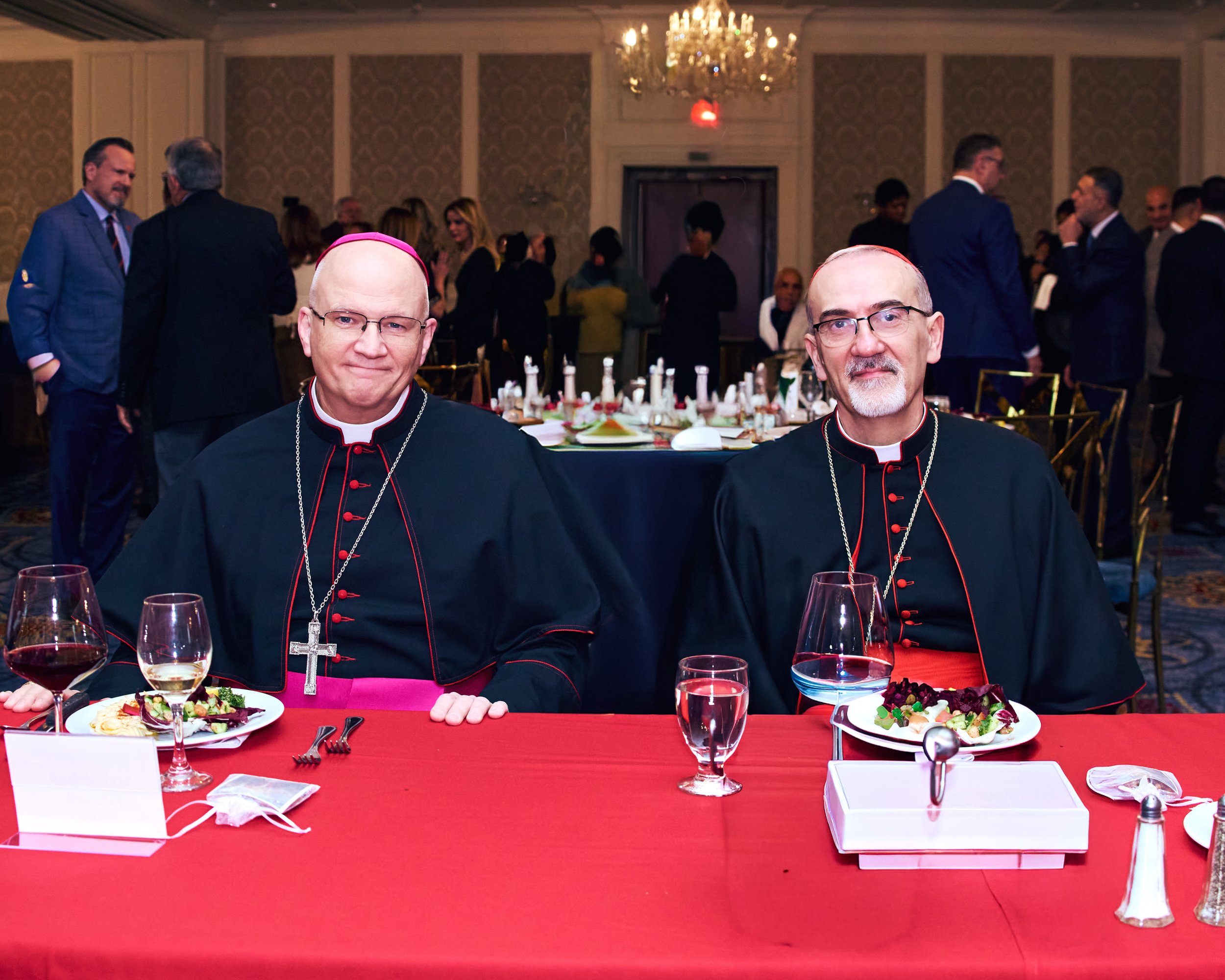
Archbishop Weisenberg with Archbishop Pizzaballa at an event at Shenandoah Country Club.
Photo by Nico Salgado Photography
Archbishop Weisenberger on faith and the future
INTERVIEW BY MIKE SARAFA
As he approaches his first anniversary as Archbishop of Detroit, Archbishop Edward Weisenberger reflects on a year marked by collaboration and visible signs of hope. Arriving from Tucson to lead one of the nation’s most historic and complex archdioceses, he stepped into a city whose very motto promises resurrection. In his first year, he has encountered not only Detroit’s resilience, but also something that deeply surprised him: vibrant parishes filled with young families and children, a powerful sign of a living Church.
Chaldean News: Archbishop, in March, you will celebrate your one-year anniversary as Archbishop of Detroit. What one thing about Detroit or the Diocese has surprised you the most?
Archbishop Weisenberger: What a year it has been! I knew coming here that I would be joining a resilient community. The City of Detroit’s motto is no secret: Speramus meliora; resurget cineribus, or “We hope for better things; it will rise from the ashes.” The city itself is really on the rebound and I feel incredibly blessed to be a part of it—even as it’s happening. Concerning the Archdiocese, I was surprised and inspired to see so many children at Church when I visit parishes. I like to say, “you don’t know what you don’t know,” and what many don’t know here in Detroit is that there appears to me to be a lot more young people at Mass than other dioceses; and that’s a huge blessing. The schools are also incredible. In parish after parish, I meet people who are committed to honoring their community’s heritage of a rich and powerful faith in ways that build on it for future generations.
CN: When you came to Detroit from Tucson, Arizona, had you heard about the Chaldean Community? There are a Chaldean population and a Chaldean church in the Phoenix area.
AW: While I had very little contact with the Phoenix Diocese, yes, I knew about the Chaldean Church, along with other communities of our Eastern Rite brothers and sisters. I was well aware of the Chaldeans in Phoenix, and they are known for a vibrant parish and community life. Actually, I have always been struck by the rich diversity of our shared Catholic faith. I knew that southeast Michigan is home to one of the largest Chaldean Catholic communities in the world, but I have had the opportunity since my appointment to learn and come to know and appreciate this community far better. The Chaldean Church is known for its faith and deep love for the Church, and Bishop Kalabat is greatly respected among the hierarchy.
CN: The Detroit Archdiocese is unique in that it is also home to the largest Chaldean Rite Diocese in the world. How have you found your interactions with the Chaldean Church and people?
AW: My interactions thus far with the Chaldean Eparchy has been marked by an exceptional welcome, kindness, generosity, and powerful witness to the Gospel. I’m not trying to flatter anyone (truly!) but my interactions with the Chaldean people have been nothing short of a blessing. Each time we cross paths, I find reverence in the liturgy, an inspiring commitment to community and family, and a strong sense of identity rooted in faith. The presence of the Chaldean Church and culture in Detroit enriches the broader community. However, I believe that the fundamental unity of faith between the Chaldean and Roman churches strengthens one another in wonderful ways.
CN: In what ways do you anticipate the two sister churches working together?
AW: We are blessed in Detroit to experience the universality of the Church in such a visible way. Though we worship according to different liturgical traditions, we share the same faith, the same sacraments, and the same mission. I look forward to continued collaboration in charitable outreach, support for immigrant and refugee families, promotion of vocations, and our shared witness to peace and human dignity. As an example of this, when I called Bishop Kalabat and told him the Latin Rite Patriarch of Jerusalem was coming, I wasn’t able to finish my sentence before he jumped in and said, “That’s wonderful, that’s great, how can we help?” When I think of the emergency financial assistance our churches raised together for Gaza and the suffering of Palestine, and good will built up by the visit of the Patriarch, I am reminded that there is nothing that cannot be accomplished when people of faith come together!
CN: You have been outspoken on a series of grave public policy matters in the United States, including immigration and the ICE crackdown, the situation in Gaza and the Holy Land, and most recently you were openly critical of President Trump for the overt reposting of a racist trope about the Obamas. What is your message to the Detroit faithful about our duty as Christians on these types of issues?
AW: As Christians, one of our primary callings is to defend the dignity of every human person. This responsibility flows from the truth that every person is created in the image and likeness of God, from Christ’s command to love our neighbor as ourselves, and from His teaching that whatever we do to the least of our brothers and sisters, we do to Him. Whenever any of these principles are threatened—whether by acts of racism or hatred, neglect of the vulnerable, or other tragedies of this nature—it is our duty as Christians to form our conscience according to the Gospel and then to proclaim these truths into the world. I sometimes fear that the silence of those who have a voice but do not use it may be a crime almost as grave as those committing acts of cruelty.
CN: On the suffering of the people in the Holy Land, what prompted you to invite Cardinal Pizzaballa, the Latin Patriarch of Jerusalem, to Detroit? What did his visit teach us about the need in that part of the world? What impressions did you take away from the response of the Detroit faithful to you call to help the suffering people of the Holy Land?
AW: The Holy Land holds a special place in the heart of every Christian as the birthplace of our faith. I have wanted to invite His Beatitude, Cardinal Pizzaballa for a pastoral visit for quite some time, but the grave situation in his Patriarchate took obvious precedence. His presence in the Archdiocese of Detroit reminded us that the Church is truly one body, and that when one part of the body suffers, the whole body suffers. I was deeply moved by the generosity of the faithful here in Detroit, including a great many within the Chaldean community. It was a powerful moment of solidarity under one mission, one faith, and one Lord.
While it is not in direct answer to your question, I would note, too, that the Patriarch’s visit wasn’t just for the peoples of Gaza. His visit actually did a lot for us. In our Western world we tend to think only in terms of “fixes” or “solutions.” Cardinal Pizzaballa clearly welcomes our efforts to change the lives of the suffering. Even if he never said it directly to me, I suspect he probably would appreciate our efforts for real and lasting change—change to alleviate the suffering so evident throughout the Holy Land. However, a great truth to which he opened my eyes is that we probably can’t fix the situation in the Holy Land, but we can be something of the healing Christ for our brothers and sisters there.
This isn’t defeatism, and again, I suspect he appreciates our efforts on the political and human level. However, he revealed that the task for those who are struggling to live there today is to determine how to live the life of a true, committed, loving Christian in the midst of their suffering. We cannot wait until all is well before we embrace the Gospel of Jesus Christ. Rather, we must find the way to be a people of the Gospel in whatever circumstances we find ourselves.
When I think about my life I must humbly admit that there were far too many times I found myself grumbling at the Lord, frustrated by the issues I was facing. It was the witness of the Patriarch that helped me to see that whatever circumstances or situations I find myself in today—whether happy or sad, marked by justice or injustice, wounded by war or strengthened by peace—it is precisely in these circumstances where I must carry the Gospel with me and let it come to life in me. That was a powerful gift to me and, I believe, to all who encountered him.
CN: You are embarking on a process that will require a major restructuring of the Diocese with respect to buildings, parishes, and priests. What is your hope for the best outcome of this endeavor?
AW: The best outcome—our intended outcome—is to have vibrant parishes, flourishing priests, a mission-ready Church. What does this mean? We are working together in collaboration with our priests and parishioners, to properly align our clergy, ministries, and resources so that parishes can become living centers of faith and community; that our clergy can serve with strength and joy, and that our local Church is positioned to take the Gospel beyond our doors and directly to those who need to hear it most.
I have to admit that we Catholics—and for very, very good reasons—love our church buildings. They are more than just bricks, mortar, wood, and stained glass. Rather, our lives of faith are somehow embedded in these sacred places. The small parish church of my grandparents in Kansas is lovingly cared for, but the farming community around it is all but gone. That spot is sacred to me, and the thought of it closing would be a real wound. However, I also know that as a follower of Jesus Christ, when it is my time to present what I did with my life to God, I do not anticipate God will ask me how well I took care of buildings. I do suspect God will ask about my efforts to build the Kingdom of God—to preach the Gospel so that others would want to join our Church—and to put our precious resources into evangelization and making new disciples.
I never want my words to wound, and yet there are some words of wisdom or data that have been powerful for me. The first is the expert research that teaches us that if a young adult walks into a Church and encounters a small group of very elderly worshippers, that young adult will never come back. On the other hand, if a young adult walks into a church that’s fairly full, with an engaged crowd and visible ministries, there’s a good chance he or she will want to return. How do we experience more of that kind of community? I think it starts by recognizing that the excessive number of Masses offered in churches with very small congregations is probably comforting to those small congregations—and that’s not unimportant. But the price we’re paying is exhausted priests, a demoralizing sense of struggle to hold on, and the frustration of fundraising for buildings that oftentimes are already in debt and almost always in need of massive amounts of money to maintain or restore. So many of our church buildings were built for far larger communities and for populations largely gone. To gather the people together for one unified community with larger, more vibrant congregations increases the ability to evangelize. There’s just so much more a community can do when it has adequate numbers, committed families, and the necessary finances.
A final note is that I was told something that remains lodged in my brain and in my heart. I found it both haunting and motivating. A seminarian said to me, “Thank you Archbishop, thank you so much for doing this restructuring. Some of my seminarian brothers and I were talking, and we really weren’t looking forward to our priesthood being fifty years of managing decline.” Wow! I don’t think we’ve stopped to think about the impact the current situation has had on seminarian recruitment. While these young men are truly committed, we need to give them the hope of spending their lives forming disciples, not struggling to come up with insurance premiums.
CN: Do you have a message you would like to share with the readers of the Chaldean News?
AW: I want to express my gratitude for your witness to the Gospel. As I noted earlier, your fidelity to your traditions and devotion to the community are gifts to our entire Church. I look forward to all of us continuing to pray for one another, learn from one another, and serve Christ side by side.