
A New Face for an Ancient Church
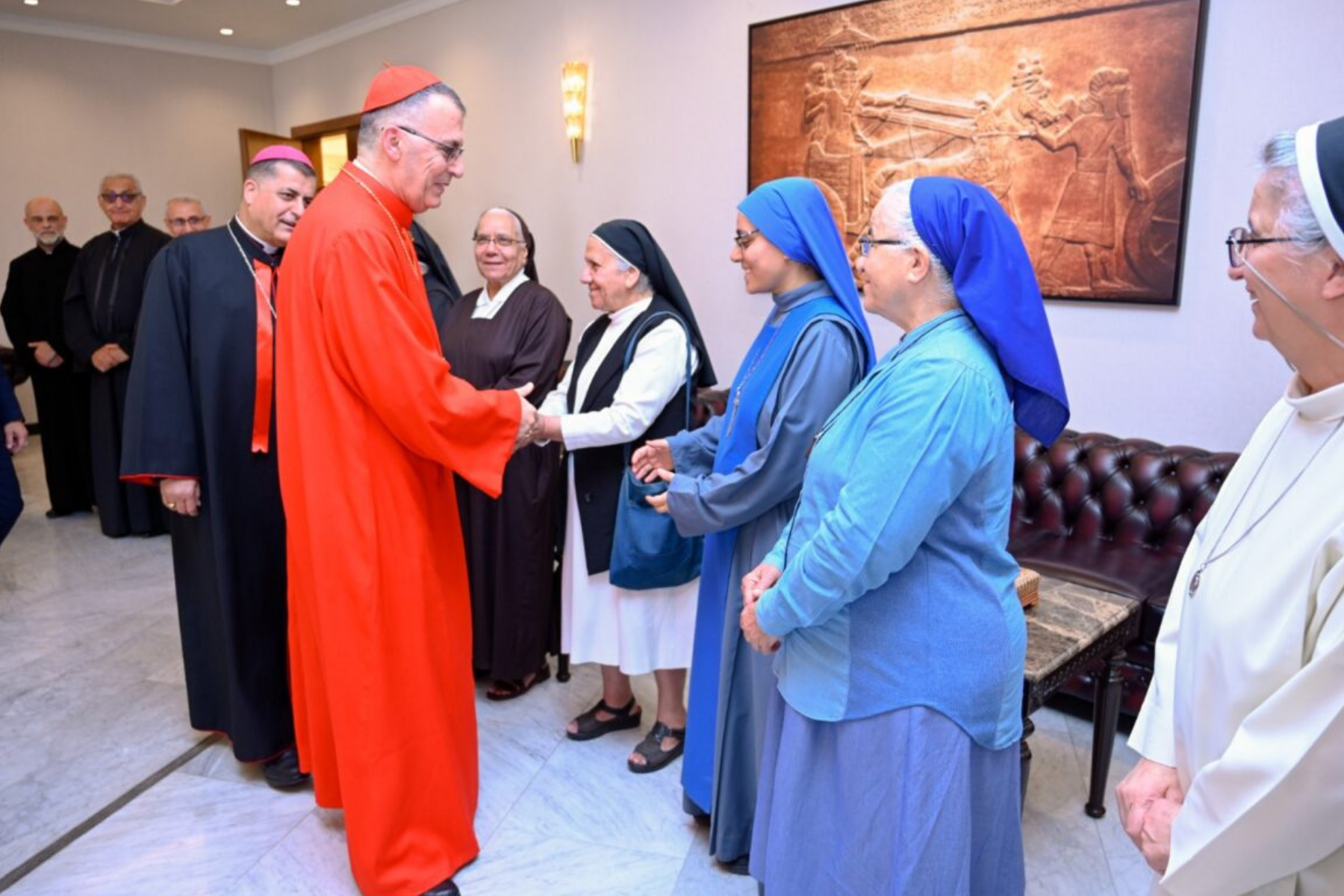
The new Patriarch is received in Baghdad by a group of clergy and nuns.
Paul III Nona and the next chapter of the Chaldean Church
By Hanan Qia
On April 9, 2026, the Synod of Bishops of the Chaldean Catholic Church gathered in Rome in a moment that carried profound significance for a Church whose roots stretch back more than two millennia. Far from being a routine administrative election, the gathering marked a pivotal turning point for a community now facing urgent questions of survival, identity, migration, and continuity.
After days of prayer, deliberation, and ecclesial discernment, the Synod elected Archbishop Emil Shimoun Nona as the new Patriarch of the Chaldean Church.
Upon accepting his election, he chose the name Paul III—a name carrying both spiritual and historical resonance, inspired by Saint Paul the Apostle and the legacy of earlier Chaldean patriarchs who bore the same name. In a statement published on the Patriarchate’s official page, he explained the meaning behind this choice:“I chose the name Paul in reference to two figures. The first is Saint Paul, because he is a profound personality, a great theologian, and a teacher who presents the faith with depth, while at the same time carrying apostolic zeal to proclaim this theology and teach the faith to others.
“The second figure is Patriarch Paul II Cheikho, who was a model of humility and pastoral care. For these two figures, I chose the name Paul.”
From the outset, the choice appeared less like a formality and more like a statement of vision for a Church entering a complex and uncertain era.
Emil Nona was born in Alqosh in 1967, one of the most historically and spiritually significant towns in the Nineveh Plains. His early formation was rooted in a deeply faith-centered community shaped by memory, identity, and continuity. He was ordained a priest in Baghdad in 1991 before pursuing advanced theological studies in Rome, specializing in anthropological theology—a discipline focused on understanding the human person through the lens of faith. This academic foundation would later shape his pastoral and human-centered approach to ministry.
Upon returning to Iraq, he served in the Diocese of Alqosh in various pastoral and educational roles before being ordained a bishop in 2010 at the age of forty-two, becoming one of the youngest Chaldean archbishops at the time. His most defining chapter, however, began when he was appointed to lead the Archdiocese of Mosul during one of the city’s most turbulent periods.
In Mosul, he faced not ordinary pastoral challenges but a city under fear, violence, and instability. When ISIS seized Mosul in 2014, he experienced displacement alongside his people, leaving for Erbil with thousands of Christian families forced from their homes, churches, and villages. Amid displacement camps and humanitarian crisis, his ministry evolved into a deeply human presence rooted in accompaniment and resilience.
That experience left a lasting imprint on his leadership. The man who now returns to Baghdad as Patriarch did not study displacement from afar; he lived it, sharing in the uncertainty and loss of his community.
In 2015, he moved to Australia to lead the Chaldean Eparchy there, transitioning from a Church wounded within its homeland to one striving to preserve its identity in diaspora. In Sydney, Melbourne, and across Chaldean communities abroad, he faced the challenges of younger generations navigating between cultures, questions of language and belonging, and the tension between integration and heritage. There, he increasingly became a bridge between Iraq and the diaspora, between memory and modern life.
On May 18, 2026, he returned to Baghdad—not as a visiting bishop, but as Patriarch of the Chaldean Church. The return carried deep symbolism for a man whose journey had passed through Alqosh, Mosul, Erbil, Rome, and Australia before arriving again in the Iraqi capital at a moment when the Church itself is seeking to redefine its presence between homeland and diaspora.
During the final days of May, he was received in Baghdad amid an atmosphere of anticipation and hope before his formal enthronement at Saint Joseph Chaldean Cathedral—a moment extending far beyond liturgical ceremony into broader questions about the future of Christianity in Iraq and the region.
Today, the Chaldean Church stands at a crossroads. How can it preserve its presence in Iraq? How can younger generations remain connected to their Chaldean identity? And how can the Church continue to offer meaning and hope in a region shaped by displacement and transformation?
In many ways, the life of Paul III Nona reflects the recent journey of the Chaldean Church itself: from the ancient towns of the Nineveh Plains, through displacement and diaspora, and back once more to Baghdad. His election therefore represents not merely an institutional transition, but the beginning of a new chapter in which the Church reconsiders its relationship with homeland, diaspora, and the people it serves.