
Return From Diaspora
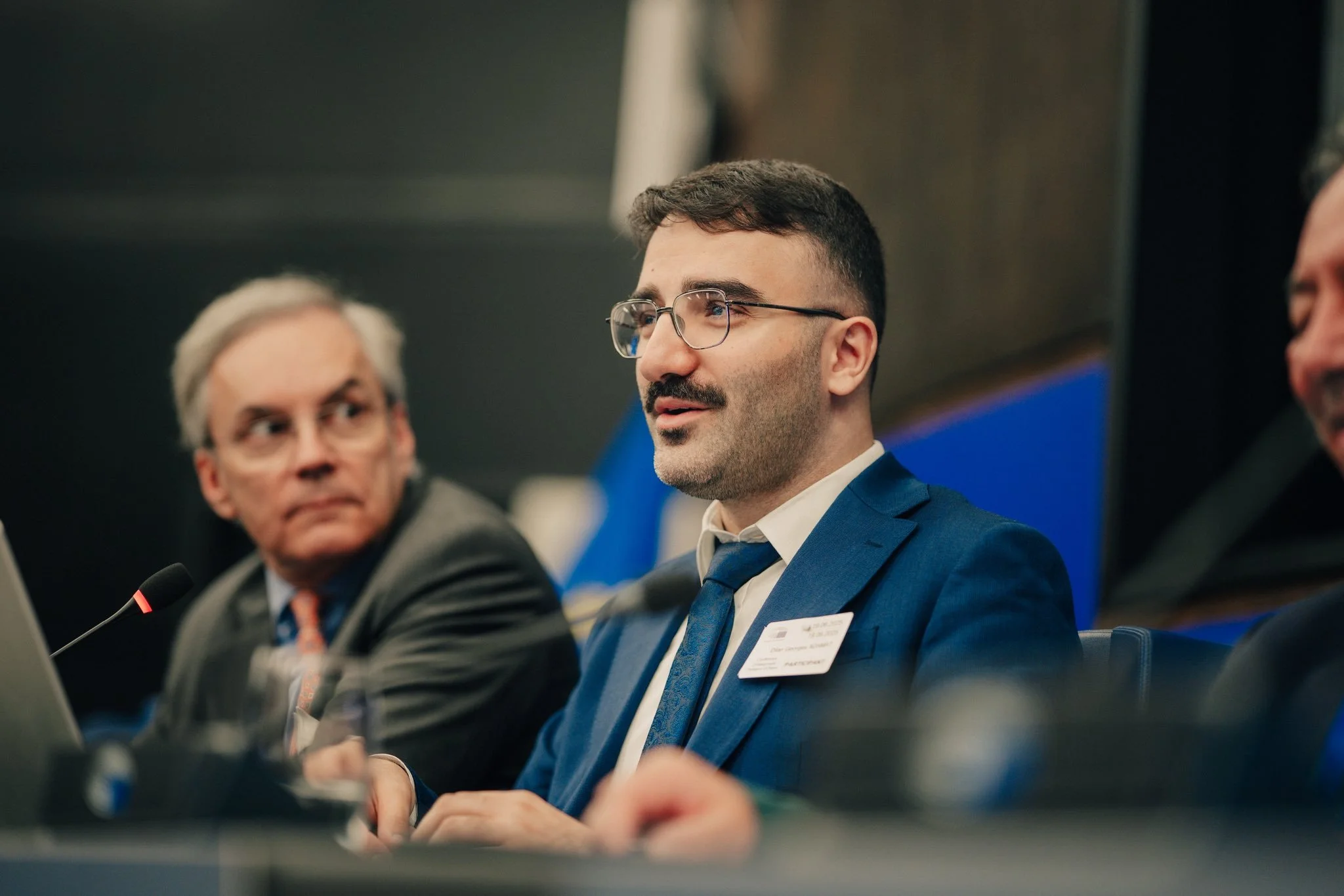
Dilan Adamat addressing the European Parliament.
Living life in the homeland
By Crystal Kassab, Ed.D.
A few weeks before his 29th birthday, Dilan Adamat returned to Ankawa, Erbil, Iraq, from France, where he had lived since he was one year old. His family had escaped the aftermath of the Persian Gulf War in 1991 and settled in Nantes, a town in the western region where his dad’s friend from Iraq had relocated. Like many other diaspora kids, he grew up French, but with Chaldean traditions, food, and language; yet as an adult, he longed for something deeper– reclaiming his roots on ancestral land.
“Our culture and our existence are at risk if we don’t remain,” asserted Adamat, now 35.
He was no stranger to the country, its people, or its customs. Adamat and his family regularly visited Iraq in the summers, and it profoundly impacted him. He realized it was such a different world from what he was used to. He saw firsthand the struggles, and though he felt useless at the time, he found meaning in the experiences that led him to decide to go back home.
In 2015, Adamat graduated with his master’s in business law from Université Paris XII Val de Marne, four hours away from Nantes, and began working as a business development manager for a law firm. He would visit Iraq once or twice a year on his own and was deeply attracted to being there. Going back to France became sad and frustrating; he thought to himself, “I’m working to pay bills, not living!” Then the idea of returning for good became stronger.
His parents and relatives thought he was crazy.
“I’m not crazy,” he said. “I just think outside the box! People normalize being slaves to their way of life in America, France, and other places. Life here in Erbil is more humane.”
Adamat’s family had built a house in Ankawa in the early 2000s and leased it out. When the renters moved away in 2019, he moved in and is very happy with his decision to stay, despite the recent bombings and drone strikes in Erbil by Iran and its affiliated proxy militias.
To him, the simple life there is real freedom. Expenses are few and taxes are little to none. This alone gives people a lot of flexibility with time and finances. One can live comfortably off a few hundred American dollars a month, which is becoming increasingly attractive to the Chaldeans, Assyrians, and Syriacs in diaspora. There is also a “rural exodus” happening in Iraq–people are leaving the villages and moving to the cities.
Telkeppe, for example, has less than a couple of hundred Chaldeans left there. Meanwhile, Erbil has built a few churches in recent years to accommodate the faithful.
After settling in, Adamat began working at Babylon FM, the only all-English hit radio station in Iraq, as a morning co-host and host of a weekly French show. He also worked for non-government organizations (NGOs), such as Oxfam and Catholic Relief Services, until last year, when the Trump administration imposed sweeping freezes and reductions on foreign assistance and reshaped the U.S. Agency for International Development (USAID).
In the meantime, Adamat founded The Return in 2023, an NGO registered in Iraq and France that supports “return mobility,” a term he uses to focus on adjustment in the homeland for those returning.
He started with his own three goals:
Do it myself.
Help others come back.
Normalize life here.
“I can’t help others if I’m not a part of it,” he said. “I came here because I wanted to dedicate myself to the cause. If we don’t do it for ourselves, nobody will do it for us. If we take the lead, we will thrive.”
He wants returnees to know there are people like him in Erbil who can help them, even if they do not speak Sureth or Arabic. English is commonly spoken there. The group has assisted nearly 50 people from around the world who have diverse connections to Iraq in finding homes, jobs, and workspaces.
Some of them left as adults, so it is fairly easy for them to adjust. Some of them left within the past couple of decades, obtained citizenship elsewhere, and returned before fully integrating into their host countries. Some of them are second or third generations in the diaspora who have no memories or ties to Iraq but their parents’ and grandparents’ stories, yet they are conscious of losing the culture and identity outside of Iraq. Nearly half of the returnees are American, yet Detroit’s Chaldean population exceeds that of Iraq.
Adamat said Sureth is used daily in Ankawa because Chaldeans are the majority, and there are neighboring areas with high concentrations as well. There is no worry of ethnic or religious intimidation; his main fear is that Aramaic will become like Latin vernacular, where its everyday tongue will cease to exist except in liturgical or scholarly writings.
“Language is living culture and identity,” he remarked. “We belong to it, and we don’t want it to disappear.”
The Return has physically helped people move in, and they have also been there to provide moral support. Adamat claims that a sense of belonging was the primary motivation for most people. But a prospective returnee must not be naive about life in Iraq. He points out that choosing a life there means sacrificing something one has in the place one is currently in, be it family, home, job, identity, language, or roots.
The group has plans for an ambitious project called “The Hub,” a community center in Ankawa that will welcome returnees and serve their needs, which includes business offices, conference rooms, and an exhibition hall. They are currently working on funding and hope to get some projects completed within the next decade or so. He insists this is not an overall humanitarian project, but a social one that invites people home where they belong.
“We kill ourselves slowly by leaving the homeland. The only way we can survive as a people is to come back.”
For more information on The Return, including testimonials and a Guide to the Homeland, go to the-return.co/ or follow on IG @the_return_org. Dilan Adamat can be found on Facebook, IG @dilan.adamat, and his blog dilanadamat.com.